Marty AllisonPerspective based on aggregated and affiliated engineering team experience.
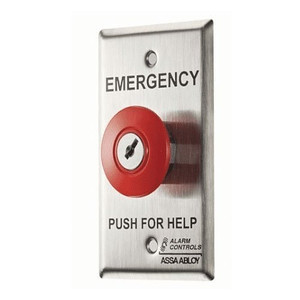
We've deployed the HES KR-3 across dozens of access control retrofit and new-build projects, and it occupies a specific operational niche that often gets overlooked until a compliance audit or fire-marshal sign-off surfaces the requirement. The KR-3 exists because manual reset capability is a life-safety mandate, not a convenience feature. On a multi-story office or parking structure, a tenant or building operations team needs the ability to unlock a door at the strike level without relying on a networked system, a backup server, or an emergency-egress signal cascading through software logic. The latching key mechanism ensures that only authorized personnel with the physical key can trigger that reset—eliminating the scenario where a fumbled hand-punch or a well-meaning but unauthorized employee accidentally disengages a strike during an incident response. That said, the KR-3 is not a substitute for proper emergency-egress design or ADA-compliant push-to-exit hardware; it's an auxiliary control that lives upstream of the strike and integrates into the reset circuit. The dual N/C contacts give you flexibility: you can wire two strikes in parallel to a single KR-3 key, or you can daisy-chain multiple units to create a hierarchical reset topology (e.g., a master key at the security office resets tier-1 strikes, building ops gets a tier-2 key for secondary egress). Cost-wise, the KR-3 is a modest line-item addition to any access control budget, but the lifecycle value is high because you're adding manual override capability without redesigning the entire strike circuit or introducing a new power supply. We've seen integrators initially resist the KR-3 because it feels "old school" in a networked environment, but once they grasp the life-safety logic and the separation-of-concerns architecture (manual override independent of electronic control), it becomes a no-brainer on any professional installation.
Technical Highlights:
- Dual N/C Contact Configuration: Each contact is fully independent and rated for parallel or sequential circuit logic. This means you can wire one contact to monitor strike status and the other to trigger an auxiliary alarm or log event—all from a single KR-3 device. No relay modules or programmable logic controllers needed for basic auxiliary circuits.
- 12/24 VDC Native Compatibility: Direct operation without step-down transformers or interface modules. Installation is a pair of wires to the strike control panel's reset terminal and return path; no additional power conditioning or grounding gymnastics.
- Positive Mechanical Latch: The key-operated mechanism physically latches the reset state, holding it until manually released. This eliminates voltage-transient false triggers and aligns with fail-safe design philosophy: the device defaults to a safe (energized) state and requires intentional human action to change it.
- Compact, Modular Form Factor: 2 lb footprint fits into standard strike enclosures and control-cabinet DIN rail spaces. OEM and retrofit installations are equally straightforward—no custom fabrication or panel redesign required.
Deployment Considerations:
- The KR-3 is a manual-override device, not an automatic reset mechanism. It requires physical key access and intentional actuation. In high-traffic or unsupervised areas, this is a feature (prevents casual nudging of a door into reset). In secure-only-by-key scenarios, verify that your key-holder access and response time meet operational SLA before relying on it as your primary manual recovery path.
- Dual N/C contacts offer flexibility, but wiring topology matters. If both contacts are wired in parallel to the same strike reset circuit, they function identically—no operational gain. If you're using a second contact for alarm monitoring or a daisy-chain scenario, map the logic on paper before installation to avoid silent failures.
- The KR-3 integrates natively with HES 5000 and 7000 series strikes. Verify strike model before ordering if you're retrofitting a mixed-brand site (Assa Abloy, Securitron, etc.). Legacy strikes may require an interface relay or contact-closure adapter—not all 12/24 VDC reset circuits are wired identically.
- Key management and custody are your responsibility. The KR-3 does not audit or log manual resets—it's purely mechanical. If chain-of-custody or reset-event logging is a compliance requirement, you'll need to layer access-control software logic or physical key-log procedures on top of the device.
- Environmental factors: The KR-3 is rated for interior installation in standard commercial temperature and humidity ranges. Outdoor or harsh-environment mounting requires an enclosure. The latching mechanism has no rubber seals, so prolonged exposure to dust or moisture can jam the keyway.
The HES KR-3 is the right choice for system integrators, facility managers, and security operations teams building or upgrading access control infrastructure where manual-reset redundancy, life-safety compliance, and separation of electronic controls from physical override are design requirements. It's not a smart device; it's an intentional step backward from networked complexity into mechanical reliability. For the right project and the right integrator mindset, that's exactly the differentiator. Explore the full HES catalog for complementary strike and control solutions.