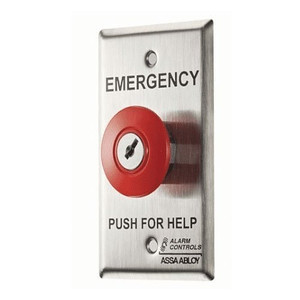
HES KR-2 Latching Key Reset Mechanism
The HES KR-2 is a latching key reset mechanism designed for integration into access control and alarm system panels. It provides manual reset capability through a key-actuated interface, with two independent normally open relay contacts for routing reset or control signals to multiple circuit branches. This auxiliary component sits between a physical reset keyway and the panel's logic, enabling facilities to maintain manual override capability without requiring operator access to the control panel itself.
Key Features
- Dual N.O. Relay Contacts: Two independent normally open outputs allow simultaneous signaling to separate access control logic branches or alarm monitoring circuits without crosstalk.
- Latching Mechanism: Key-actuated design maintains the reset state until manually cycled — eliminates accidental transient triggers and ensures deliberate system control.
- Panel-Agnostic Integration: Compatible with standard access control panels, alarm system controllers, and auxiliary relay logic — works with virtually any 12 VDC or 24 VDC panel that accepts dry relay contact inputs.
- Indoor Wall or Ceiling Mount: Compact form factor mounts directly to panel enclosures or nearby walls, keeping the reset function physically proximate to the controlled equipment.
- US Manufacturing: Factory-new, domestically sourced product with Manufacturer Warranty support.
- Minimal Power Draw: Passive latching operation requires no continuous power — relay contacts are actuated by the panel or external 12/24 VDC logic when the key is turned.
The KR-2 solves a recurring integration gap: access control and alarm systems often need a hardwired manual reset mechanism that can trigger multiple downstream logic branches without adding complexity to the panel firmware or requiring custom relay modules. The latching key interface gives facilities a tangible, tamper-evident reset point — turn the key, the contacts change state, and the panel sees a clean electrical signal. Two independent N.O. outputs mean you're not limited to a single reset path; you can route one contact to the access control reset logic and the other to alarm acknowledgment, or any other split-circuit scenario your system topology demands.
Deployment scenarios include emergency reset stations in multi-tenant buildings (where tenants need to reset their own alarm without calling a technician), auxiliary control in large panel installations (where a second reset point on the opposite side of a facility is needed), and redundant control pathways in life-safety systems (where you want two independent signal routes to critical logic, each with its own relay contact). The device integrates transparently — the panel sees nothing more than a pair of momentary or latching contact closures, which it interprets according to its own programmed logic. No special drivers, no VMS API calls, no firmware updates required.
Because the KR-2 is passive and latching, it persists in the reset state even if power is lost to the panel or the control circuit momentarily glitches. This can be an advantage (the reset condition is held until you consciously turn the key back) or a consideration (you must account for the latched state in your system initialization logic). Most integrators wire the KR-2 contacts as a conditional trigger — the panel checks the relay state during startup or at regular intervals and takes the appropriate action if the key is in the reset position.
The two-contact configuration also enables a common architecture pattern: one contact directly controls or triggers a relay module downstream, and the second contact provides a feedback or monitoring signal back to the panel (or to a separate alarm circuit) to confirm the reset action occurred. This redundancy is particularly useful in high-security or life-safety environments where you need assurance that a reset command was successfully delivered and acted upon.
Marty AllisonPerspective based on aggregated IP Security Depot and affiliated engineering team experience.
We've integrated the HES KR-2 into dozens of legacy and modern access control installations, and it remains one of the most straightforward auxiliary reset mechanisms available. What makes it valuable isn't flashy — it's reliability and simplicity. The latching key interface eliminates the common problem of accidental reset triggers caused by vibration, electrical noise, or operator fumbling. Once you turn the key, the relay contacts latch into their new state and stay there until you deliberately turn the key again. The panel sees a clean, stable signal. In our experience, the dual N.O. contacts are the real payoff. Most facilities start with a single reset path, but once they run one contact into the panel's reset input and the second into an alarm acknowledgment relay or a separate monitoring circuit, they realize the flexibility that second output provides. We've also seen integrators use the KR-2 in multi-zone alarm environments where a single manual reset point needs to propagate to several independent zone controllers — each zone gets its own relay output, no additional components needed. The downside: the latching nature means you have to carefully choreograph your panel initialization logic. If the KR-2 is in the reset position at power-up, your panel will see that state immediately, and depending on how the panel is programmed, it may auto-reset or wait for a key turn to acknowledge. Read the panel's manual, test the sequence in a lab environment before field deployment.
Technical Highlights:
- Two Independent N.O. Relay Contacts: Each contact is electrically isolated from the other, allowing you to route them to separate 12 VDC or 24 VDC circuits without concern for voltage drop or crosstalk. Common deployment is one contact to panel reset, one to an external relay or monitoring circuit.
- Latching Mechanism: Key-actuated latch holds the relay state even during power interruption. This is a feature if your panel needs to know the reset was initiated and held, but you must account for it in startup logic — the panel cannot assume it's in a neutral state until the key is deliberately cycled back.
- Passive Operation: No continuous power draw; the latching function is purely mechanical. The panel supplies momentary 12/24 VDC to the coil only when needed, and the mechanical latch maintains position. Ideal for low-power or redundant control scenarios.
- Universal Panel Compatibility: Works with any panel that accepts dry relay contacts — Honeywell, 2GIG, Bosch, GE, DSC, Napco, and virtually every traditional access control or alarm panel on the market. No firmware or driver integration required.
- Tamper-Evident Interface: The physical key mechanism means you can use a keyed switch with a known custodian — no electronic credentials to clone or intercept, and turning the key is an auditable, non-repudiable action.
Deployment Considerations:
- Latching state persists across power cycles — ensure your panel's initialization routine or startup logic accounts for a latched reset condition. Some panels reset on power-up only if the KR-2 is already in the latched position; others require a manual key turn after power restoration. Test this sequence in advance.
- Mount the KR-2 in an accessible but secure location — typically on the access control or alarm panel enclosure itself, or on an adjacent wall within the secure equipment area. Key access controls who can reset the system; if the reset key is lost or turned without authorization, you've lost part of your compliance audit trail.
- Wiring the two N.O. contacts to separate 12 VDC or 24 VDC sources is fine, but both contacts share the same mechanical latch — if one contact is held closed by external logic, the second contact state is unaffected. Plan your wiring so that neither output circuit back-feeds current through the other.
- The KR-2 is indoor-rated; mounting it in a damp or corrosive environment (parking structure, outdoor equipment room) is not recommended. If you need an outdoor reset mechanism, consider a weatherproof guard or a separate sealed enclosure.
- The key mechanism itself is the single point of failure — loss or damage to the key means you cannot manually reset the system without replacing the mechanism. Consider keeping a spare key in secure storage and documenting the key number and source.
The HES KR-2 is the right choice for integrators and facilities who need a no-nonsense, key-controlled reset mechanism that interfaces cleanly with standard panels and doesn't require specialized firmware or network integration. If your project calls for manual reset capability with multiple downstream control paths and you want to avoid adding a separate relay module or PLC, the KR-2 delivers that in a single compact component. Explore the full HES catalog for additional auxiliary devices and control modules.