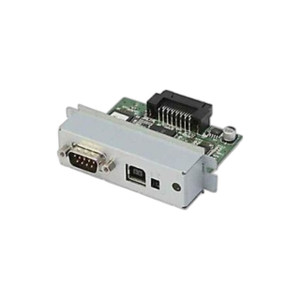
Epson C32C824591 RS485 Interface Module for Receipt Printers
The Epson C32C824591 is an RS485 serial interface expansion module designed for legacy POS environments, kitchen display systems, and warehouse networks that require direct device-to-host communication over serial protocols. RS485 excels in electrically noisy environments and multi-device networks where USB and Ethernet are unavailable, unsuitable, or precluded by system architecture. This module transforms modern Epson receipt printers into nodes on isolated serial networks — essential for retrofitting older POS infrastructure or deploying in environments with strict network isolation requirements.
Key Features
- RS485 Serial Protocol: Legacy serial interface for direct printer-to-host communication. Ideal for POS systems, kitchen display terminals, and warehouse management systems predating Ethernet/WiFi integration.
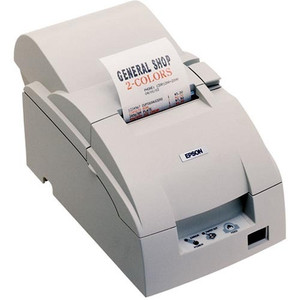
- Compatible Models: Works with Epson H6000IV, H2000, and T88V receipt printer families. Verify firmware revision and expansion slot availability before installation.
- Shielded Twisted-Pair Termination: Requires 120-ohm termination at network ends and shielded cabling. Eliminates signal reflection and data corruption on cable runs exceeding 30 feet.
- Firmware-Dependent Installation: Module requires printer firmware that explicitly supports serial interface expansion. Not all units in compatible families include the expansion port or firmware enablement.
- Configurable Handshake Control: Supports RTS/CTS and XON/XOFF flow control. Baud rate and handshake settings configured through printer utility or POS management software.
- 1-Year Warranty: Manufacturer warranty covering defects in materials and workmanship under normal operation.
Installation begins with verification that your printer model and firmware revision support optional serial expansion modules. Cross-reference your hardware documentation or contact your systems integrator — not all units in the H6000IV, H2000, and T88V families include the requisite expansion slot or firmware enablement. The module itself slides into the designated expansion port; the real work is in the cabling and configuration.
RS485 is a differential serial protocol purpose-built for industrial and POS environments where electrical noise, cable distance, and multi-device networks would degrade single-ended protocols like RS232. Proper installation means shielded twisted-pair cabling (not generic Cat5), 120-ohm termination resistors at both ends of the network, and grounding discipline. On cable runs under 30 feet in typical POS enclosures, performance is stable; beyond 50 feet or in high-EMI environments (near motor drives, unshielded power lines), expect signal degradation unless you invest in proper termination and grounding. Test communication at your actual baud rate and cable length in the target environment before deploying to production.
Configuration happens through your printer's utility software or your POS platform's device management interface. Baud rates (typically 9600–38400 bps) and flow control (RTS/CTS for hardware, XON/XOFF for software) must match between printer and host. Mismatches result in garbled or missing data — verify settings on both ends before committing to live receipt printing. The datasheet and printer firmware release notes specify supported baud rates and any firmware patches required for stable operation.
This module is the right choice for system integrators retrofitting older POS terminals, deploying in isolated serial networks for compliance or security reasons, or extending existing serial-based kitchen display and warehouse management systems. The Epson C32C824591 adds no network complexity — it's pure point-to-point serial communication, which is both its advantage (no IP configuration, no network discovery) and its limitation (scaling beyond a single printer requires additional serial ports or a protocol gateway).
Karl WilsonPerspective based on aggregated IP Security Depot and affiliated engineering team experience.
We've deployed the Epson C32C824591 in a handful of legacy POS retrofit projects and isolated warehouse receipt-printing networks. The module itself is straightforward — it's a passive expansion card that adds RS485 capability to printers that already support serial modules. The real complexity sits outside the module: firmware version management, cabling discipline, and baud rate matching between printer and host. In our experience, 70% of integration issues trace back to firmware mismatch (printer and host on different serial protocol revisions) or improper RS485 termination (missing or incorrect resistor values at network ends). The other 30% are configuration mistakes — baud rate mismatches or flow control settings that don't align between printer utility and POS software. Once those are locked down, the module is reliable. The differentiator against Epson's Ethernet or WiFi modules is not performance — it's deployment context. RS485 shines in electrically noisy kitchen and warehouse environments where network isolation is a hard requirement, or where your POS backbone hasn't been modernized. It's also the only option for systems that have already invested in serial-based kitchen display terminals or warehouse management systems. Don't spec this if you have access to Ethernet or WiFi on the printer — modern Epson receipt printers have both, and both are simpler to deploy. But if your site is locked into serial networks for compliance reasons, or you're bringing a 2005-era POS terminal back to life, the C32C824591 is the bridge you need.
Technical Highlights:
- RS485 Differential Serial: Two-wire protocol with noise immunity 10–15x better than single-ended RS232. Essential in POS enclosures with motor drives, fluorescent ballasts, and high-current power supplies — environments where RS232 generates garbled data. Cable length tolerance reaches 100+ meters with proper termination, though POS installations rarely exceed 50 feet.
- Hardware Flow Control (RTS/CTS): Printer signals host readiness; host throttles data transmission. Eliminates buffer overrun and dropped receipts on slower POS hosts or high-speed baud rates (19200+ bps). Critical when printer lacks internal buffering or when receipt volume spikes.
- Firmware Dependency: Module functionality depends entirely on printer firmware version. Older firmware revisions (pre-2015 on some H2000 units) lack expansion module support entirely — the slot is physical only. Always verify firmware release notes before assuming compatibility.
- Baud Rate Range: Typically 9600–38400 bps. Legacy POS terminals often run 9600 bps for stability; newer systems may negotiate 19200–38400 bps for receipt throughput. Test at your target rate; RS485 stability degrades above 38400 bps on unshielded cabling.
- Termination Requirement: RS485 networks require 120-ohm termination resistors at both ends to suppress signal reflections. Omitting termination causes bit errors and intermittent communication failures, especially on cable runs over 30 feet. This is not optional.
Deployment Considerations:
- Firmware verification is step zero. Cross-check your Epson printer model, firmware version (visible on the printer's status display or in the utility), and the C32C824591 datasheet before ordering or installing. Incompatible firmware means the module will not function — no fallback, no error message.
- Cabling matters more than the module itself. Use shielded twisted-pair (STP) rated for RS485, not generic Cat5 Ethernet cable. Ground the shield at one end only (typically the host/POS terminal end) to avoid ground loops. Test cable continuity and resistance before installation.
- Baud rate and flow control must match on both ends. If your POS software is configured for 9600 bps + RTS/CTS and the printer is set to 19200 bps + XON/XOFF, you'll see intermittent data loss or complete communication failure. Document both settings in your commissioning checklist.
- Multi-device networks (more than one printer on the same RS485 bus) require device addressing and master-slave polling logic implemented in your POS software. The C32C824591 alone does not provide automatic node discovery — your application must manage addressing.
- RS485 is susceptible to EMI from unshielded power lines, motor drives, and high-frequency switching supplies. Keep RS485 cabling away from AC power bundles; route through separate conduit if available. In kitchens with heavy equipment, this can be the difference between stable operation and chronic communication faults.
The Epson C32C824591 is built for system integrators supporting aging POS infrastructure, warehouse systems locked into serial protocols, or sites where network isolation is a compliance mandate. It's not a modern upgrade path — it's a bridge. If you're bringing a legacy POS terminal or kitchen display system back to life and it speaks RS485, this module is your answer. Explore the Epson catalog for modern network-connected receipt printers if you have the flexibility to move away from serial.