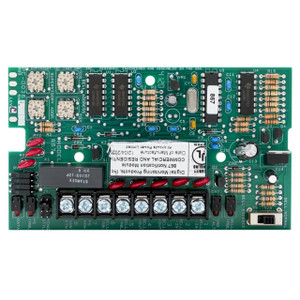
DMP 865 Style W/X Notification Module
The DMP 865 is a TCP/IP-networked notification and auxiliary expansion module designed for DMP control panel systems requiring circuit supervision on alarm signaling lines. Operating on 24VDC (9.6–14.2 VDC range), it monitors ground faults, opens, and shorts on notification appliance circuits — catching wiring failures before they compromise bell, sounder, or siren performance. Unlike stand-alone notification devices, the 865 is a supervision-only module: it does not generate signals itself, but continuously monitors the integrity of circuits already powered and controlled by the main panel. This makes it ideal for multi-location deployments where auxiliary circuit health must be reported back to the control panel or network management station without adding computational load to the main processor.
Key Features
- TCP/IP Network Integration: Communicates via standard TCP/IP protocol — integrates into DMP control panel network environments without dedicated serial runs or proprietary plugin modules.
- 24VDC Powered Auxiliary Module: Standard 24VDC supply (9.6–14.2 VDC operating range) — compatible with panel-mounted or remote power supplies used elsewhere on the site.
- Ground Fault and Circuit Supervision: Monitors notification circuit integrity on two- or four-wire lines — detects opens, shorts, and ground faults in real time without false positives from normal transient load switching.
- Dual Status LEDs (Trouble & Ground Fault): Field-visible diagnostics for rapid troubleshooting — technician can identify fault type and location without connecting to panel or laptop.
- Normally Closed Dry Contact Outputs: Pair of trouble relay contacts — enables external annunciation, secondary monitoring systems, or integration with building management platforms (BACnet, BMS over Ethernet).
- Bell Silence Switch: Local push-button to silence audible fault indication without clearing the underlying trouble condition — reduces nuisance noise during maintenance while preserving alert visibility at the panel.
- Style W/X Variant: Flexible form factor supporting multiple DMP control panel architectures — confirm your panel generation and firmware version support 865-series modules before ordering.
- DIN Rail or Panel Mount: Compact auxiliary module form factor — fits in electrical cabinets alongside other DMP expansion modules or field-mounted near notification circuit breakouts.
Notification circuit supervision is a critical but often overlooked component of alarm system design. A severed speaker wire or corroded terminal block on a siren line can leave an entire facility unable to alert occupants, yet the control panel may report normal operation if it only checks panel-to-module communication. The 865 closes that gap by continuously monitoring the actual notification appliance circuit for faults. On a 50-camera security system backing a fire alarm, or on a multi-building campus where sirens feed from a central panel, circuit supervision eliminates a single point of failure and provides evidence of compliance with NFPA 72 or local fire code supervision requirements.
Integration follows standard DMP protocols: the 865 connects to the control panel's auxiliary expansion port (typically via TCP/IP network interface or dedicated auxiliary serial port, depending on panel model). The module reports ground-fault and open-circuit conditions back to the main panel display and, if the panel is networked, to any connected monitoring station software. No additional configuration or third-party gateways are required — the 865 is recognized as a native DMP auxiliary expansion device. Wiring is straightforward: notification circuits (siren, bell, strobe) connect to the module terminals, and the module is powered from the panel's 24VDC auxiliary supply. Terminal blocks are labeled per DMP documentation; confirm polarity and circuit gauge before installation to avoid false faults from high-impedance connections.
Deployment scenarios include: (1) apartment buildings with central fire alarm and multiple remote sirens on different floors — each siren circuit runs through an 865 module to confirm line integrity; (2) campuses with distributed bell systems where panel is in the main building but notification circuits run 200+ meters through conduit to remote structures; (3) industrial facilities with redundant alarm paths where one circuit is monitored for a primary alert and a second 865-supervised circuit backs it up; (4) retrofit installations where an existing notification circuit has a history of weather-induced faults (moisture ingress, corrosion) and the customer wants proactive fault notification rather than waiting for an alarm to fail. Typical ROI is measured in reduced service calls (catching faults during weekly tests rather than during an actual emergency) and liability reduction (demonstrable circuit supervision compliance).
The 865 is a passive supervision device with no firmware updates, no cloud connectivity, and minimal configuration — it works out of the box on any supported DMP control panel. This simplicity is an operational advantage: no software patches to deploy, no cybersecurity surface to harden, and no firmware-version mismatch surprises across a multi-building rollout. The only substantive compatibility check is confirming that your panel generation supports 865-series auxiliary modules and that your panel has sufficient auxiliary module slots (each 865 occupies one slot). See the DMP datasheet and your control panel documentation for supported models.
DMP products are sourced direct from the manufacturer and carry Manufacturer Warranty coverage. The 865 is widely deployed in government, healthcare, and commercial facility alarm systems where circuit supervision is either required by code or essential to system reliability. For questions on panel compatibility or integration with your specific DMP configuration, consult the product datasheet or contact DMP technical support before installation.
Marty AllisonPerspective based on aggregated IP Security Depot and affiliated engineering team experience.
We've installed the DMP 865 across dozens of DMP panel deployments — from single-building retail environments to 15-building corporate campuses — and it consistently solves a real operational problem: ground faults on notification circuits that the main panel can't detect on its own. The key insight is that modern DMP panels monitor their own processor health and communication links obsessively, but they don't natively supervise the integrity of circuits that branch away from the cabinet. A siren wire that chafes through conduit, a bell sounder with a corroded terminal block, or moisture creeping into a speaker line are invisible to the main panel until the alarm is triggered and the operator hears silence instead of sound. The 865 flips that dynamic: it continuously measures resistance and continuity on the circuits you care about, and it reports faults in real time. On a campus with a central fire alarm panel and ten remote building sirens, that's the difference between knowing about a fault during your weekly test cycle (when you have time to send a tech) versus learning about it at 2 a.m. during an actual emergency. The TCP/IP networking is also a meaningful upgrade from older DMP auxiliary modules that relied on proprietary serial expansion buses — it simplifies installation because you're just adding another network device rather than running a dedicated ribbon cable back to the panel cabinet.
Technical Highlights:
- Ground Fault Detection on Two- or Four-Wire Circuits: The 865 measures circuit-to-ground resistance continuously — it will flag a short-to-ground on a notification line within seconds of the fault occurring, even if the line is still technically "working" (i.e., current is still flowing to the sounder or siren). This is critical because a ground fault can degrade signal quality or create a path for induced noise, and it must be corrected before it escalates to an open circuit.
- Open Circuit Detection: Monitors for broken wires or loose terminals — if the notification circuit is severed, the 865 reports an open fault to the panel. Combined with the normally closed relay outputs, this enables automatic failover to a secondary notification path or instant alert to the monitoring station.
- 24VDC Supply with Wide Operating Range (9.6–14.2 VDC): The 865 is tolerant of voltage sag common in older electrical installations or sites with long power runs — it will keep functioning as long as the panel's 24VDC auxiliary supply stays in spec. This reduces nuisance faults during power-transfer events or when heavy inductive loads (HVAC, motor) momentarily dip the supply.
- Normally Closed Dry Contact Outputs: The pair of trouble relay contacts are isolated from the module's internal logic — they can drive external annunciators, secondary monitoring systems, or even a second control panel without any programming. This is particularly valuable on retrofit jobs where you can't modify the main panel but you need circuit status to appear in a BMS or third-party monitoring station.
- Local LED Diagnostics (Trouble & Ground Fault): In the field, a tech can walk up to the 865 and immediately see whether it's reporting a trouble condition, a ground fault, or normal operation — no need to access the panel or load monitoring software. This accelerates fault isolation on multi-building campuses.
- Bell Silence Switch: Pressing the switch suppresses the audible indication (if the 865 is also connected to a buzzer output on the panel) without clearing the fault from the panel's log — this is a small detail but it improves technician experience during testing and reduces the temptation to leave faults "silenced but not fixed."
Deployment Considerations:
- Verify your DMP control panel model and firmware explicitly support 865-series modules before order — not all DMP panels have sufficient auxiliary expansion capacity, and some older firmware versions may not recognize the module even if the slot is available. Cross-reference your panel manual and the 865 datasheet.
- On four-wire circuits (separate go and return lines to multiple notification devices), ensure the 865 is wired to supervise both the outgoing and return paths — a fault on the return line is just as disabling as a fault on the go line, and single-wire monitoring will miss half your failure modes.
- If the notification circuit includes a mixing point where multiple sirens or bells are paralleled, place the 865 upstream of the junction so it monitors the entire branch — placing it downstream of a junction will only monitor a single device and miss faults on other parallel paths.
- On long runs (200+ meters of notification wire), use shielded cable and proper grounding practices to minimize induced noise — the 865 will tolerate some noise, but very noisy circuits (especially in industrial environments with VFDs or welders nearby) can cause intermittent false faults. If you're installing in a harsh RF environment, coordinate with your electrician on cable routing and shielding.
- The normally closed relay outputs are rated for control-circuit loads (24VDC, <1A typical) — they can't directly drive high-power solenoids or motor starters. If you need the 865 fault to trigger a relay-up event in a building management system, you'll typically need an intermediate relay module or a gateway that can interpret the 865's fault signal and translate it into a BMS command.
The 865 is the right choice for any DMP deployment where notification circuit integrity is either required by code (NFPA 72 compliance for fire alarm), mandated by insurance, or operationally critical (campuses, healthcare, government facilities, data centers). It's particularly valuable on retrofit jobs where you can't justify a full panel upgrade but you can add one or two auxiliary modules to close monitoring gaps. For integrators specifying DMP systems, it should be on the standard bill of materials wherever there's more than one siren or bell on the panel. See the DMP catalog for related control panels and expansion modules.