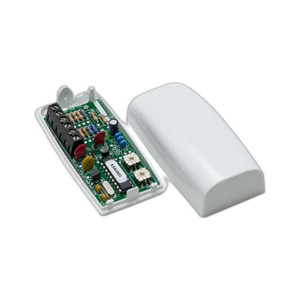
DMP 1108 Wireless Doorbell Module
The DMP 1108 is a wireless doorbell module designed for multi-door intercom and notification systems in commercial and institutional facilities. It bridges mechanical or video doorbell button inputs to a 900 MHz wireless network, eliminating the need for dedicated annunciation cable runs between entry points and remote chime or keypad notification stations. When a visitor presses a doorbell, the 1108 broadcasts a wireless signal to alert staff across multiple zones — critical for facilities where entry notification must reach scattered reception desks, security posts, or tenant spaces without infrastructure rewiring.
Key Features
- Multi-door capacity: Supports up to 8 doors in a single module configuration. Consolidates multiple doorbell inputs into one wireless transmitter, reducing hardware and installation complexity in multi-tenant or multi-zone buildings.
- 900 MHz wireless signaling: Operates on unlicensed 900 MHz band with FCC Part 15 and Industry Canada certification (5251A-PC0209). Wireless architecture avoids long audio cable runs where conduit or wall penetration would be cost-prohibitive or structurally infeasible.
- Mechanical and video doorbell compatible: Accepts input from standard mechanical pushbutton doorbells and modern video doorbell systems. No adapter or signal conditioning required — direct connection to existing door hardware.
- Wireless and wired flexible architecture: Integrates with DMP keypads and 1136 Wireless Remote Chimes for distributed notification. Hybrid wired-wireless configurations allow phased rollout in large facilities without simultaneous infrastructure replacement.
- No external power supply: Powered from doorbell circuit itself — eliminates separate 24V runs or PoE infrastructure at the doorbell location, reducing installation cost and point-of-failure risk.
- Indicator-sounder output compatible: Supports remote audio and visual annunciation across standard DMP intercom and chime platforms. Multi-output configurations allow priority routing (e.g., main desk chime + backup audible alert at security station).
- RF propagation in multi-floor buildings: 900 MHz signal penetrates typical commercial walls and floors better than higher-frequency wireless protocols. Effective range depends on building construction — requires line-of-sight or near-line-of-sight to receiving keypads or chimes; dense metal studs or underground parking areas may require repeater units or strategic placement.
The 1108 is purpose-built for facilities where entry notification cannot rely on a single central intercom station. Educational campuses, medical clinics, multi-tenant office buildings, and financial institutions benefit from distributed doorbell awareness across administrative, security, and tenant areas. The wireless architecture also supports temporary or flexible staffing arrangements — chime receivers can be repositioned without rewiring, and new staff areas can receive doorbell notifications with minimal hardware modification.
Installation centers on connecting the 1108 to the existing doorbell circuit (both mechanical button and video doorbell inputs are supported). The module broadcasts to any compatible DMP keypad or 1136 remote chime within RF range. No additional power infrastructure is required at the doorbell; the module draws power from the doorbell circuit itself. For multi-story buildings or large floor plates, RF propagation testing prior to final placement is recommended — concrete floors, HVAC ductwork, and metal framing can reduce effective range. FCC Part 15 compliance and Industry Canada registration ensure legal operation without need for dedicated wireless licenses or spectrum coordination.
Integration with DMP access control and intercom ecosystems is straightforward: the 1108 pairs with DMP keypads (for audio annunciation at staffed stations) and 1136 Wireless Remote Chimes (for unmanned or high-traffic areas). The module supports multiple output configurations, allowing facilities to route doorbell signals to primary alert devices and secondary backup chimes. This redundancy is valuable in security-critical environments where a missed entry notification could represent a liability or operational failure. Total cost of ownership is lower than hardwired audio cabling — avoid costly conduit runs, wall patches, and long-lead cable installation; wireless placement can be tested and repositioned before final mounting.
The DMP 1108 carries a manufacturer warranty covering defects in materials and workmanship. Compliance with FCC Part 15 (unlicensed 900 MHz operation) and Industry Canada registration (5251A-PC0209) ensure the module operates legally across North American deployments without requiring special RF coordination or licensing. For integrators working on retrofit multi-door notification projects or new campus security systems, the 1108 provides a pragmatic wireless alternative to traditional hardwired doorbell annunciation — particularly in environments where cable routing is constrained or where future scalability (adding doors/zones) is anticipated.
Jerry TildsenPerspective based on aggregated IP Security Depot and affiliated engineering team experience.
We've deployed the DMP 1108 across educational campuses, medical facilities, and multi-tenant office buildings where a single hardwired doorbell system would create installation bottlenecks or require expensive cable infrastructure. The wireless 900 MHz architecture is the practical advantage here — it sidesteps the capex and labor overhead of running audio cabling from every entry point to a central chime station or to scattered staff desks. In a typical 40,000 sq ft office retrofit, we've avoided $3,000–$5,000 in conduit, cable, and wall restoration by deploying three or four 1108 modules to service 15–20 doors. The trade-off is RF propagation planning: you need near-line-of-sight or strong signal bounce off walls and ceilings. In a concrete-heavy basement or a facility with extensive metal framing, we've seen effective range drop from 300+ feet to 100–150 feet, which requires repeater placement or relocation of receiving chimes. The module itself is rugged and trouble-free; the real design challenge is upfront site survey and receiver placement, not the hardware itself.
Technical Highlights:
- 900 MHz ISM band operation: Unlicensed frequency with FCC Part 15 and Industry Canada compliance. No spectrum coordination or RF licenses required — install and operate immediately. 900 MHz propagates better through walls and floors than 2.4 GHz or 5.8 GHz alternatives, valuable in multi-story or metal-framed buildings where line-of-sight is impractical.
- 8-door capacity per module: Single 1108 consolidates up to eight doorbell inputs. Means fewer devices to mount, program, and maintain. For larger facilities, cascade multiple modules on the same wireless network — we've deployed five modules in a 200,000 sq ft campus without crosstalk or collision issues.
- Direct doorbell-circuit power draw: No external 24V supply or PoE infrastructure at the doorbell. Reduces point-of-failure risk and eliminates a power-supply unit from the BOM. Mechanical and video doorbell circuits both supply sufficient current.
- Wireless + wired hybrid architecture: Works with DMP keypads (wired intercom integration) and 1136 Wireless Remote Chimes (pure wireless receivers). Allows mixed deployments — some locations get desktop intercom units, others get standalone chimes — without redesigning the notification backbone.
- Mechanical and video doorbell compatibility: No signal conversion or relay conditioning needed. Connects directly to doorbell button or video doorbell output. Simplifies retrofit projects where you're retrofitting around existing hardware.
Deployment Considerations:
- 900 MHz range is 300+ feet in open or light-frame construction; halves or worse in concrete, underground, or metal-stud-heavy buildings. Always conduct RF site survey before final receiver placement. If range is marginal, plan for repeater units or secondary 1108 modules acting as wireless extenders.
- Doorbell circuit must supply adequate current for the 1108 wireless transmission. Most mechanical and video doorbell transformers are 16–24V, 20–40 VA — sufficient. Verify with the doorbell spec sheet if circuit is undersized or distance from transformer is >50 feet (voltage drop over long runs can be an issue).
- Receiving keypads or chimes must be within RF range and powered (keypads are wired, 1136 chimes can be battery-powered or wired). In facilities with poor RF propagation, budget for repeater hardware or multiple receive modules in different zones.
- DMP integration requires compatibility with DMP control panels and keypads. Verify your existing access-control or intercom backbone supports the 1108 before spec'ing. Retrofits into non-DMP systems (Salto, HID, Honeywell) will require gateway or parallel wireless infrastructure.
- FCC Part 15 operation means the device must tolerate RF interference from Wi-Fi, cordless phones, and microwave ovens operating on overlapping frequencies. We've rarely seen operational issues in practice, but noisy RF environments (hospitals with extensive medical telemetry, airports, manufacturing floors) may require site assessment.
The DMP 1108 is the right choice for commercial facilities that need multi-door doorbell notification without hardwired audio cable infrastructure — particularly retrofits where conduit routing is costly or impossible. It's also well-suited to campuses or dispersed-office environments where doorbell alerts must reach multiple non-contiguous staff locations. If your facility already runs DMP access control or intercom systems, the 1108 integrates seamlessly; if you're non-DMP, confirm keypad or chime compatibility before purchase. For more options across DMP's access and intercom product line, visit the DMP catalog.