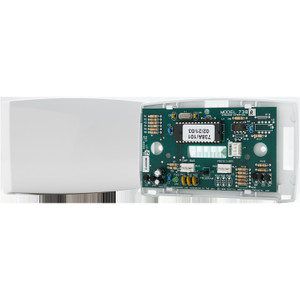
DMP 869 Style D Initiating Module
The DMP 869 is a Style D initiating module designed to expand fire alarm and security control panels with two independent four-wire initiating circuits rated for 8–25 VDC operation. It integrates waterflow switches, manual pull stations, and non-powered burglary and fire detectors into existing DMP panel architecture without requiring main control unit replacement. Built-in supervision monitors both zones continuously for opens, shorts, and ground faults—catching wiring failures or device disconnections before an alarm condition occurs. Deploy the 869 when retrofit capacity expansion is required on DMP systems or when modular zone distribution across multiple building zones streamlines installation labor.
Key Features
- Dual Four-Wire Initiating Circuits: Two independent supervised zones per module. Each circuit supports waterflow switches, pull stations, smoke detectors, and heat detectors rated for the 8–25 VDC supply range.
- Ground-Fault Supervision: Continuous monitoring of both initiating circuits detects wiring faults and device isolation before alarm dispatch—reducing false alarm burden and improving panel diagnostics.
- 8–25 VDC Operating Range: Matches standard DMP power distribution in both retrofit and new-build installations, simplifying supply-line design and reducing auxiliary power infrastructure.
- Style D Module Format: Plugs into DMP expansion slots or auxiliary module racks without field rewiring of main panel terminals—modular design accelerates commissioning and reduces main control unit load.
- Multi-Zone Capacity Expansion: Stack multiple 869 modules to scale initiating points across distributed locations—parking structures, warehouse zones, or multi-floor retrofits—while maintaining centralized supervision and alarm routing.
- Four-Wire Loop Topology: Supervised initiating and return paths per zone eliminate single-point wiring failures and provide circuit-level diagnostics for technician troubleshooting during maintenance visits.
The DMP 869 addresses the most common retrofit constraint: existing panels at or near zone capacity. Rather than replacing the main control unit (capex and downtime risk), the 869 adds initiating points incrementally. Each module occupies a single expansion slot and draws minimal auxiliary power, making it ideal for phased security deployments or facilities that add building sections over time.
Wiring topology is straightforward: each four-wire circuit carries positive and negative power plus separate signal pairs for the initiating and return paths. This architecture supports runs up to approximately 500 feet per zone under standard shielded cable—typical for campus deployments or large commercial floors. Ground-fault detection requires proper cable shielding and single-point grounding at the panel end; field commissioning must verify this configuration to avoid nuisance faults on extended runs in electrically noisy environments (near VFDs, high-current power distribution, or RF sources).
Supervision of opens and shorts is automatic and transparent to the operator. A fault condition displays on the DMP panel's status display and logs to the event history. Many integrators use this diagnostic data during preventive maintenance rounds—detecting loose terminal screws, water intrusion in outdoor pull stations, or aging detector contacts before they fail operationally. In facilities with mandatory fire code compliance (healthcare, hospitality, data centers), this pre-failure warning reduces emergency service dispatch and associated liability.
The 869 is compatible with DMP control panels and systems that support auxiliary module expansion. Confirm your panel model number accepts Style D initiating circuit modules and has available expansion slots before ordering. Consult the datasheet or contact DMP technical support to verify compatibility with your specific panel firmware revision—some legacy panels require firmware updates to recognize newly added modules.
Marty AllisonPerspective based on aggregated IP Security Depot and affiliated engineering team experience.
We've installed dozens of DMP 869 modules across retrofit security upgrades, and it remains one of the most cost-effective ways to add initiating capacity without swapping control hardware. The dual four-wire circuit design is the real operational advantage—it gives you genuine zone-level diagnostics instead of a single supervised line that masks fault location. In a 200-detector deployment across five floors, that granularity pays off during quarterly maintenance tests and emergency troubleshooting. The ground-fault supervision feature is solid, but it does require discipline during installation: improper cable shielding or shared grounding with power distribution will generate false faults on runs over 300 feet. We've seen this trip up installers unfamiliar with DMP's grounding topology—they ground both ends of the cable or miss the shielded pair requirement entirely. One job site gave us six callback service calls before we caught a shielding error on the third-floor run. The other consideration is expansion slot availability on your existing panel. Older DMP panels (mid-2000s) often ship with fewer available slots than newer architecture—you may need to confirm this before spec'ing the 869. On newer panels, it's plug-and-play.
Technical Highlights:
- Dual Independent Four-Wire Circuits: Each circuit carries its own positive/negative supply and isolated signal pair. This means a fault on one zone doesn't affect the other—critical for separating fire zones from burglary zones or building zones from parking structures. Diagnostics isolate to the faulted circuit instantly.
- 8–25 VDC Flexibility: DMP panels ship with 24 VDC auxiliary supplies as standard. The 869's wide voltage tolerance means it works on aged supplies, UPS-backed systems, or future hardware upgrades without component replacement. No surprises in legacy facilities.
- Ground-Fault Detection (Passive Supervision): Monitors cable integrity and device connections without active polling—zero latency, always on. Catches a disconnected detector within seconds of the failure. On high-traffic facilities (hospitals, airports), this early warning prevents operational blindness in a security zone.
- Modular Expansion Without Main Panel Reconfiguration: Slide the 869 into an empty slot, wire the initiating circuits, and the panel recognizes the added zones automatically (assuming firmware supports it). No reprogramming of main panel logic, no downtime on existing zones—integrators bill this as a fast retrofit.
- Standard DMP Module Form Factor: Works in the same physical slot as other DMP auxiliary modules (relay expansions, input/output cards). Facilities with mixed DMP hardware can stack modules of different types in the same rack, simplifying inventory and training.
Deployment Considerations:
- Confirm your DMP control panel model explicitly supports Style D initiating circuit modules and has at least one available expansion slot. Older panels (pre-2010) or panels configured with maximum auxiliary modules may have no available slots—force-fitting the 869 will cause boot failures or ignored zones.
- Cable runs per zone should stay under 500 feet on standard shielded twisted-pair (18–22 AWG). Beyond 500 feet, ground-fault faults may appear even with correct wiring—confirm run length during site survey and use intermediate repeater modules or panel relocation if you exceed this distance significantly.
- Ground-fault supervision requires single-point grounding of cable shield at the panel end only. Do not ground at the device end or at intermediate junction boxes. If your site has legacy panels with improper grounding practices, test the 869 on a short run first before committing the full installation.
- Wire termination screws must be torqued consistently and checked quarterly during maintenance. Loose terminals on a four-wire circuit will generate intermittent open-circuit faults and consume service calls. Include this in your preventive maintenance schedule.
- If adding the 869 pushes your total initiating points significantly higher, notify your monitoring center—some legacy monitoring contracts cap the event log size or alarm throughput. A sudden influx of new zone initiations can overwhelm legacy listener hardware on the monitoring center end.
The DMP 869 is the right choice for security integrators and facility managers who need to add fire or burglary zones to an existing DMP panel without capital replacement. It's particularly valuable in phased campus expansions, multi-tenant retrofits, and facilities bound by code to maintain discrete fire zones. For a deeper look at the full DMP auxiliary module ecosystem and compatible control panels, explore the DMP catalog.