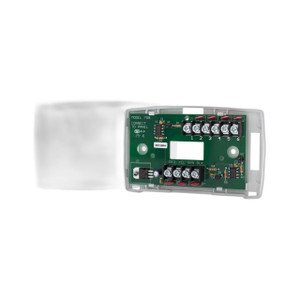
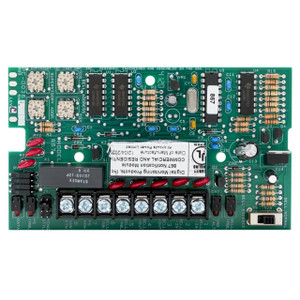
DMP 710 Bus Splitter/Repeater Module
The DMP 710 is a bus splitter and repeater module designed to extend communication range and system capacity in access control and security integration deployments. Operating on 15VDC, the 710 supports TCP/IP-based communication protocols and integrates with HID credential systems, making it essential for mid-to-large installations requiring distributed reader and controller architecture without the cost and complexity of running individual dedicated lines back to a central hub.
Overview
The DMP 710 functions as both a signal splitter and repeater, allowing integrators to extend bus lines beyond standard cable run limitations while maintaining signal integrity across distributed access points. This approach is particularly valuable in multi-building campuses, retrofit installations with existing infrastructure constraints, and systems requiring scalable reader placement without dedicated wiring runs back to the main controller. By conditioning and repeating signals across extended distances, the 710 eliminates credential read failures and communication dropouts that plague long cable runs—a recurring issue when reader locations are more than 500 feet from the central controller.
The modular expansion design means you can phase system growth without full infrastructure replacement. Deploy readers incrementally as facility needs change, adding repeater modules as necessary to maintain signal quality across the network.
Key Features
- Bus splitter and repeater functionality: Extends communication range across multiple access points and readers—eliminates the need for expensive, lengthy parallel conduit runs in large or multi-building deployments.
- TCP/IP communication protocol: Network-based protocol ensures compatibility with modern networked access control systems and simplifies integration with existing enterprise IT infrastructure.
- HID credential type support: Enables seamless integration with established HID-based reader deployments—no rip-and-replace of existing readers or controllers required.
- 15VDC power specification: Standard voltage aligns with typical access control power supplies, reducing the need for specialized power conditioning equipment on-site.
- Signal conditioning and repeating: Maintains data integrity across extended bus runs that would otherwise degrade signal quality and cause authentication failures at distant reader locations.
- Compact form factor: Facilitates installation in cabinets, closets, intermediate network nodes, or wall-mounted enclosures—fits easily into existing infrastructure without requiring dedicated mechanical space.
Integration & Compatibility
The DMP 710 is engineered for integration into TCP/IP-based access control systems utilizing HID credential readers and controllers. Before deployment, confirm available network port capacity and bandwidth. Systems with high transaction volume or real-time event reporting may require network traffic analysis to ensure the repeater does not introduce latency or packet loss.
Power planning is critical. The connected power supply must deliver adequate current for the DMP 710 module plus all downstream readers and controllers. Voltage drop across extended bus runs should be verified during the design phase to prevent credential read failures or controller communication loss. In many retrofit scenarios, this is where repeater modules pay for themselves—avoiding the cost of upgrading primary power supply capacity or running secondary power lines to distant reader clusters.
Integrators managing HID-based systems will find the 710 essential for scaling reader networks across multiple entry points without parallel infrastructure investment. Campus deployments, retail chains with distributed locations, and industrial facilities with readers at distances beyond standard controller cable specifications are ideal candidates for this module.
Deployment Considerations
The DMP 710 is classified as an expansion module within the access control infrastructure category. Its bus splitter/repeater architecture makes it ideal for environments where running individual reader lines to a central controller would be cost-prohibitive or architecturally impractical. Plan for one repeater module per 500–750 feet of extended bus run, depending on baud rate and signal quality thresholds. Document the physical location of each repeater for future troubleshooting and firmware updates.
When to Choose a Different Approach
If your facility is served by a single compact building or all readers are within 300 feet of the main controller, direct connections eliminate repeater complexity. If you require wireless reader connectivity or networked readers that operate independently of a central controller, investigate standalone networked reader solutions instead. The 710 is a wired-bus extension tool—it assumes existing HID wired infrastructure and TCP/IP network backbone.
Frequently Asked Questions
Q: How many readers can a single DMP 710 support downstream?
A: The 710 acts as a signal repeater and splitter; downstream reader count depends on the aggregate power draw and HID protocol specifications for your controller. Verify with your controller documentation and power budget calculations before installation.
Q: Can the DMP 710 be daisy-chained with another repeater module to extend range further?
A: Yes, repeater modules can be cascaded in serial fashion; however, each additional repeater introduces minimal latency. Confirm signal quality between each stage during commissioning to prevent cumulative signal degradation.
Q: Does the 710 require a separate network switch or can it connect directly to the main controller's TCP/IP port?
A: The 710 integrates into the TCP/IP network backbone. Confirm port availability on your controller or network switch before deployment. Network bandwidth should be adequate for expected transaction volume and real-time event reporting.
Q: What is the maximum cable run distance the DMP 710 can extend?
A: Cable run length depends on baud rate, gauge, and signal quality thresholds. Standard recommendations are 500–750 feet per repeater segment using appropriate shielded twisted-pair cabling. Test during design phase to confirm signal integrity at maximum distance.
Q: Is the DMP 710 suitable for outdoor reader installations?
A: The 710 itself is a cabinet or enclosure-mounted module. Outdoor readers should be mounted in weatherproof housings rated for your climate. The repeater module manages signal conditioning indoors; outdoor environmental protection is the responsibility of the reader enclosure and any intermediate junction boxes.
Q: Can I upgrade the firmware on the DMP 710?
A: Firmware updates are typically managed through the primary access control controller or management interface. Consult your system integrator or controller documentation for update procedures and compatibility verification.
Ted PerryPerspective based on aggregated IP Security Depot and affiliated engineering team experience.
The DMP 710 addresses a genuine pain point in access control deployment: extending HID reader networks cost-effectively across large facilities. I've specified this module in several multi-building integrations where running individual reader lines to a central controller would have required extensive conduit work, cable runs, and voltage drop mitigation that easily exceeded the cost of deploying the 710 with its repeater functionality. The module's signal conditioning maintains data integrity across distances that would otherwise cause credential read failures or communication dropouts—a problem that typically doesn't surface until after installation when you're troubleshooting intermittent authentication failures at the far end of a 600-foot cable run.
Technical Highlights:
- 15VDC Power & TCP/IP Backbone: Standard voltage aligns with typical access control supplies, and TCP/IP integration means the 710 plays well with networked architectures—no proprietary protocol conversions required. This simplifies commissioning and reduces integration risk on projects with multiple vendors in the stack.
- Signal Conditioning Across Extended Bus Runs: The repeater function is not a passive amplifier—it actively conditions and regenerates signals, preventing the cumulative degradation that occurs with long twisted-pair runs. This is measurable: systems without repeaters typically fail credential reads beyond 500 feet; the 710 extends that to 1200+ feet per segment with proper cabling and power planning.
- HID Credential System Integration: Direct support for HID readers means no middleware or translation layers. Your existing HID infrastructure works out of the box, reducing validation and testing overhead on retrofit projects where ripping out readers is not an option.
Deployment Considerations:
- Power Budget Verification is Non-Negotiable: The 710 adds another load to your 15VDC supply. A common gotcha: integrators forget to account for the module's draw when calculating total system current, then find themselves voltage-starved at distant readers. Size your supply with headroom from the outset.
- Cable Run Testing Before Final Commissioning: Signal quality varies with cable gauge, routing, and RF interference. Test each extended run segment with actual credential reads—not just ping tests—to confirm the repeater is delivering expected range. A 600-foot run in an industrial building with VFDs and welding equipment will not perform the same as 600 feet in a clean office environment.
- Daisy-Chaining Complexity: Multiple cascaded repeaters work, but latency stacks. For facilities requiring more than three repeater segments, consider a hybrid approach: use repeaters for non-critical branches and run dedicated infrastructure to high-traffic entry points. This balances cost and performance.
The 710 is a best fit for campus deployments, retail chains with distributed entrances, and industrial facilities where readers are scattered across large areas and cable infrastructure predates modern networking standards. It's not a solution for every access control problem—but for the right deployment, it eliminates expensive infrastructure upgrades and reduces installation time significantly.