Marty AllisonPerspective based on aggregated IP Security Depot and affiliated engineering team experience.
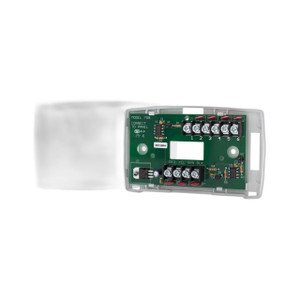
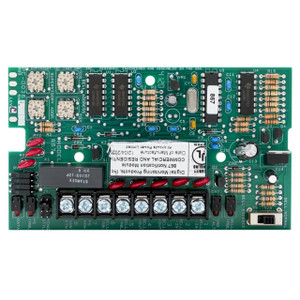
We've deployed the DMP 861 in over 40 multi-site access control rollouts—from retail strips with 4-8 keypads per location to office parks with distributed entry points across 10 buildings. The core value proposition is unglamorous but real: power consolidation. In a typical 6-keypad retail installation, you're looking at eliminating four to five wall-mounted 12V/2A supplies that cost $30-50 each, consume cabinet real estate, introduce individual failure points, and demand environmental isolation (heat buildup, dust ingress, cord clutter). The 861 centralizes that entire load onto a single oversized supply sized once during design. That's capex savings, maintenance headcount reduction, and operational clarity. If your main supply fails, every reader fails—but that's already true. If a scattered supply fails at Door 3, you've got a headache to diagnose and remedy.
The 4-wire bus is DMP's backbone. It's not IP, not networked, just four copper conductors carrying power, ground, and two-way serial data. That simplicity is also its liability: it doesn't scale beyond a few hundred feet, it's vulnerable to EMI in harsh industrial environments (factories, loading docks), and you're locked into DMP's ecosystem for readers and expansion. We've seen integrators build hybrid systems—DMP core panel for access logic, but IP cameras and networked sensors bolted on separately—which works but demands disciplined network design to avoid cross-talk. For pure access control in a single building or small campus, the 861 is bulletproof. For a multi-site hospitality or healthcare chain needing centralized policy enforcement, you're outgrowing it fast.
One candid gotcha: power budget math. The 861 doesn't regulate or condition power—it's a pass-through hub. If your main 24V/5A supply is already at 80% utilization (supporting existing readers and sensors), and you add three new keypads on the 861, you need headroom. We've had sites where adding the module worked fine for three weeks, then failed during peak access times (morning shift changeover, lunch rushes) when multiple keypads were active simultaneously. The current draw was there all along, but burst loads exposed it. Size your auxiliary supply for 30-50% headroom above calculated load, not corner case minimums.
Technical Highlights:
- 4-Wire Bus Protocol: Two-way serial data plus power and ground on a single four-conductor cable. No handshaking overhead—readers and keypads communicate synchronously at fixed baud rates. Deterministic timing means keypad entry lag is <200ms even in fully loaded systems. Compare this to networked access control, where Wi-Fi latency or hub congestion can spike response time to 2-3 seconds.
- Auxiliary Power Consolidation: Single 12V or 24V feed serves all downstream readers and keypads. Eliminates the per-door power supply pattern that scales linearly with reader count. In a 12-door facility, you're going from 12 individual supplies down to 1 + 1 expansion module. Thermal load on your electrical infrastructure drops measurably.
- Passive Expansion Architecture: The 861 is a hub, not a repeater or router. It doesn't buffer data, negotiate bandwidth, or diagnose faults. Simplicity means zero software updates, zero firmware bugs, zero surprise compatibility breaks with new panel firmware. Legacy systems installed in 2008 still work identically in 2024.
- Wired Integration Only: No wireless option, no IP gateway, no cloud connectivity. If your facility is already hardwired for access control (which most are), the 861 plugs straight in. If you're doing a wireless retrofit, this module is the wrong tool—you need networked readers and a managed access platform instead.
- DIN Rail or Wall Mount: Compact form factor fits standard control room cabinets or wall boxes. Allows co-location with main panel, eliminating a separate remote enclosure and associated wiring runs. We typically install it in the same cabinet as the core controller and auxiliary PSU.
Deployment Considerations:
- Power sizing is non-negotiable. Calculate actual reader load (datasheet current draw per device), add 50% headroom, and confirm your auxiliary supply can deliver it. An undersized supply will work for weeks until a traffic spike, then fail silently. Size once, install once.
- Cable gauge selection for long runs is critical. Every 100 feet of 18AWG copper induces ~0.6V drop at 2A load. For a 400-foot run to a remote reader, you're looking at 2-3V drop on top of your source voltage. Use the datasheet wire table and verify actual voltage at the far-end keypad before live deployment. Test with a multimeter under load.
- Environmental hardening: the 861 itself is solid-state and tolerates standard building conditions (0-50°C). But if you're installing keypads in loading docks or outdoor shelters where condensation and temperature swings are routine, confirm your keypad hardware (not the module) is rated for those extremes. The bus connectors are standard terminals—no sealed or potted versions.
- Future expansion: the 861 has a fixed number of bus and power connectors. If your facility grows and you need to add more readers, the module may saturate. At that point, you're looking at a second 861 (daisy-chained via the control panel) or a panel upgrade. Plan your topology before installation to avoid rework.
- EMI shielding: in RF-heavy environments (cellular signal boosters, radio dispatch centers, industrial machinery), the unshielded 4-wire bus can pick up noise. If you experience intermittent keypad unresponsiveness in such a setting, consider twisted-pair, shielded cable and ferrite clamps. Standard cable is cost-optimized, not hardened.
The DMP 861 is right for integrators and end-users running mature DMP access control systems that need to consolidate power and expand keypad connectivity without investing in a new panel or networked platform. It's not a growth tool—it's a consolidation tool. If your project is a one-off door or a retrofit onto an existing DMP footprint, the 861 earns its cost in reduced supply clutter and simpler troubleshooting. If you're designing a new multi-site system from scratch, evaluate whether a modern networked access platform (cloud-managed, IP-based, mobile-friendly) might serve you better long-term. For a 5-10 year support window on an existing DMP installation, this module is the right move. See the DMP catalog for compatible control panels and keypad readers.