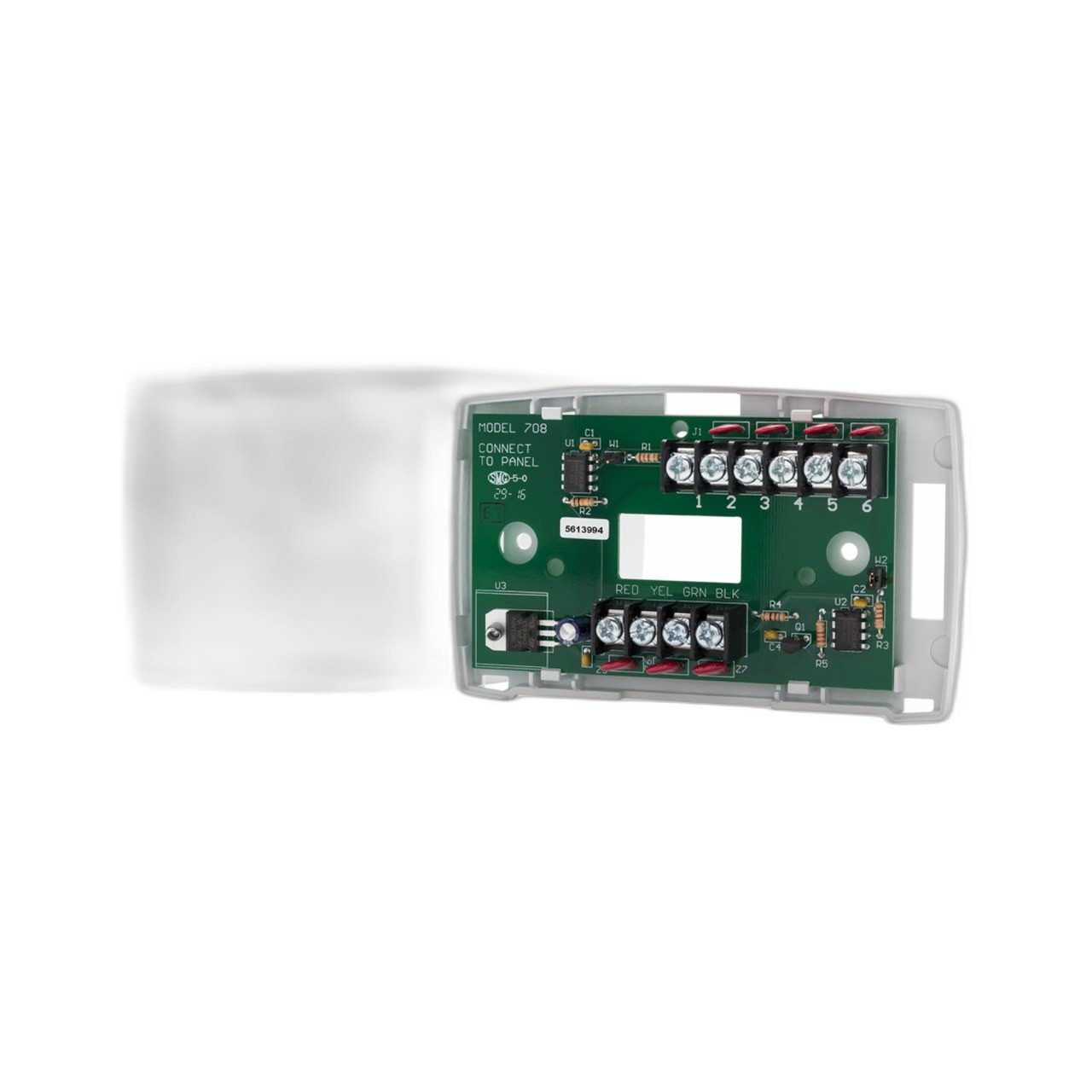
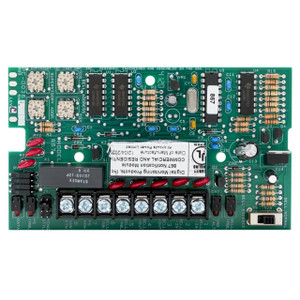
DMP 708 Bus Extender Modules
The DMP 708 is a bus extender module pair designed for distributed security installations requiring LX-Bus signal regeneration across long cable runs or electrically noisy environments. Operating at 15VDC nominal (8–15 VDC range), the 708 restores signal timing and amplitude lost over extended distances — critical for multi-zone and multi-panel deployments where the control panel topology spans buildings, separate structures, or runs alongside power and telephone cabling. These modules are engineered for professional integrators who need reliable signal conditioning without overcomplicating the installation.
Key Features
- LX-Bus Signal Regeneration: Each module pair reshapes and re-times the signal to restore margins lost over extended runs. Eliminates data corruption and timing skew on long cable spans.
- 15VDC Operation: Rated 8–15 VDC for compatibility with standard DMP power supplies and distributed architectures. Operates reliably in field-voltage ranges without performance degradation.
- Multi-Zone / Multi-Panel Expansion: Supports distributed system topologies where bus extension is required per your control architecture. Integrates seamlessly into existing DMP installations.
- Electrically Noisy Environment Tolerance: Signal regeneration mitigates crosstalk and EMI from adjacent power lines, telephone cabling, and RF sources — common in industrial and campus deployments.
- Compact Field-Mountable Enclosure: Two-piece high-impact ivory plastic housing (8.6 x 5.9 x 1.2 in) rated for mounting at the extension point. No special tools or alignment required beyond standard wirework discipline.
- Modular Expansion Architecture: Designed for integrators building distributed security systems where bus topology must scale across multiple sites or zone layers.
The 708 pair is not a passive coupler or splitter — it is an active signal conditioning device. Each module regenerates the LX-Bus signal, restoring timing margins and ensuring reliable data transmission over distances (and electrical environments) where passive extension would fail. This is the practical reason to deploy them: you're solving a real signal-integrity problem, not adding redundancy for its own sake.
Installation is straightforward for professional integrators. Mount the two-piece enclosure at the point where the extended run begins, wire the bus input and output per DMP documentation, and verify signal integrity at the remote panel using standard DMP diagnostics. No firmware updates, no configuration software, and no special commissioning steps — the 708 works transparently once properly wired. The compact form factor fits in utility boxes and panel-adjacent mounting locations without requiring dedicated cabinet space.
Compatibility is scoped to DMP distributed architectures and LX-Bus topologies. Before ordering, verify that your control panel supports external module expansion and that your system documentation specifies bus extension as part of your multi-zone or multi-panel layout. DMP provides integration guidance in the 708 datasheet and system planning documents.
Manufacturer Warranty covers the 708 modules and enclosure against defects in materials and workmanship. The 0.44 lbs per-unit weight and compact dimensions make field stocking practical for integrators deploying DMP systems across multiple sites.
Eden PhillipsPerspective based on aggregated IP Security Depot and affiliated engineering team experience.
The DMP 708 is a straightforward but essential tool in distributed security system topology. In our experience, the majority of 708 deployments are driven by one of three scenarios: (1) campus installations where the control panel and remote zone modules are separated by 500+ feet of cable run, (2) industrial sites where the control topology must co-exist with high-current power distribution and switchgear (introducing EMI into passive bus runs), or (3) multi-building facilities where the system is split across separate structures and passive extension simply fails due to signal degradation. The 708 solves all three by actively regenerating the signal — it's not a passive band-aid, it's a legitimate engineering solution. The 15VDC operation keeps the module compatible with standard DMP power supplies, and the compact form factor means you can mount it in a utility box or control enclosure without racking or thermal management headaches. Where the 708 is not the answer: small single-building installations where bus runs are under 200 feet and cabling is routed away from power lines — in that case, passive extension or direct panel connection is cheaper and simpler.
Technical Highlights:
- Active Signal Regeneration: The 708 reshapes the LX-Bus signal, restoring rise times and amplitude margins lost over long cable runs or noisy electrical environments. This is mandatory for runs exceeding passive cable ratings — passive extension in these scenarios results in intermittent zone faults or panel communication timeouts.
- 15VDC Nominal Operation (8–15 VDC Range): Field voltage tolerance is built in — you don't need a regulated 15V power supply to within 1%. Standard DMP power supplies and battery backup systems operate reliably across the 8–15 VDC window, and the 708 maintains signal conditioning across that entire range.
- Transparent Integration: No configuration software, no module ID assignment, no commissioning steps beyond wiring and signal verification. The 708 passes the LX-Bus protocol through unchanged — your existing zone modules, keypads, and repeaters see no topology change.
- Compact Field-Mountable Enclosure: 8.6 x 5.9 x 1.2 in form factor fits standard utility boxes or control panel side-mounting without consuming rack space or requiring external cooling. Two-piece high-impact plastic is rated for wall and pole mounting in both indoor and protected outdoor environments.
- Multi-Panel Expansion Support: The 708 is engineered for distributed architectures where multiple control panels or zone expanders need to be bridged over extended LX-Bus runs. Each module pair extends a single bus segment; daisy-chaining multiple 708 pairs for ultra-long runs is supported per DMP planning documentation.
Deployment Considerations:
- Verify your DMP control panel topology supports external module expansion before installation. Some older or compact DMP configurations do not provide the expansion connector required for the 708 — check your panel documentation or contact DMP tech support.
- The 708 is a bus-level regenerator, not a repeater or bridge — it passes one LX-Bus segment input to one output. Do not attempt to use it as a splitter or multi-drop junction; the signal conditioning is designed for linear end-to-end runs, not branching topologies.
- Power supply current draw is minimal (well under 100 mA at 15VDC), but confirm that your DMP power supply has headroom for the 708 and any downstream zone modules. Undersized power supplies in extended-run scenarios cause voltage sag and signal degradation at the remote end.
- Installation best practice: locate the 708 enclosure at the midpoint of the extended run or at the beginning of the long segment (nearest the control panel). This maximizes the benefit of signal regeneration for the remainder of the downstream run.
- Test signal integrity at the remote zone module using DMP diagnostics (bus communication test or zone loop check) immediately after wiring. If you see intermittent faults after installation, the 708 is often the solution — document the symptoms and verify 15VDC at the module before ordering a second unit or troubleshooting further upstream.
The DMP 708 is for integrators and end users building distributed multi-zone or multi-panel DMP security systems where LX-Bus extension is a documented requirement of the system architecture. If your topology fits this profile and you're experiencing signal degradation over long runs or in electrically noisy environments, the 708 is the proven solution. For more information on compatible DMP modules and multi-panel expansion strategies, visit the DMP catalog.