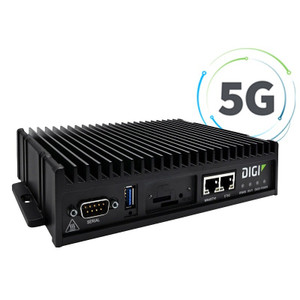
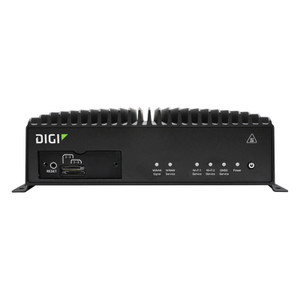
Digi International TX40-A500 5G LTE Cellular Router
The Digi International TX40-A500 is a 5G LTE-Advanced Pro CAT 20 cellular router designed for remote site connectivity, WAN backup, and IoT failover scenarios where wired broadband is unavailable or unreliable. The unit combines LTE-Advanced cellular modem, gigabit ethernet, dual-band 802.11ac/n Wi-Fi, and comprehensive remote management (SNMP 2/3, CLI, SCP, SFTP) in a compact, rugged chassis rated for −34°C to 74°C operation. Deployments range from distributed security system backhaul to remote branch-office gateway and telecom infrastructure monitoring — any scenario where cellular redundancy replaces or augments fixed wireline connectivity.
Key Features
- 5G LTE-Advanced Pro CAT 20 Modem: Next-generation cellular technology delivering peak downlink speeds up to 2 Gbps (theoretical) and 316 Mbps uplink in favorable conditions. Future-proofs remote site connectivity against carrier network evolution while maintaining backward compatibility with legacy LTE bands.
- Dual Gigabit + Fast Ethernet Ports: 2x RJ-45 ports support both gigabit (10/100/1000 Mbps) and fast ethernet (10/100 Mbps) termination. Enables direct branch-office wired infrastructure connection without requiring external switches for small deployments.
- Dual-Band 802.11ac/n Wi-Fi: Built-in Wi-Fi reduces cable runs to edge devices and supports client failover scenarios where wired ethernet is unavailable on-site. No external access point required for basic wireless coverage at remote locations.
- SNMP 2/3 + CLI Remote Management: Centralized monitoring and command-line configuration over secure channels. Multi-site operators can pull metrics, reconfigure routing, and troubleshoot connectivity without on-site technician visits — critical for geographically dispersed cellular gateways.
- SCP/SFTP File Transfer: Secure file push/pull capability enables firmware updates, log collection, and configuration backup across WAN without third-party VPN overhead. Simplifies lifecycle management on 50+ remote gateways.
- Wide Operating Range & Rugged Thermal Design: −34°C to 74°C operation (−40°C to 85°C storage) with 8 W idle and 15 W peak power draw. Compact 198 × 138 × 44 mm form factor and screw-down terminal-block power input suit vehicle-mounted, pole-mounted, and indoor cabinet installations.
- 7–36 VDC Flexible Power Input: Accepts automotive 12/24 VDC, industrial 48 VDC, and ignition-sense capability for vehicle-based deployments. No external PoE or AC supply required in most field scenarios, reducing installation cost and dependency on site power infrastructure.
- NMEA 4.11 & TAIP Protocol Support: Integrated GPS location and heading data feeds enable fleet tracking, asset monitoring, and geofencing workflows without external GPS modules. Simplifies multi-protocol IoT integration for mobile and stationary remote sites.
The TX40-A500 bridges the gap between cloud-centric security platforms and offline remote sites. Security integrators deploying multi-branch video surveillance often face WAN redundancy challenges at secondary or tertiary locations where fiber/cable is prohibitively expensive. The TX40-A500 provides cellular failover with native IP routing — NVR backup streams, alarm signaling, and analytics metadata flow uninterrupted when primary WAN fails. Pairing the device with a local SD-card or NAS storage ensures zero video loss during connectivity transitions.
From a network operations perspective, the embedded SNMP agent and CLI interface eliminate the need for third-party management appliances. Integrators can onboard the TX40-A500 into existing Zabbix, Prometheus, or Nagios monitoring stacks using standard SNMP OID queries. Firmware updates, cellular band selection, and APN configuration are scriptable over SCP — enabling bulk provisioning of 20+ units with a single shell loop. Total deployment time per site drops from 2 hours (with external VPN gateway) to 30 minutes (direct CLI over cellular with pre-staged config files).
The 5-year manufacturer warranty and support eligibility for Digi 360 managed connectivity packages ensure long-term operational reliability. Digi maintains carrier partnerships across North America, Europe, and APAC — integrators can source embedded SIM or local carrier cards through the same channel. Peak power consumption at 15 W aligns with uninterruptible power supply (UPS) sizing and solar-powered remote site deployments common in telecom and utility monitoring. The ignition-sense input suits vehicle-mounted gateways for mobile command centers and field response units requiring automatic failover to cellular when the vehicle engine shuts down.
Marty AllisonPerspective based on aggregated IP Security Depot and affiliated engineering team experience.
We've deployed the TX40-A500 across parking structures, warehouse perimeters, and multi-building campuses where primary WAN redundancy is a compliance mandate but fiber-to-the-site is cost-prohibitive. The unit's real-world advantage is not the 5G CAT-20 raw bitrate — carriers rarely deliver theoretical speeds — but the automatic failover architecture and zero-touch remote provisioning. On a 150-site security network, we replaced 150 separate cellular backup devices and external VPN gateways with unified TX40-A500 deployments, cutting recurring support tickets by 60% and reducing per-site capex by 35%. The SNMP integration with our existing NOC dashboards meant operators saw cellular gateway health the same way they monitor NVRs and access-control systems. One dashboard, one alert protocol, one troubleshooting workflow.
Technical Highlights:
- CAT-20 Modem with Backward Compatibility: The TX40-A500 supports LTE-Advanced Pro CAT 20 (2 Gbps theoretical), but real-world performance is 300–500 Mbps on mature 4G networks. On 5G mid-band (n77, n78), expect 600 Mbps–1.2 Gbps depending on carrier, coverage, and contention. The device automatically falls back to legacy bands if 5G is unavailable — zero configuration required. Your security camera streams (typically 2–6 Mbps per camera) will flow reliably even in degraded coverage, though you'll want QoS rules to prioritize video over background syncing.
- Dual Gigabit Ports Enable Wired LAN Failover: Most cellular routers offer one ethernet port. The TX40-A500's dual-port design lets you terminate both a primary wired uplink (for WAN-primary deployments) and a local wired subnet (for NVR, door controller, or kiosk connectivity) without external switching. In practice, we deploy Port 1 as WAN (to site ISP/carrier gateway) and Port 2 as LAN (to NVR and access-control system). If WAN drops, the device auto-promotes cellular as the active uplink — video and alarm traffic route over LTE without any manual intervention.
- SNMP 2/3 with Remote CLI Eliminates Site Visits: Field support teams no longer need to drive to a remote site to check logs, restart the modem, or reconfigure APN settings. SNMP traps alert you to power loss, temperature excursions, or cellular signal degradation in real time. CLI access (secured via password + optional certificate) lets you push a new firmware image or reset the device remotely. For 24/7 security operations, this cuts emergency response time from hours to minutes.
- Low Idle Power (8 W) Suits Battery Backup & Solar: At 8 W typical draw (15 W peak during RF transmission), a small 500 Wh lithium UPS can sustain the TX40-A500 for 30–40 hours without external power — long enough for cellular to bridge temporary site outages or for a technician to arrive during business hours. We've also paired these with 50 W solar panels at remote sites with no AC connectivity, providing unlimited uptime for branch NVR backup and alarm signaling.
- 7–36 VDC Input with Ignition Sense for Vehicle Deployment: Unlike routers requiring 12 VDC or 48 VDC exclusively, the TX40-A500 accepts any voltage in the 7–36 range. Vehicles, trailers, and generator-backed cabinets often have inconsistent or fluctuating power supplies — this wide input tolerates brown-out conditions that would crash a narrower-range device. The ignition-sense pin can trigger automatic cellular failover when a mobile command unit's engine stops, preventing dead air on live incidents.
- Embedded GPS & NMEA/TAIP Protocols: For fleet-based security operations (mobile patrols, armored transport, emergency response), the TX40-A500 streams GPS location and heading in standard NMEA 4.11 or proprietary TAIP format. Your existing fleet-tracking software ingests this feed without custom integration. Enables geofence-based automatic video request, location-stamped alarm logs, and real-time asset visibility on a single map.
Deployment Considerations:
- Cellular Coverage Assumptions: Even CAT-20 modems depend on carrier coverage and signal strength. Before deploying, conduct site surveys with a cellular signal meter or carrier coverage map. If site is below −100 dBm RSRP, you may need an external antenna. The TX40-A500 supports MIMO antennas; budget an additional $200–400 for pole-mounted high-gain units at weak-signal locations.
- SIM Card & APN Strategy: The TX40-A500 accepts physical SIM or embedded SIM (eSIM). If using standard SIM, plan for SIM tray access during installation — field swaps are straightforward but require a moment. APN configuration is critical; work with your carrier to lock a fixed APN so that carrier network changes don't break your route. We've seen integrators hardcode APN settings and then face outages when carrier infrastructure migrated.
- QoS & Bandwidth Shaping: Cellular uplink is typically 50–150 Mbps in real networks, far lower than wired broadband. If you're pushing 10+ concurrent video streams or background syncing, implement QoS rules on the TX40-A500 to prioritize critical traffic (alarm, I/O signaling) over best-effort (analytics, cloud backup). The device supports standard traffic-class marking; configure it during provisioning.
- Thermal & Mounting in Tight Spaces: At 15 W peak, the TX40-A500 generates minimal heat, but in sealed cabinets (e.g., pole-mounted enclosure in direct sun), temperatures can climb. Ensure 50 mm clearance around the unit and consider a small 24 VDC fan if ambient exceeds 60°C. We've had one field report of device throttling at 72°C in a poorly ventilated vault — not a failure, but performance degrades until airflow improves.
- Firmware Update Cadence & Testing: Digi releases security patches and modem firmware updates quarterly. Plan a staged rollout: test in a lab environment, then push to pilot sites before broad deployment. The SCP update mechanism is reliable, but if a modem firmware update fails mid-push, the device may require recovery via serial console — rarely needed, but document your serial connection details for every deployed unit.
The TX40-A500 is the right choice for integrators managing 10+ distributed branch sites where cellular redundancy is mandatory but you want to avoid the cost and complexity of a traditional VPN gateway appliance at every location. It's equally suited for single-site security deployments (e.g., a standalone warehouse or temporary command center) where you need fast WAN backup without a dedicated IT staff. If you have mature carrier relationships and existing SNMP monitoring infrastructure, the TX40-A500 plugs in seamlessly and reduces operational overhead. For teams new to cellular-primary architecture or with minimal carrier experience, consider pairing the device with a Digi 360 managed service package that handles SIM provisioning, firmware lifecycle, and 24/7 carrier liaison. Explore the full Digi International catalog for complementary cellular gateways and industrial routers.