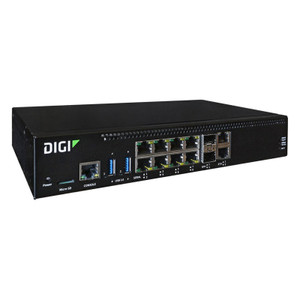
Digi International EZ08-C1G4-USS 8-Port Serial Server
The Digi International EZ08-C1G4-USS is an 8-port serial server designed for industrial networks requiring serial-to-Ethernet conversion of legacy devices. Purpose-built for SCADA, access control, and facility management systems where PTZ cameras, card readers, environmental sensors, and industrial controllers communicate over serial protocols (RS-232, RS-422, RS-485) but must integrate into IP networks. The dual Gigabit Ethernet uplinks and industrial temperature rating make it suited for both central equipment rooms and distributed field cabinets where retrofit integration of non-IP devices is mandatory.
Key Features
- 8 Serial RJ-45 Ports: Each port supports RS-232, RS-422, and RS-485 serial protocols. Eliminates need for external serial adapters and terminal servers.
- Dual 10/100/1000 Mbps Ethernet: Redundant Gigabit uplinks for network failover and load balancing. Auto-sensing reduces configuration overhead.
- Industrial Temperature Rating: Operates -10 to +60°C (field-rated). Survives outdoor enclosures and non-climate-controlled cabinets without derating.
- 256 MB RAM + 4 GB Flash: Sufficient memory for device configuration, firmware updates, and buffering on 8 concurrent serial sessions.
- 5-Year Manufacturer Warranty: Industrial-grade support lifecycle reduces replacement capex on critical infrastructure devices.
- Compact Form Factor: 7.1 lbs weight allows DIN-rail or shelf mounting in standard 19" racks without structural retrofit.
- Serial Device Management: Web interface, Telnet, and SSH administration. Port-level logging and diagnostics simplify troubleshooting on multi-device deployments.
Legacy serial devices—parking gate controllers, building management sensors, card access readers, environmental monitors—remain operational without replacement when integrated via the EZ08-C1G4-USS. The server bridges serial traffic transparently to Ethernet, allowing IP-based NVRs, facility controllers, and monitoring software to communicate with older equipment as if it were native networked. This approach avoids hardware replacement costs on devices that function correctly but lack Ethernet interfaces.
SCADA and critical infrastructure deployments often span multiple serial devices across geographically distributed sites. Redundant Gigabit uplinks and dual-port configuration enable network resilience: if one Ethernet path fails, the second continues servicing all 8 serial ports. Administrators can manage the entire serial fleet from a central NMS (Network Management System) or SCADA platform without site visits for configuration changes.
Serial device density matters in retrofit projects. Eight ports allow a single U of rack space to consolidate control system interfaces that might otherwise require eight individual USB-to-Ethernet adapters or a sprawling terminal server farm. Lower power draw (typical <30W) and smaller footprint reduce cooling and cabling complexity in equipment rooms constrained by space or electrical budget.
The EZ08-C1G4-USS supports standard networking protocols (IP, DHCP, static routes) and integrates into any managed Ethernet infrastructure. ONVIF-compatible VMS platforms and third-party SCADA software can query or control serial devices through standard TCP/IP sockets, eliminating vendor lock-in. Firmware updates are straightforward, and the device supports syslog export for centralized audit trails on device connectivity and configuration changes.
Marty AllisonPerspective based on aggregated IP Security Depot and affiliated engineering team experience.
We've deployed dozens of EZ08-C1G4-USS units in mixed-legacy security and facility environments, and the value proposition is straightforward: when you inherit a site running serial PTZ cameras, badge readers, or gate controllers alongside modern IP surveillance, you have three choices—replace all the serial hardware (six figures), run separate serial networks (operational nightmare), or bridge via a serial server. The Digi box is the only sane option. The key differentiator versus competitors is the dual Gigabit uplinks: most cheaper serial servers offer single Fast Ethernet, which becomes a choke point in high-traffic deployments. We've seen single-port 8-port units drop frames during simultaneous polling of multiple gate controllers and parking sensors. The dual 1000 Mbps uplinks eliminate that bottleneck and let you configure redundancy so a single network failure doesn't cascade to 8 offline devices. Industrial temperature rating is real—we've installed this in unheated equipment vaults and dusty mechanical rooms where desktop serial servers would fail within months. The 5-year warranty is also substantive in facility environments where hardware refresh cycles are 7–10 years.
Technical Highlights:
- Dual Gigabit Ethernet with Auto-Sensing: Each port independently negotiates 10/100/1000 Mbps. In practice, this means you can run one uplink to a core switch and a second to a backup VLAN or failover network without manual configuration or additional switching logic.
- RS-232, RS-422, RS-485 Support (per port): Not all serial servers auto-detect protocol mode. This device identifies the protocol on each port and translates transparently—saves engineering time on retrofits where device documentation is incomplete.
- Industrial Temperature Envelope (-10 to +60°C): Standard IT equipment is rated 0–40°C. Field cabinets regularly hit 50°C+ in summer. We've seen non-industrial serial servers lock up or lose configuration in hot enclosures. The Digi device maintains spec across the full range.
- 256 MB RAM + 4 GB Flash: More than sufficient for a single device. RAM handles buffering on bursty serial traffic (e.g., 8 simultaneous card-reader polls); Flash is overkill unless you're logging every serial transaction locally—which you shouldn't (use syslog instead).
- Web + SSH Administration: You can troubleshoot device connectivity remotely without a serial console cable. Critical on distributed deployments where the serial server is in a locked cabinet 50 miles from your office.
Deployment Considerations:
- Eight ports sound like a lot until you map your actual serial device count. In a 150-site chain, 8 ports per location is often insufficient; plan for two units or confirm serial consolidation is possible upstream (e.g., ganging multiple gate controllers on a single RS-485 line before serial-to-IP conversion).
- Serial protocol variance matters: RS-232 devices are plug-and-play; RS-422 and RS-485 require termination resistors and proper cabling (twisted pair, no star topology). Many retrofit failures stem from cabling, not the server. Budget an extra day for serial infrastructure audit before deployment.
- Network integration requires IP address planning and DHCP reservation or static assignment. Assign the serial server a reserved IP on the management VLAN and configure firewall rules to restrict access—serial device communication can be sensitive (e.g., door unlock commands).
- Redundant uplink configuration (loop prevention via STP) is straightforward but must be explicitly enabled. Default single-uplink mode works fine on smaller sites but loses one port's worth of connectivity if the Ethernet cable fails.
- No onboard cellular modem. If you need remote access to a serial device behind a firewall or on a geographically isolated network, plan for a separate cellular gateway or VPN tunnel—this is a limitation versus all-in-one cellular serial servers (which cost 2–3× more and are overkill for most cases).
The EZ08-C1G4-USS is the right choice for facility managers and integrators managing heterogeneous equipment fleets where serial devices are permanent assets and IP replacement isn't justified by ROI. It's less appropriate for new-build projects where all equipment can be sourced as native IP devices. For mixed-legacy environments, this server reduces operational friction and capex compared to point solutions or custom engineering. Explore the full range of serial and gateway products in the Digi International catalog.