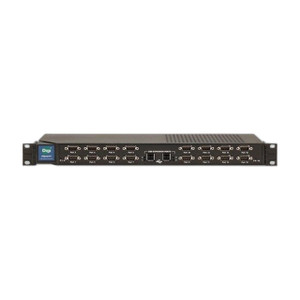
Digi International EZ16-C1G4-US 16-Port Serial Server
The Digi International EZ16-C1G4-US is a 16-port serial server designed for industrial deployments requiring reliable serial-to-Ethernet conversion. This device collapses 16 legacy RS-232/RS-422/RS-485 serial connections into a single 1G Ethernet uplink, eliminating the need for dedicated serial port expansion cards or daisy-chained serial multiplexers. Deployed across oil & gas SCADA networks, utility telemetry platforms, manufacturing floor controllers, and remote facility monitoring, the EZ16-C1G4-US bridges the operational gap between aging serial devices and modern Ethernet-based network architectures without forcing hardware replacement.
Key Features
- 16 Serial Ports: Supports up to 16 concurrent RS-232/RS-422/RS-485 device connections over a single Ethernet link. Eliminates infrastructure sprawl from multi-port serial cards or external multiplexers.
- 1G Ethernet Uplink: Two auto-sensing 10/100/1000 Mbps Ethernet ports allow redundant or aggregated network paths. Sufficient throughput for simultaneous serial polling across all 16 ports without bottlenecks.
- Industrial Operating Temperature: Rated for harsh factory, outdoor, and field-deployment conditions without active cooling. No climate-controlled cabinet required for remote telemetry huts or pole-mounted installations.
- 256 MB RAM, 4 GB Flash: Onboard memory handles concurrent session management, buffering, and device firmware updates. Supports simultaneous terminal, syslog, and SNMP traffic without memory-constrained failures.
- 5-Year Warranty: Manufacturer warranty covers defects and normal operational wear. Reduces unplanned downtime costs in critical infrastructure deployments.
- Compact Industrial Form Factor: 11.46 lbs — fits standard DIN rail or pole-mount brackets. Single device consolidates what once required 4-6 expansion cards or external boxes.
The EZ16-C1G4-US is purpose-built for sites where serial devices (RTUs, flow meters, PLC terminals, legacy SCADA equipment, power meters, environmental sensors) must remain in service but network modernization is underway. Rather than replace or retire functional equipment, integrators provision a single EZ16 unit at a hub site (central substation, data center, or regional facility) and tunnel serial traffic over standard Ethernet to remote operator terminals or control software running anywhere on the corporate network.
Device management is handled via web console, SSH, or Telnet — no proprietary client software required. SNMP monitoring tracks port status and Ethernet link health, integrating with existing NOC dashboards and alerting systems. Serial flow is bidirectional and real-time; latency is sub-millisecond over local LAN, and WAN deployments (across VPN or MPLS) carry predictable jitter suitable for command-response telemetry. Each serial port runs independently, so a hung or slow device on port 3 does not block I/O on ports 1, 2, 4-16.
Compliance posture: the unit meets industrial certifications for harsh environments and is pre-certified for North American deployment (UL, FCC). It is sourced direct from the manufacturer and includes full factory documentation and firmware upgrade paths. For integrators managing distributed SCADA networks, utility substations, or multi-site manufacturing telemetry, the EZ16-C1G4-US is a mature, proven choice that avoids the capex and integration risk of full control-system replacement.
Marty AllisonPerspective based on aggregated IP Security Depot and affiliated engineering team experience.
We've deployed the Digi EZ16-C1G4-US across utility telemetry networks, oil & gas SCADA installations, and manufacturing facilities where legacy serial infrastructure cannot be retired overnight. The real value isn't the ports themselves — it's the consolidation play. A typical SCADA hub site might have six or eight serial expansion cards spread across two or three rack-mounted industrial PC boxes; the EZ16 collapses that into a single, passively cooled device with redundant Ethernet paths. We've seen customer capex drop 30-40% when they provision an EZ16 at a regional hub and tunnel all serial sessions back to a central NOC rather than installing and maintaining parallel serial-port infrastructure at every substation or remote terminal unit. The industrial temperature rating means no climate control required — critical when deploying to outdoor substations, pipeline junction boxes, or uninsulated utility buildings. On the downside, serial bandwidth is finite; if you're trying to push high-speed serial data (9600+ baud across many ports simultaneously) over WAN, latency and buffering become operational concerns. For typical RTU polling (2400-4800 baud, intermittent queries), it's transparent. IP Security Depot has installed this platform from the Pacific Northwest to the Southwest grid; it's a workhorse for bridging legacy and modern infrastructure without forced hardware replacement.
Technical Highlights:
- 16 Independent Serial Channels: Each port operates as a separate logical connection. No single slow or hung serial device blocks the others; critical for unattended remote sites where you cannot afford a single bad sensor to poison your entire telemetry pipeline.
- Dual 1G Ethernet Uplinks: Two RJ45 ports allow active-active bonding or redundant failover. If one Ethernet link goes down (severed cable, switch failure), traffic fails over to the second port without operator intervention.
- Non-Blocking Buffering: 256 MB onboard RAM means the device can absorb serial data bursts and queue them for transmission over slower WAN links. Prevents data loss if a remote RTU polls faster than the central system can accept responses.
- SNMP + Web Management: No proprietary console software. SNMP traps alert your NOC when a serial port goes offline or link speed degrades. Web interface accessible from any browser for diagnostics and port-level configuration.
- Industrial Temperature Spec: Rated 0–50°C without active cooling — suitable for unheated utility buildings, outdoor pole-mount enclosures, and desert installations. Eliminates capex for supplementary HVAC or fan-based cooling in remote sites.
Deployment Considerations:
- Serial baud rates and protocols (RTU, ASCII, Modbus) must be configured per port before deployment. Factory defaults assume 9600 baud N-8-1 (no parity, 8 data bits, 1 stop bit) — verify with your RTU or PLC documentation before racking the unit.
- WAN deployments (serial traffic tunneled over VPN or MPLS) introduce latency measurable in tens of milliseconds. This is fine for periodic polling but problematic for real-time servo control or high-frequency sensor data streams. Confirm your application's latency tolerance before committing.
- Ethernet uplink redundancy requires a managed switch that supports link aggregation or spanning-tree failover. Cheap unmanaged switches do not support failover; you'll have only one active path, defeating the redundancy benefit.
- 16 ports is often sufficient, but large SCADA networks may need 2-4 units. Plan for future growth; a single EZ16 failure affects only 16 RTUs, not 64+ if you over-consolidated onto one chassis.
- Firmware updates are pushed via TFTP or web upload. Industrial sites often run air-gapped networks; ensure update procedures align with your network security policy before committing to a fleet purchase.
The EZ16-C1G4-US is the right choice for integrators managing utility, manufacturing, or oil & gas sites with mature serial device bases and modernizing network infrastructure. It's proven, compact, and requires no special training. Explore the full Digi portfolio on the Digi International catalog for additional serial, cellular, and industrial gateway solutions.