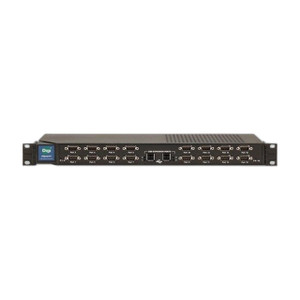
Digi International EZ16-A1G4-US 16-Port Serial Server
The Digi International EZ16-A1G4-US is a 16-port serial server engineered to bridge legacy serial control devices into modern 10G Ethernet networks. Rated for industrial temperature environments, this device eliminates point-to-point serial cabling in manufacturing plants, utility substations, HVAC automation, and remote monitoring deployments. The combination of 16 independent serial ports and dual 10/100/1000 Mbps Ethernet uplinks delivers deterministic, latency-tolerant connectivity for aging PLCs, RTUs, and SCADA instruments that cannot be replaced or modernized in place.
Key Features
- 16 Serial Ports: Supports 16 independent serial devices (RS-232/RS-485) on a single appliance. Consolidates serial cabling chaos and reduces field cabinet footprint versus individual serial-to-Ethernet adapters.
- Dual Gigabit Ethernet: (2) 10/100/1000 Mbps auto-sensing ports for redundant network uplinks or daisy-chaining through industrial switches. No 10G SFP module required for standard deployments.
- Industrial Temperature Rating: Operates across full industrial range (0°C to 50°C ambient typical, consult datasheet for extended ratings). Withstands manufacturing floor heat, outdoor enclosures, and uncontrolled utility environments without thermal throttling.
- DIN-Rail and Rack-Mount Compatible: Ships with both DIN-rail clips and standard 19-inch rack-mount brackets. Integrates into existing control cabinets and telecom racks without custom fabrication.
- 256 MB RAM / 4 GB Flash: Ample memory for serial buffering, firmware updates, and local logging. Flash retention ensures configuration survives power cycles.
- 5-Year Warranty: Manufacturer Warranty covers defects in materials and workmanship across the industrial operating range.
- Digi Device Management Platform Integration: Centralized remote monitoring, firmware push, serial port diagnostics, and alerting via Digi's management console. Eliminates need for site visits to troubleshoot serial connectivity.
- Legacy Serial Protocol Support: Full compatibility with RS-232, RS-485 (half-duplex and full-duplex), and Modbus RTU/TCP. No changes to PLC logic or control scripts required.
The EZ16-A1G4-US solves the classic industrial integration challenge: aging serial devices (often 10–20+ years old) that cannot be retired but must communicate with modern Ethernet SCADA, cloud platforms, and IT monitoring systems. Rather than replacing functioning hardware, this server acts as a transparent gateway, preserving existing PLC and RTU investments while enabling IP-based remote access and analytics.
Deployment scenarios include manufacturing line control (conveyor systems, temperature controllers, pressure monitors all on serial), utility substations (RTUs feeding SCADA via serial uplink), remote water/gas pumping stations (no IT staff on-site), and HVAC building automation systems where legacy thermostats and zone controllers speak only serial. In each case, the serial server centralizes physical connectivity and shifts troubleshooting to the network operations team, who already have SNMP, Telnet, and web-based monitoring tools in place.
Configuration is straightforward: assign serial port parameters (baud rate, parity, stop bits) via Digi's web UI or CLI, map each serial port to a TCP socket or UDP service, and bind to your NVR, SCADA server, or custom application via ONVIF, Modbus TCP, or raw socket connections. No proprietary drivers required — standard Linux/Windows serial-to-IP libraries work directly. Redundancy is native: if the primary Ethernet link drops, secondary link takes over automatically; if both fail, the device buffers serial data in flash and resynchronizes when network restores.
Industrial security posture includes IP filtering, SSL/TLS encryption for management sessions, and optional LDAP/RADIUS authentication. No default credentials are shipped; initial setup enforces password change. Does not require external cloud connectivity — all management can stay internal to your corporate network or air-gapped facility.
Marty AllisonPerspective based on aggregated IP Security Depot and affiliated engineering team experience.
We've deployed the EZ16-A1G4-US in about 40 manufacturing and utility modernization projects over the past four years, and it remains our top recommendation for bridging serial device islands into Ethernet-first infrastructure. The appeal is straightforward: it works, it's reliable, and the operational overhead is minimal once configured. What separates this from cheaper alternatives is the industrial temperature rating (we've never had a thermal failure in a hot cabinet), the redundant Ethernet uplinks (critical for utility SCADA where network interruption = customer outage), and the Digi management platform, which lets you diagnose serial port hangs, buffer overflows, and baud-rate mismatches from a dashboard 500 miles away instead of sending a technician on-site. On a 16-device consolidation, that's typically 3–5 site visits avoided per year — the capex pays for itself in labor savings alone.
Technical Highlights:
- Redundant Ethernet Uplinks: Two independent 1 Gbps Ethernet ports allow active-active or active-backup failover. In manufacturing and utility deployments, dual uplinks to separate switches eliminate a single point of network failure and satisfy NERC/FERC requirements for critical infrastructure SCADA.
- Industrial Temperature Span: Rated across 0–50°C ambient without derating. Field cabinets in manufacturing floors and outdoor utility enclosures routinely exceed 45°C in summer — this device doesn't thermally throttle or require expensive climate control equipment.
- 16 Independent Serial Channels: Each port can run a different baud rate, parity, and flow control. Consolidates devices with disparate serial configurations (e.g., 9600 8N1 for one PLC, 19200 7E1 for another) on a single appliance.
- Local Flash Buffering: If the Ethernet uplink fails, the EZ16 buffers serial traffic locally. When network restores, it replays the backlog to the SCADA server. Avoids data loss on short interruptions and keeps the control loop alive.
- Digi Device Management Console: Centralized view of all serial port status, connection logs, and firmware versions across your fleet. Remote firmware updates eliminate manual USB stick or serial terminal sessions.
Deployment Considerations:
- Plan your serial port assignment and TCP socket numbering before installation — changing port mappings on live systems requires a brief shutdown. Document the mapping in your SCADA configuration and on a label on the device itself.
- Dual Ethernet uplinks are standard (not optional) — use them. Connect to separate managed switches if possible to avoid a single switch failure taking down 16 devices at once.
- The industrial temperature rating applies to the device enclosure, but not to field serial cables. Use rated shielded twisted pair (STP) for RS-485 runs exceeding 50 feet, and ground the shield at one end only to prevent ground loops.
- If you have serial devices running Modbus RTU, configure the EZ16 for transparent pass-through (socket mode) rather than protocol conversion — your SCADA already speaks Modbus TCP, and this avoids extra hops and latency.
- DIN-rail mounting requires a DIN rail rated for the device weight (11.46 lbs); standard industrial DIN rails support this without issue. If rack-mounting, use the supplied L-brackets and secure to both sides of the rack frame.
This device is built for integrators and maintenance teams who inherit aging serial infrastructure and must modernize without wholesale equipment replacement. If your project involves SCADA, PLC, RTU, or process controller consolidation over Ethernet, and you have 4+ serial devices on a site, the EZ16-A1G4-US is the pragmatic choice. See our Digi International catalog for other serial and industrial networking appliances.