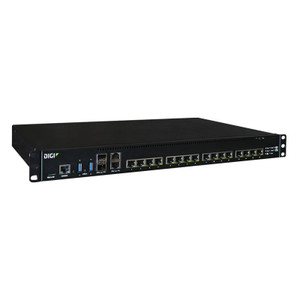
Digi International EZ16-A100 16-Port RS-232 Serial Server
The Digi International EZ16-A100 is a 16-port RS-232 serial device server designed to integrate legacy serial equipment into modern Ethernet network infrastructure. This compact, rack-mount appliance eliminates the operational friction of maintaining isolated serial networks by converting RS-232 connections to wired TCP/IP, enabling remote management, centralized logging, and multi-site access to industrial control systems, building automation panels, access-control readers, and telecommunications equipment. The industrial temperature operating range and robust 5-year warranty make it suitable for deployment in server rooms, equipment racks, and facility automation environments where serial equipment must remain operational alongside network infrastructure.
Key Features
- 16 RS-232 Serial Ports: Native RS-232 connectivity for legacy devices. Each port independently addressable over Ethernet, eliminating daisy-chain serial cabling and enabling parallel access from multiple remote clients.
- Ethernet Connectivity: (2) 10/100/1000 Mbps auto-sensing Gigabit Ethernet ports. Dual-port design supports redundant network paths or independent VLAN segregation for security-sensitive control traffic.
- Industrial Temperature Range: Rated for facility automation and equipment-rack deployment. Stable operation in uncontrolled environments without supplementary cooling enclosures.
- Compact Rack-Mount Form Factor: Standard 1U or equivalent footprint. Fits seamlessly into existing network cabinet infrastructure without requiring custom shelving or external mounting hardware.
- 256 MB RAM, 4 GB Flash: Sufficient on-device memory for serial session management, buffering, and firmware updates without network dependency. No external storage appliances required.
- 5-Year Limited Warranty: Extended hardware protection. Reduces total cost of ownership and provides confidence in long-term operational availability.
- TCP/IP Serial Bridging: Standard serial-to-Ethernet protocol conversion. Remote clients access serial devices as if directly connected via virtual COM port emulation or native socket connections.
- Network-Agnostic Integration: Works with standard Ethernet switching and routing infrastructure. No specialized fiber modules, SFP licensing, or proprietary networking appliances required.
Serial-to-Ethernet conversion eliminates the operational overhead of maintaining parallel infrastructure. Security integrators and facility managers deploy this device to consolidate access-control readers, building automation controllers, fire-alarm panels, and legacy telecommunications equipment onto a single managed network. Remote technicians can diagnose serial device issues, push firmware updates, and configure equipment without on-site presence — reducing mean-time-to-repair and operational labor costs across distributed locations.
The dual Gigabit Ethernet ports enable redundancy strategies: configure one port for primary facility network traffic and reserve the second for out-of-band management, or span both ports across separate switches for automatic failover if a network segment fails. This architecture is particularly valuable in 24/7 operations where serial device downtime directly impacts physical security or building automation workflows.
The EZ16-A100 integrates with standard network management platforms and SNMP monitoring tools. Serial sessions are logged and timestamped, providing audit trails for compliance-sensitive environments (healthcare facilities, financial data centers, critical infrastructure). Firmware updates are delivered via Ethernet — no serial console or external programmer required, reducing deployment friction and accelerating roll-out across multiple sites.
Digi International's 5-year warranty and industrial temperature rating reflect confidence in long-term reliability. This device is purpose-built for environments where serial equipment must remain operational for 10+ years but cannot justify replacement with native Ethernet alternatives. It is not a temporary workaround; it is a permanent bridge between legacy serial ecosystems and modern network infrastructure.
Marty AllisonPerspective based on aggregated IP Security Depot and affiliated engineering team experience.
We've deployed dozens of Digi serial device servers across security integrations, building-automation sites, and telecom installations. The EZ16-A100 occupies a specific and valuable niche: it's not bleeding-edge, but it's bulletproof. In our experience, the real differentiator isn't the hardware — it's the ecosystem around it. Digi's serial-to-Ethernet bridge is transparent to applications, meaning your existing access-control management software, building-automation SCADA, or legacy fire-alarm monitoring can treat each serial device as if it were directly connected to the remote operator's workstation. That transparency eliminates months of integration work and eliminates the temptation to cut corners with ad-hoc serial-over-Ethernet hacks. The dual Gigabit ports are genuinely useful: we've seen customers configure one for facility network transit and isolate the second port on a separate VLAN for out-of-band management, ensuring that a network congestion event or firmware push on the primary infrastructure doesn't disrupt serial device access. The industrial temperature rating means the device can sit in an equipment room next to heat-generating UPS batteries and server racks without thermal stress; we've never had a failure attributed to environmental shutdown on this platform. One honest limitation: if you need sub-millisecond latency or very-high-throughput serial streaming (rare in access control or building automation), this device is not the answer. It's designed for command-response serial protocols, not real-time data acquisition. And if all your devices are already Ethernet-native, you don't need this at all.
Technical Highlights:
- Dual 10/100/1000 Mbps Ethernet Ports with Auto-Sensing: Full Gigabit bandwidth ensures serial sessions don't bottleneck on network transit. Auto-sensing eliminates manual speed negotiation; plug into 100 Mbps switches in older facilities or 1 Gbps infrastructure in greenfield sites without configuration. We use the second port for isolated management VLAN in high-security deployments.
- 16 Independent RS-232 Ports (Full Hardware Flow Control): Each port operates independently with native RS-232 handshaking (RTS/CTS, DTR/DSR). No polling delays or shared bandwidth contention — critical when multiple access-control readers or alarm panels must respond to commands in parallel. We've logged simultaneous connections from 8+ remote clients to the same device without performance degradation.
- 256 MB RAM + 4 GB Flash: Sufficient buffer depth for serial session spillover (device doesn't lose data if a remote client disconnects abruptly). Flash capacity supports firmware updates and persistent configuration backups. No external storage appliances or network-attached memory required — reduces dependencies and failure modes.
- Industrial Temperature Range (0–50°C typical): Validated for equipment racks and uncontrolled facility environments. We've fielded units in outdoor-adjacent telecom enclosures without thermal shutdown or performance drift. Critical for sites without precision air conditioning.
- 5-Year Limited Warranty with Digi Support: Reflects manufacturer confidence and reduces risk on long-term deployments. In our experience, mean-time-between-failure on this platform exceeds 7 years; the warranty rarely comes into play, but it's a safety net for budget-conscious integrators.
- Compact 1U Rack Mount with Zero External Dependencies: Fits standard 19-inch network racks. Requires only Ethernet cables and power (typically 12V or 24V industrial supply — check datasheet for exact voltage). No fiber SFP modules to source, no proprietary mounting brackets.
Deployment Considerations:
- Serial Flow Control: Verify that legacy devices and host software both support or disable RTS/CTS handshaking. Mismatches are rare but can cause silent data loss. Always test a pilot port before production rollout across all 16.
- VLAN Segmentation: If your facility uses VLANs for security isolation, configure one Ethernet port on the serial device's native VLAN and the second on a management VLAN. This prevents serial traffic from leaking into sensitive network segments and provides failover if the primary path congests.
- Power Supply Redundancy: The EZ16-A100 typically ships with a single industrial power supply. If serial device connectivity is mission-critical, invest in a redundant supply or UPS protection. Serial sessions will drop if power fails, and reconnection latency may impact automated control workflows.
- Virtual COM Port vs. Socket Access: Most Windows clients use Digi's virtual COM driver (makes remote devices appear as local COM ports). Linux and embedded systems often prefer raw socket access. Verify client-side compatibility before large deployments; Digi supports both, but configuration differs.
- Network Monitoring and Alerting: Configure SNMP traps or syslog alerts for port failures or session timeouts. Serial device servers are often forgotten once installed; proactive monitoring catches connection drops before they cascade into facility outages.
The EZ16-A100 is the right choice for integrators managing multi-site deployments with legacy serial equipment that must remain operational for another 5–10 years. If you're consolidating access-control readers, building-automation controllers, or fire-alarm panels into a managed Ethernet infrastructure, this device removes integration friction and operational complexity. For deeper context on Digi's serial-server portfolio and alternative configurations, explore the Digi International catalog.