
Vivotek NV9321P vs Hanwha QRN-830S: Specification Comparison
Both the Vivotek NV9321P and the Hanwha QRN-830S are 8-channel IP network video recorders targeting different deployment environments. The NV9321P is purpose-built for mobile and field use with M12 weatherproof connectors and a vehicle-mountable form factor, while the QRN-830S is a rack-style desktop unit optimized for fixed indoor installations with 4K local display output and a single internal HDD bay. This comparison examines recording capacity and throughput, physical build and power environment, and integration and management capabilities.

In This Guide
- How do the NV9321P and QRN-830S compare on recording capacity, resolution, and throughput?
- How do the two recorders differ in physical build, PoE budget, and operating environment?
- Which recorder offers broader integration, protocol support, and management tooling?
- Which should you choose: the NV9321P or the QRN-830S?
- Side-by-Side Specs
- FAQ
How do the NV9321P and QRN-830S compare on recording capacity, resolution, and throughput?
The Vivotek NV9321P supports 8 IP camera channels and records in H.265 and H.264. Its specifications do not state a maximum recording bandwidth, maximum supported resolution per channel, or internal storage capacity. The absence of these figures makes direct throughput comparison impossible from the provided data.
The Hanwha QRN-830S also supports 8 channels and records H.265, H.264, and MJPEG. It specifies a maximum recording bandwidth of 80 Mbps and supports resolutions from CIF up to 8MP per channel. Local simultaneous playback reaches 8 channels; remote playback supports up to 8 channels per user across a maximum of 3 remote users. Storage is a single SATA HDD bay with a 6 TB maximum. The QRN-830S provides significantly more documented recording performance detail than the NV9321P.
How do the two recorders differ in physical build, PoE budget, and operating environment?
The Vivotek NV9321P is explicitly rated for mobile and vehicle deployments. Its M12 weatherproof connectors provide vibration and moisture resistance suited to in-vehicle or field use. It weighs 11.0 lbs (approximately 5.0 kg) and measures 13.8 × 13.4 × 8.3 inches. It delivers 802.3af PoE per channel across all 8 ports. Its total PoE budget, input voltage, and maximum system power draw are not specified in the provided data.
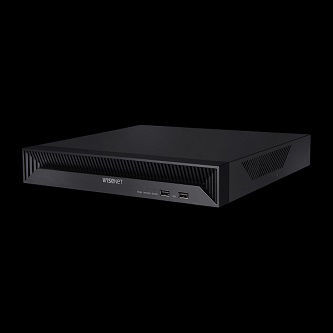
The Hanwha QRN-830S is a compact fixed-installation unit measuring 300 × 47.6 × 238.9 mm (11.8 × 1.9 × 9.4 inches) and weighing 1.32 kg (2.91 lbs). It uses standard RJ-45 connectors — 8 × 10/100 PoE ports plus one Gigabit LAN/WAN uplink — with a documented PoE budget of 65 W and a maximum system draw of 84 W (including one HDD with PoE active). Input is 54 VDC / 1.55 A via DC adapter. Its operating range is 0 °C to +40 °C at 20–85% RH. No IP or weatherproof rating is stated. The NV9321P's M12 connectors are purpose-designed for harsh environments the QRN-830S's RJ-45 ports cannot match.
Which recorder offers broader integration, protocol support, and management tooling?
The Vivotek NV9321P's provided specifications note H.265/H.264 compression, Object Analytics, and GPS tracking via Google Maps, and list 'Management Tools,' 'Camera Selector,' and 'Bandwidth Calculator' as features. Supported protocols, VMS compatibility, remote access methods, and security features are not enumerated in the supplied data.
The Hanwha QRN-830S publishes a detailed protocol stack: IPv4/IPv6, TCP/IP, UDP, RTP, RTSP, HTTP/HTTPS, NTP, DHCP, SMTP, SNMP, ONVIF Profile-S, and Hanwha's proprietary SUNAPI (server and client). Security includes IP address filtering, user access logging, 802.1x authentication, device certificate support (Hanwha Techwin Root CA), and signed firmware. Remote access supports up to 10 live unicast and 20 multicast users simultaneously. Mobile apps run on iOS and Android via RTP/RTSP/HTTP/CGI. N+1 failover and ARB redundancy are supported. P2P setup is available via QR code. Web viewer supports Windows 10, macOS 11, Chrome, Edge, and Safari. The QRN-830S's integration documentation is substantially more complete than what is provided for the NV9321P.
Which should you choose: the NV9321P or the QRN-830S?
Our take: The NV9321P is the stronger choice when the deployment requires mobile, vehicle-mounted, or field-hardened operation where M12 weatherproof connectors and a ruggedized form factor are non-negotiable. The QRN-830S is the stronger choice for fixed indoor installations where documented performance, integration depth, and display capability drive the decision. Three concrete spec deltas: (1) The QRN-830S specifies an 80 Mbps max recording bandwidth and 8MP per-channel resolution; the NV9321P provides neither figure. (2) The QRN-830S delivers 4K HDMI output at 3840×2160/30 Hz for local monitoring; no display output is listed for the NV9321P. (3) The QRN-830S carries a documented 65 W PoE budget across its 8 × 802.3af/at ports; the NV9321P lists 802.3af per channel but states no aggregate PoE budget. Buyers standardizing on Hanwha SUNAPI or Wisenet VMS should prefer the QRN-830S; buyers deploying in vehicles or temporary command posts should evaluate the NV9321P.
Side-by-Side Comparison
Spec-for-spec, from manufacturer data.
| Specification | Vivotek NV9321P | Hanwha QRN-830S |
|---|---|---|
| Product Type | NVR (Mobile/Field) | NVR (Fixed/Desktop) |
| Camera Channels | 8 IP cameras | Max. 8CH |
| Max Recording Bandwidth | — | Max. 80 Mbps |
| Max Camera Resolution | — | 8MP |
| Compression | H.265, H.264 | H.265, H.264, MJPEG |
| PoE Ports | 8 × 802.3af per channel | 8 × RJ-45 PoE (10/100) + 1 × Gigabit LAN/WAN |
| PoE Budget | — | 65 W |
| Max System Power Draw | — | 84 W (1 HDD, PoE ON) |
| Connector Type | M12 weatherproof | RJ-45 |
| Local Display Output | — | HDMI (3840×2160 @ 30 Hz) |
| Internal Storage | — | 1 × SATA, max. 6 TB |
| Dimensions (W×H×D) | 13.8 × 13.4 × 8.3 in | 11.8 × 1.9 × 9.4 in (300 × 47.6 × 238.9 mm) |
| Weight | 11.0 lbs | 2.91 lbs (1.32 kg) |
| ONVIF Support | — | ONVIF Profile-S |
| Operating Temperature | — | 0 °C to +40 °C |
| NDAA Compliance | Stated compliant | — |
Frequently Asked Questions
Which should you choose: the NV9321P or the QRN-830S?
The NV9321P is the stronger choice when the deployment requires mobile, vehicle-mounted, or field-hardened operation where M12 weatherproof connectors and a ruggedized form factor are non-negotiable. The QRN-830S is the stronger choice for fixed indoor installations where documented performance, integration depth, and display capability drive the decision. Three concrete spec deltas: (1) The QRN-830S specifies an 80 Mbps max recording bandwidth and 8MP per-channel resolution; the NV9321P provides neither figure. (2) The QRN-830S delivers 4K HDMI output at 3840×2160/30 Hz for local monitoring; no display output is listed for the NV9321P. (3) The QRN-830S carries a documented 65 W PoE budget across its 8 × 802.3af/at ports; the NV9321P lists 802.3af per channel but states no aggregate PoE budget. Buyers standardizing on Hanwha SUNAPI or Wisenet VMS should prefer the QRN-830S; buyers deploying in vehicles or temporary command posts should evaluate the NV9321P.
Is the NV9321P or QRN-830S better for a vehicle or trailer-based surveillance deployment?
The NV9321P is purpose-specified for mobile and vehicle use, with M12 weatherproof connectors rated for field and in-vehicle conditions and a form factor described as mobile/portable. The QRN-830S uses standard RJ-45 connectors with no stated weatherproof or vibration rating and is designed for fixed indoor installation. For vehicle or mobile deployments, the NV9321P is the appropriate option based on the provided specifications.
Which recorder supports higher-resolution cameras?
The Hanwha QRN-830S explicitly supports up to 8MP per channel at up to 80 Mbps total recording bandwidth. The Vivotek NV9321P's specifications do not state a maximum per-channel resolution or total recording bandwidth, so a direct comparison cannot be made from the available data.
Can both recorders integrate with third-party cameras and VMS platforms?
The QRN-830S documents ONVIF Profile-S support alongside Hanwha's SUNAPI protocol, enabling integration with ONVIF-compliant cameras and Wisenet VMS. The NV9321P's provided specifications do not list supported protocols or VMS compatibility. Buyers requiring confirmed third-party camera and VMS integration should verify NV9321P compatibility directly with Vivotek, as the supplied spec data does not address this.
Get a Second Opinion on Your Camera Choice
Share your site layout, coverage goals, and budget. Our team will validate the camera selection, flag anything we would change, and recommend products that match the use case.