
Unitech HT730-LJ6142BG vs Unitech HT330-QA62TM3G-Z3: Specification Comparison
The HT730-LJ6142BG and HT330-QA62TM3G-Z3 are both wearable handheld terminals from Unitech America, designed for warehouse, logistics, and field operations where hands-free or body-worn scanning improves throughput. The HT730 is a Wi-Fi-connected 2D imaging scanner running Android 10, while the HT330 is a Bluetooth-paired wearable terminal running Android 12. Buyers cross-shopping these units are typically evaluating wireless architecture, scan engine capability, battery endurance, and ruggedness ratings to match a specific deployment environment.
In This Guide
- Which unit's wireless architecture and scan engine better fits your operation?
- Which model delivers longer shift coverage and better battery flexibility?
- Which unit is better hardened for harsh environments, and which platform is more current?
- Which should you choose: the HT730-LJ6142BG or the HT330-QA62TM3G-Z3?
- Side-by-Side Specs
- FAQ
Which unit's wireless architecture and scan engine better fits your operation?
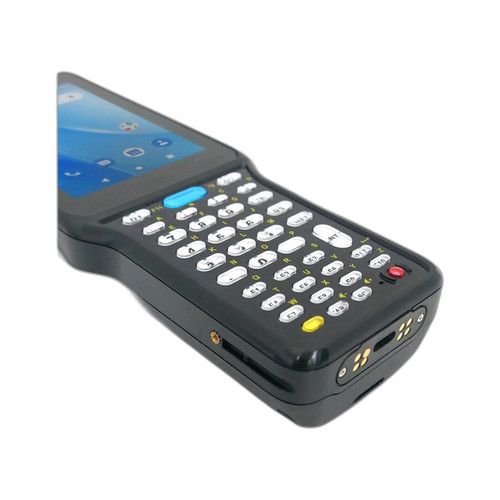
The HT730-LJ6142BG connects independently to the network via Wi-Fi (2×2 MU-MIMO) and also supports 4G dual-SIM and Bluetooth, giving it standalone connectivity without needing a paired host device. Its 2D imaging engine captures QR Code, Data Matrix, PDF417, Dot Code, Code 128, Code 39, UPC, EAN, and linear 1D codes at 60 fps with a 30-degree tilt-down scan pattern — a meaningful throughput advantage in high-volume pick-pack environments.
The HT330-QA62TM3G-Z3 connects via Bluetooth 5.0 and also lists 2.4GHz + 5GHz and GPS in its wireless spec, but operates as a paired peripheral rather than a standalone networked device. Its scan engine type is not specified in the provided specs — no imager type, symbology list, or scan rate is stated. Buyers requiring confirmed 2D decode capability should verify engine specs directly with Unitech before selecting the HT330.
Which model delivers longer shift coverage and better battery flexibility?
The HT730-LJ6142BG carries a 6,700 mAh removable Li-ion battery rated for 20–26 hours of continuous operation. The larger capacity directly supports extended shifts or environments where swap stations are limited, and the removable design allows hot-swap without device downtime.
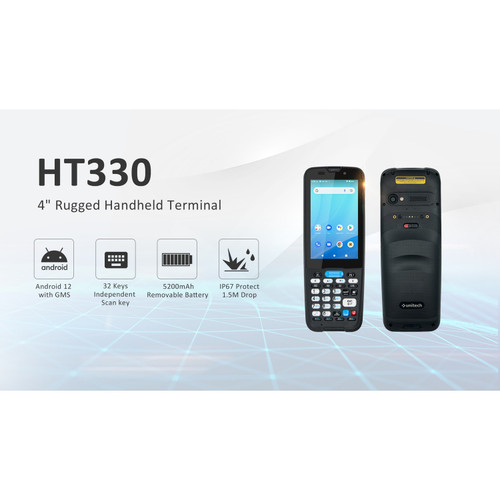
The HT330-QA62TM3G-Z3 uses a 5,200 mAh removable Li-ion battery rated for 20 hours of operation — a 1,500 mAh deficit versus the HT730. Both units claim shift-long runtime, but the HT730's higher capacity provides a buffer under heavier processing loads or colder ambient conditions that accelerate discharge. Neither spec sheet discloses charging time.
Which unit is better hardened for harsh environments, and which platform is more current?
The HT730-LJ6142BG is rated for 1.8m drops to concrete, extending to 2.4m with an optional bumper. Its construction is described as sealed industrial. No IP ingress-protection rating is stated in the provided specs. The HT730 runs Android 10, which is an older OS version at time of comparison.
The HT330-QA62TM3G-Z3 carries an explicit IP67 rating — confirmed dust-tight and submersion-resistant to 1 meter for 30 minutes — and a 1.5m drop rating to concrete, 300mm lower than the HT730 without a bumper. The HT330 runs Android 12, a more current OS release, and specifies 3GB RAM and 32GB internal flash storage. No equivalent memory or storage spec is provided for the HT730.
Which should you choose: the HT730-LJ6142BG or the HT330-QA62TM3G-Z3?
Our take: The HT730-LJ6142BG is the stronger choice when independent Wi-Fi connectivity, confirmed 2D imaging at 60 fps across a broad symbology set, and maximum battery capacity are the primary requirements. Its 6,700 mAh battery outpaces the HT330's 5,200 mAh by 1,500 mAh, its drop rating of 1.8m (2.4m with bumper) exceeds the HT330's 1.5m rating, and its standalone Wi-Fi plus 4G dual-SIM architecture eliminates dependency on a paired host device. Conversely, the HT330-QA62TM3G-Z3 offers an explicit IP67 ingress-protection rating absent from the HT730's spec sheet, runs the more current Android 12 OS, and discloses 3GB RAM / 32GB storage — specs the HT730 does not publish. Choose the HT730 for high-volume scanning with network independence; choose the HT330 where liquid or dust exposure is a confirmed hazard and Bluetooth pairing to an existing host is acceptable.
Side-by-Side Comparison
Spec-for-spec, from manufacturer data.
| Specification | Unitech HT730-LJ6142BG | Unitech HT330-QA62TM3G-Z3 |
|---|---|---|
| Product Type | Wearable 2D Scanner | Wearable Bluetooth Scanner |
| Primary Wireless | Wi-Fi 2×2 MU-MIMO | Bluetooth 5.0 |
| Additional Wireless | 4G dual-SIM; Bluetooth | 2.4GHz + 5GHz; GPS |
| Scan Engine | 2D Imager | — |
| Scan Rate | 60 fps | — |
| Symbologies (2D) | QR Code; Data Matrix; PDF417; Dot Code | — |
| Symbologies (1D) | Code 128; Code 39; UPC; EAN | — |
| Battery Capacity | 6,700 mAh removable | 5,200 mAh Li-ion removable |
| Battery Runtime | 20–26 hours continuous | 20 hours |
| Drop Rating | 1.8m (2.4m with bumper) | 1.5m to concrete |
| IP Rating | — | IP67 |
| Operating System | Android 10 | Android 12 |
| RAM | — | 3GB |
| Storage | — | 32GB internal flash |
| Screen Size | 4 inch | 4-inch touchscreen |
| Keypad | 47-key | 32-key physical keypad |
Frequently Asked Questions
Which should you choose: the HT730-LJ6142BG or the HT330-QA62TM3G-Z3?
The HT730-LJ6142BG is the stronger choice when independent Wi-Fi connectivity, confirmed 2D imaging at 60 fps across a broad symbology set, and maximum battery capacity are the primary requirements. Its 6,700 mAh battery outpaces the HT330's 5,200 mAh by 1,500 mAh, its drop rating of 1.8m (2.4m with bumper) exceeds the HT330's 1.5m rating, and its standalone Wi-Fi plus 4G dual-SIM architecture eliminates dependency on a paired host device. Conversely, the HT330-QA62TM3G-Z3 offers an explicit IP67 ingress-protection rating absent from the HT730's spec sheet, runs the more current Android 12 OS, and discloses 3GB RAM / 32GB storage — specs the HT730 does not publish. Choose the HT730 for high-volume scanning with network independence; choose the HT330 where liquid or dust exposure is a confirmed hazard and Bluetooth pairing to an existing host is acceptable.
Is the HT730-LJ6142BG or HT330-QA62TM3G-Z3 better for outdoor or wet warehouse environments?
Based on the provided specs, the HT330-QA62TM3G-Z3 has an explicit IP67 rating confirming dust-tight and submersion-resistant sealing. The HT730-LJ6142BG lists sealed industrial construction but no IP rating is stated in its specs. For confirmed liquid or heavy-dust exposure, the HT330's IP67 rating provides a verifiable standard the HT730's specs do not currently match.
Which scanner is better for a warehouse running its own Wi-Fi infrastructure?
The HT730-LJ6142BG is the purpose-built fit: it connects directly to Wi-Fi (2×2 MU-MIMO) and additionally supports 4G dual-SIM, operating as a fully independent networked device. The HT330-QA62TM3G-Z3 pairs via Bluetooth 5.0 to a host device and does not operate as a standalone Wi-Fi node based on the provided specs.
Does either unit confirm support for 2D barcodes like QR Code and Data Matrix?
Yes — the HT730-LJ6142BG explicitly lists a 2D imaging engine decoding QR Code, Data Matrix, PDF417, Dot Code, Code 128, Code 39, UPC, and EAN at 60 fps. The HT330-QA62TM3G-Z3's scan engine type and supported symbologies are not stated in the provided specs. Buyers requiring confirmed 2D decode on the HT330 should request a datasheet directly from Unitech.
More Mobile Computer Comparisons
- Honeywell CW45-X0N-AND10XG vs Unitech HT730-LJ6122BG
- Honeywell CW45-X0N-AND10XG vs Unitech HT730-LJ6142BG
- Honeywell CW45-X0N-AND10XG vs Unitech HT330-QA62TM3G-Z3
- Honeywell CW45-X0N-AND10XG vs Zebra TC2205-0G1250SS-US
- Honeywell CW45-X0N-AND10XG vs Honeywell CW45-X0N-AND10SG
- Honeywell CW45-X0N-AND10XG vs Honeywell CW45-X0N-BND10XG
Mobile Computer Buying Guides
Get a Second Opinion on Your Camera Choice
Share your site layout, coverage goals, and budget. Our team will validate the camera selection, flag anything we would change, and recommend products that match the use case.