
Unitech HT730-LJ6122BG vs Unitech HT330-QA62TM3G-Z3: Specification Comparison
Both the Unitech HT730-LJ6122BG and the HT330-QA62TM3G-Z3 are wearable Android-based scanning terminals designed for warehouse, logistics, and distribution-center environments where hands-free operation is a priority. The HT730 is positioned as a more capable wearable 2D scanner with cellular and Wi-Fi connectivity, while the HT330 is a Bluetooth-primary wearable terminal with IP67 sealing. This comparison examines scan capability and connectivity, ruggedness and physical build, and compute platform and storage to help integrators and IT buyers select the right unit for their deployment.
In This Guide
- Which unit offers broader scan capability and wireless connectivity options?
- How do the two units compare on drop resistance, environmental sealing, and battery endurance?
- What are the differences in operating system, compute resources, and physical interface?
- Which should you choose: the HT730-LJ6122BG or the HT330-QA62TM3G-Z3?
- Side-by-Side Specs
- FAQ
Which unit offers broader scan capability and wireless connectivity options?
The HT730-LJ6122BG is equipped with a 2D area imager reading 1D barcodes (Code 128, Code 39, UPC, EAN, and all standard linear codes), 2D symbologies (QR Code, Data Matrix, PDF417, Dot Code), and OCR text, at a scan rate of 60 fps. Its wireless stack includes 2×2 MU-MIMO Wi-Fi, Dual SIM 4G LTE, and Bluetooth — giving it both local-network and wide-area cellular connectivity without a companion device. The scan pattern uses a 30-degree tilt-down design suited to body-worn use.
The HT330-QA62TM3G-Z3 specs do not list a scan engine type, symbology set, or scan rate. Its wireless connectivity is Bluetooth 5.0 with 2.4 GHz and 5 GHz bands, and GPS is listed; however, there is no Wi-Fi access-point association or cellular capability stated in the provided specs. It pairs to a host phone or device over Bluetooth 5.0 rather than connecting independently to a network. Buyers requiring standalone network connectivity or a defined symbology set should note these gaps in the HT330's published specifications.
How do the two units compare on drop resistance, environmental sealing, and battery endurance?
The HT730-LJ6122BG carries a 1.8 m drop rating to concrete, extendable to 2.4 m with an optional bumper. No IP rating is stated in the provided specifications for this model. Its 6700 mAh removable battery is rated for 20–26 hours of continuous operation, covering extended shifts and multi-shift environments without a swap.
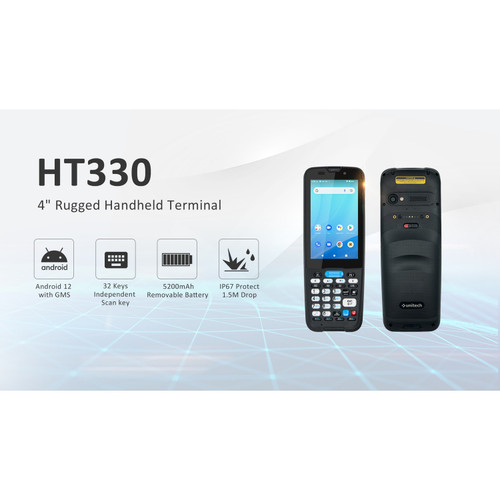
The HT330-QA62TM3G-Z3 is rated IP67 for dust and water immersion — a spec absent from the HT730's published data — and has a 1.5 m drop rating to concrete, 0.3 m lower than the HT730. Its 5200 mAh removable Li-ion battery is rated for 20 hours of operation. The IP67 rating is a meaningful differentiator for food-and-beverage, cold-storage, or outdoor yard applications where wash-down exposure is a concern, while the HT730's higher drop tolerance and larger battery favor high-intensity dry-warehouse or distribution-center use.
What are the differences in operating system, compute resources, and physical interface?
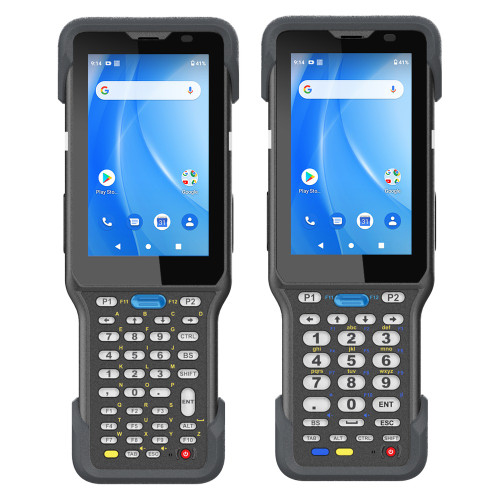
The HT730-LJ6122BG runs Android 10 and includes a 13 MP camera and a 4-inch display. It has a 29-key physical keypad. RAM, internal storage, and exact display type are not stated in the provided specifications.
The HT330-QA62TM3G-Z3 runs Android 12 — two major versions newer than the HT730's Android 10 — and provides 3 GB RAM and 32 GB internal flash storage, specs not disclosed for the HT730. It features a 4-inch touchscreen and a 32-key physical keypad, three keys more than the HT730. A camera is not mentioned in the HT330's provided specifications. Android 12 extends the security patch lifecycle and may be relevant for enterprise MDM policy compliance; buyers should verify OEM support-window commitments for both models before committing to a fleet.
Which should you choose: the HT730-LJ6122BG or the HT330-QA62TM3G-Z3?
Our take: The HT730-LJ6122BG is the stronger choice when standalone network connectivity, breadth of scan capability, and maximum battery endurance are the primary requirements. It delivers a fully specified 2D area imager reading 1D, 2D, and OCR at 60 fps — versus no scan-engine specification published for the HT330 — and supports Wi-Fi, Dual SIM 4G, and Bluetooth independently, while the HT330 relies on Bluetooth 5.0 pairing to a host device. The HT730's 6700 mAh battery (rated 20–26 hours) outpaces the HT330's 5200 mAh (rated 20 hours) and its 1.8 m drop rating (2.4 m with bumper) exceeds the HT330's 1.5 m. Conversely, the HT330-QA62TM3G-Z3 is the better fit for environments requiring IP67 environmental sealing, a more current Android 12 platform with documented 3 GB RAM and 32 GB storage, or Bluetooth-paired workflows where wash-down resistance matters more than standalone wireless.
Side-by-Side Comparison
Spec-for-spec, from manufacturer data.
| Specification | Unitech HT730-LJ6122BG | Unitech HT330-QA62TM3G-Z3 |
|---|---|---|
| Product Type | Wearable 2D Scanner | Wearable Bluetooth Scanner |
| Operating System | Android 10 | Android 12 |
| RAM | — | 3 GB |
| Internal Storage | — | 32 GB flash |
| Scan Engine | 2D Area Imager | — |
| Symbologies | 1D, 2D (QR, Data Matrix, PDF417, Dot Code), OCR | — |
| Scan Rate | 60 fps | — |
| Wireless Connectivity | Wi-Fi (2×2 MU-MIMO), Dual SIM 4G, Bluetooth | Bluetooth 5.0 (2.4 GHz + 5 GHz); GPS |
| Drop Rating | 1.8 m (2.4 m with bumper) | 1.5 m |
| IP Rating | — | IP67 |
| Battery Capacity | 6700 mAh removable | 5200 mAh Li-ion removable |
| Battery Life (rated) | 20–26 hours continuous | 20 hours |
| Display | 4-inch | 4-inch touchscreen |
| Keypad | 29-key | 32-key physical |
| Camera | 13 MP | — |
| Warranty | Manufacturer Warranty | Manufacturer Warranty |
Frequently Asked Questions
Which should you choose: the HT730-LJ6122BG or the HT330-QA62TM3G-Z3?
The HT730-LJ6122BG is the stronger choice when standalone network connectivity, breadth of scan capability, and maximum battery endurance are the primary requirements. It delivers a fully specified 2D area imager reading 1D, 2D, and OCR at 60 fps — versus no scan-engine specification published for the HT330 — and supports Wi-Fi, Dual SIM 4G, and Bluetooth independently, while the HT330 relies on Bluetooth 5.0 pairing to a host device. The HT730's 6700 mAh battery (rated 20–26 hours) outpaces the HT330's 5200 mAh (rated 20 hours) and its 1.8 m drop rating (2.4 m with bumper) exceeds the HT330's 1.5 m. Conversely, the HT330-QA62TM3G-Z3 is the better fit for environments requiring IP67 environmental sealing, a more current Android 12 platform with documented 3 GB RAM and 32 GB storage, or Bluetooth-paired workflows where wash-down resistance matters more than standalone wireless.
Is the HT730-LJ6122BG or HT330-QA62TM3G-Z3 better for cold-storage or wash-down environments?
Based on the provided specifications, the HT330-QA62TM3G-Z3 is the documented choice for those environments: it carries an IP67 rating for dust-tight and temporary water-immersion protection. The HT730-LJ6122BG has no IP rating stated in its published specs, so its suitability for wash-down cannot be confirmed from the available data.
Which unit can connect directly to a Wi-Fi network without needing a paired phone or host device?
The HT730-LJ6122BG supports 2×2 MU-MIMO Wi-Fi and Dual SIM 4G LTE as standalone radios, so it connects independently to infrastructure. The HT330-QA62TM3G-Z3's published specs list Bluetooth 5.0 as its primary wireless link and describe it as pairing to a host device; no Wi-Fi access-point connectivity is stated for the HT330 in the provided specifications.
Does the HT730-LJ6122BG or HT330-QA62TM3G-Z3 run a newer version of Android, and does that matter for enterprise deployments?
The HT330-QA62TM3G-Z3 runs Android 12; the HT730-LJ6122BG runs Android 10. For enterprise deployments using MDM platforms with minimum OS requirements or requiring recent security patch levels, Android 12 provides a longer potential support window. Buyers should confirm OEM security-update commitments for both models directly with Unitech, as that information is not included in the provided specifications.
More Mobile Computer Comparisons
- Honeywell CW45-X0N-AND10XG vs Unitech HT730-LJ6122BG
- Honeywell CW45-X0N-AND10XG vs Unitech HT730-LJ6142BG
- Honeywell CW45-X0N-AND10XG vs Unitech HT330-QA62TM3G-Z3
- Honeywell CW45-X0N-AND10XG vs Zebra TC2205-0G1250SS-US
- Honeywell CW45-X0N-AND10XG vs Honeywell CW45-X0N-AND10SG
- Honeywell CW45-X0N-AND10XG vs Honeywell CW45-X0N-BND10XG
Mobile Computer Buying Guides
Get a Second Opinion on Your Camera Choice
Share your site layout, coverage goals, and budget. Our team will validate the camera selection, flag anything we would change, and recommend products that match the use case.