
Ubiquiti USW-MISSION-CRITICAL vs TP-Link SF1009P: Specification Comparison
Both the Ubiquiti USW-MISSION-CRITICAL and the TP-Link TL-SF1009P are 9-port PoE switches intended to power IP cameras, access-control readers, and wireless APs without external injectors. Despite sharing a port count and operating-temperature range, they diverge sharply on management tier, switching speed, PoE standard, form factor, and total power budget—differences that determine where each unit belongs in a real installation. This comparison evaluates the two across port throughput and PoE delivery, physical deployment and power environment, and management and standards compliance.

In This Guide
- Which switch delivers more bandwidth and PoE headroom for powered devices?
- How do the two switches differ in physical deployment, power input, and operating environment?
- What management capabilities and compliance certifications does each switch offer?
- Which should you choose: the USW-MISSION-CRITICAL or the SF1009P?
- Side-by-Side Specs
- FAQ
Which switch delivers more bandwidth and PoE headroom for powered devices?
The USW-MISSION-CRITICAL operates at Gigabit Ethernet (1 Gbps per port) with a non-blocking switching capacity of 18 Gbps, a forwarding rate of 13 Mpps, and 9 Gbps of non-blocking throughput. Its PoE implementation is PoE++ (802.3bt) with a total budget of 120W across its PoE ports, and four ports are specified as PoE+ (802.3af/at). This budget can sustain multiple high-draw devices—PTZ cameras, multi-radio APs, or door controllers with locks—simultaneously.
The TL-SF1009P is a Fast Ethernet switch, topping out at 10/100 Mbps per port. No switching capacity, forwarding rate, or non-blocking throughput figure is provided in its specifications. Its PoE standard is PoE+ (802.3at), delivering up to 30W per port across 8 of its 9 ports. A total PoE budget figure is not specified in the provided data. The 100 Mbps ceiling is a practical ceiling for any device that needs to stream 4K or multi-stream HD video over a single link.
How do the two switches differ in physical deployment, power input, and operating environment?
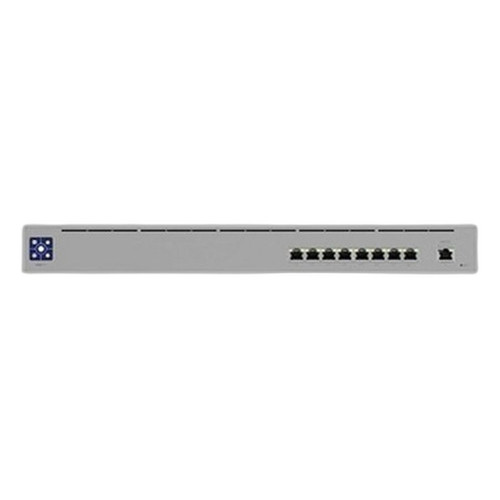
The USW-MISSION-CRITICAL is a 1U rack-mount unit (442 × 480 × 44 mm) constructed from SGCC steel, weighing 9 kg (19.9 lb) without its mount. It accepts universal AC input (100–240V, 50/60 Hz) through an internal 240W AC/DC power supply and consumes 50W excluding PoE output. The rack-mount steel enclosure is appropriate for IDF closets and equipment rooms. Operating temperature is rated -5 to 40°C (23 to 104°F).
The TL-SF1009P is a desktop unit (171 × 98 × 27 mm), dramatically smaller and lighter—physical weight is not specified. It is powered by an external 11V AC power adapter included in the box; no internal power supply rating or total wattage figure is provided in the specs. Enclosure material is not specified. Operating temperature matches the Ubiquiti unit at -5 to 40°C (23 to 104°F). The desktop form factor suits small branch locations, workgroup closets, or under-desk installations where rack space is unavailable.
What management capabilities and compliance certifications does each switch offer?
The USW-MISSION-CRITICAL is a managed switch with Ethernet-based management and supports up to 1,000 VLANs. It carries NDAA compliance—a procurement requirement for federally funded or government-adjacent physical-security projects—alongside FCC, CE, IC, and Anatel certifications. Its managed feature set enables network segmentation, traffic prioritization, and integration into a UniFi controller environment (platform dependency not detailed in the provided specs, but management interface is confirmed as Ethernet).
The TL-SF1009P is explicitly unmanaged and plug-and-play. No VLAN support, no management interface, and no remote configuration capability are provided. Certifications are not listed in the available specifications. The absence of management means no port isolation, no traffic shaping, and no NDAA compliance claim. For installations requiring network segmentation between camera VLANs and corporate traffic, or for any government or education project subject to NDAA purchasing rules, the TL-SF1009P cannot fulfill those requirements.
Which should you choose: the USW-MISSION-CRITICAL or the SF1009P?
Our take: The USW-MISSION-CRITICAL is the stronger choice when the installation demands managed networking, Gigabit uplinks, or NDAA-compliant procurement. Three spec deltas define the gap: switching speed is 18 Gbps non-blocking on the Ubiquiti versus an unspecified (Fast Ethernet, 100 Mbps per port) architecture on the TP-Link; PoE standard is PoE++ (802.3bt) with a confirmed 120W budget on the Ubiquiti versus PoE+ (802.3at) with no total-budget figure published for the TP-Link; and management depth is 1,000-VLAN managed on the Ubiquiti versus zero management on the TP-Link. The TL-SF1009P is a cost-effective desktop option for small, self-contained deployments—a handful of 1080p cameras on a flat network where plug-and-play simplicity outweighs segmentation or throughput. Buyers running multi-VLAN security networks, 4K cameras, or federally funded projects should specify the USW-MISSION-CRITICAL.
Side-by-Side Comparison
Spec-for-spec, from manufacturer data.
| Specification | Ubiquiti USW-MISSION-CRITICAL | TP-Link SF1009P |
|---|---|---|
| Device Type | Managed Gigabit Switch | Unmanaged Fast Ethernet Switch |
| Form Factor | 1U Rack Mount | Desktop |
| Total Ports | 9 | 9 |
| Port Speed | 10/100/1000 Mbps (Gigabit) | 10/100 Mbps (Fast Ethernet) |
| Switching Capacity | 18 Gbps | — |
| Non-Blocking Throughput | 9 Gbps | — |
| Forwarding Rate | 13 Mpps | — |
| PoE Standard | PoE++ (802.3bt) | PoE+ (802.3at) |
| PoE Ports | 8 (4 specified PoE+/af/at) | 8 |
| Max PoE per Port | Not individually specified (802.3bt capable) | 30W |
| Total PoE Budget | 120W | — |
| VLAN Support | 1,000 VLANs | None (unmanaged) |
| Power Input | 100–240V AC, 50/60 Hz (internal PSU, 240W) | 11V AC external adapter |
| Power Consumption (excl. PoE) | 50W | — |
| Dimensions | 442 × 480 × 44 mm | 171 × 98 × 27 mm |
| NDAA Compliant | Yes | — |
| Operating Temperature | -5 to 40°C (23 to 104°F) | -5 to 40°C (23 to 104°F) |
| Certifications | FCC, CE, IC, Anatel, NDAA | — |
Frequently Asked Questions
Which should you choose: the USW-MISSION-CRITICAL or the SF1009P?
The USW-MISSION-CRITICAL is the stronger choice when the installation demands managed networking, Gigabit uplinks, or NDAA-compliant procurement. Three spec deltas define the gap: switching speed is 18 Gbps non-blocking on the Ubiquiti versus an unspecified (Fast Ethernet, 100 Mbps per port) architecture on the TP-Link; PoE standard is PoE++ (802.3bt) with a confirmed 120W budget on the Ubiquiti versus PoE+ (802.3at) with no total-budget figure published for the TP-Link; and management depth is 1,000-VLAN managed on the Ubiquiti versus zero management on the TP-Link. The TL-SF1009P is a cost-effective desktop option for small, self-contained deployments—a handful of 1080p cameras on a flat network where plug-and-play simplicity outweighs segmentation or throughput. Buyers running multi-VLAN security networks, 4K cameras, or federally funded projects should specify the USW-MISSION-CRITICAL.
Can I use either switch to power high-wattage PTZ cameras or multi-radio access points?
The USW-MISSION-CRITICAL supports PoE++ (802.3bt) with a 120W total PoE budget, making it capable of powering high-draw devices such as PTZ cameras and tri-radio APs. The TL-SF1009P supports PoE+ (802.3at) at up to 30W per port, which covers most standard IP cameras and single-radio APs, but its total PoE budget is not stated in the available specifications, and it cannot deliver the higher wattages required by 802.3bt devices.
Is the USW-MISSION-CRITICAL or TL-SF1009P better for a government or school security project with NDAA requirements?
Only the USW-MISSION-CRITICAL carries a stated NDAA-compliant designation in its specifications. The TL-SF1009P has no NDAA compliance claim in the provided data. For any project subject to NDAA Section 889 purchasing restrictions—federal, state, or locally funded—the USW-MISSION-CRITICAL is the only option of the two that meets that requirement.
Which switch is easier to install for a small office or retail site without a dedicated IT team?
The TL-SF1009P is explicitly unmanaged and plug-and-play: connect power, connect devices, and it operates with no configuration. It ships with the power adapter and an installation guide. The USW-MISSION-CRITICAL is a managed switch requiring VLAN and network configuration; it is a 1U rack-mount unit that presupposes rack infrastructure and network administration capability. For a site with no IT staff and a handful of cameras on a flat network, the TL-SF1009P requires less setup effort.
Get a Second Opinion on Your Camera Choice
Share your site layout, coverage goals, and budget. Our team will validate the camera selection, flag anything we would change, and recommend products that match the use case.