
Speco Technologies O4KT1 vs Speco Technologies O4LT2: Specification Comparison
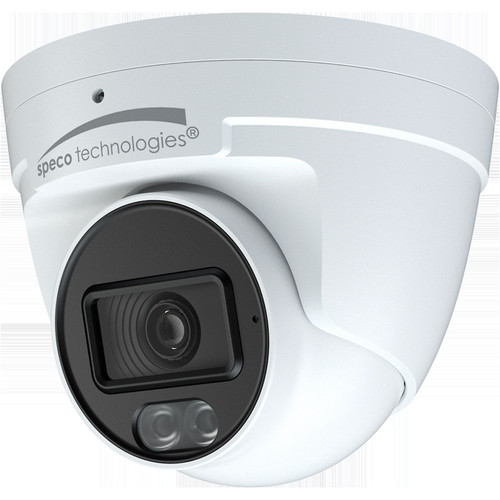
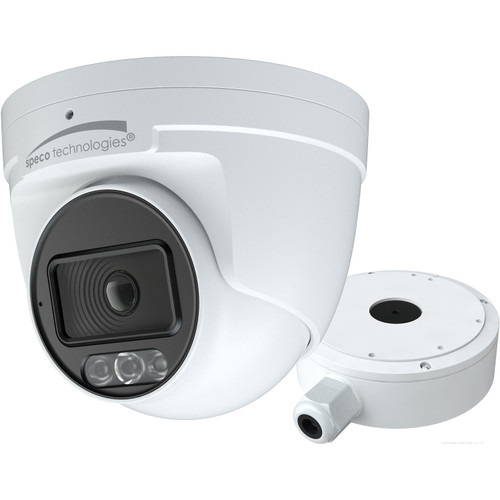
The Speco Technologies O4KT1 and O4LT2 are both 4MP IP turret cameras designed for outdoor fixed surveillance, placing them squarely in the same resolution class and form factor. Both carry IP67 ratings and run on PoE. The comparison covers imaging capability, installation requirements, and integration fit—specifically where each model diverges on sensor size, frame rate, analytics, audio, and warranty, helping integrators and IT buyers determine which unit best suits a given deployment.
In This Guide
How do the imaging specs compare?
The O4KT1 outputs 2560×1440 at a maximum of 20 fps using a 1/3" CMOS sensor, with a minimum illumination of 0.005 lux at F1.6 (AGC ON) and 0 lux with IR active. Its IR range extends to 98 ft, and it supports WDR. The O4LT2 delivers a higher native resolution of 2688×1520 at 30 fps—a 50% frame rate advantage—and uses a significantly larger 1/1.79" CMOS sensor. The larger sensor generally captures more light per pixel, though the O4LT2's minimum illumination figure is not provided in the supplied specifications. The O4LT2 uses white light intensifier technology for night vision rather than IR, which produces color night images but requires ambient or onboard white light rather than invisible IR illumination.
Both cameras share a 2.8 mm fixed lens and support WDR. The O4LT2 datasheet references approximately 110° horizontal FOV at 2.8 mm. The O4KT1 does not specify horizontal FOV in the provided specs. For installations demanding smoother motion capture—such as vehicle lanes or active pedestrian zones—the O4LT2's 30 fps is a concrete advantage. For traditional covert night coverage where invisible illumination is preferred, the O4KT1's 98 ft IR range and confirmed 0-lux IR performance are directly specified; the O4LT2 offers no IR specification.
What about installation and environment?
Both cameras carry an IP67 ingress protection rating, meaning they are dust-tight and withstand temporary water immersion—suitable for most outdoor perimeter and entrance applications. Neither specification set references an IK impact rating. The O4LT2 has a documented operating temperature range of -40°F to 140°F, which is explicitly stated. The O4KT1's operating temperature range is not provided in the supplied specifications. Installers deploying in extreme cold or heat environments should note this gap for the O4KT1.
Power input for both cameras is PoE plus 12VDC. The O4KT1 is rated for IEEE 802.3af (maximum 15.4W at the switch port) and the specification confirms it draws under 13W. The O4LT2 specifies a measured power consumption of 5.5W, making it the more power-efficient unit and compatible with lower-capacity PoE injectors and switches. The O4KT1 supports wall, ceiling, pole, and corner mounting. The O4LT2 is described as wall/soffit mountable. IK rating is absent for both models. Both cameras are white-housing units. The O4LT2 is listed at 1.0 lb; the O4KT1's weight is not specified.
Which fits your VMS and analytics better?
The O4KT1 declares ONVIF compliance (Profile not specified), RTSP, and HTTPS as VMS integration paths, and includes onboard microSD storage up to 256 GB for edge recording. It features an audio input and a built-in microphone, enabling audio event monitoring without an external audio device. Cybersecurity features specified include user ID and password, IP/MAC filtering, 802.1X, and digest authentication. The O4KT1 also lists PTZ range values (pan 0°–360°, tilt 0°–75°, rotation 0°–360°), though these likely describe physical adjustment ranges on a fixed turret, not motorized PTZ operation.
The O4LT2 is ONVIF Profile G certified, which adds on-camera recording and playback retrieval capabilities beyond basic streaming—a meaningful advantage for edge-recording VMS architectures. It includes on-camera edge analytics: motion detection, line crossing, and vehicle detection. These reduce server-side processing load and support real-time alerting without VMS analytics licenses. The O4LT2 supports two-way audio. On-board storage capacity for the O4LT2 is not stated in the provided specifications. The O4LT2 also references Wi-Fi connectivity in one specification field, though this is not confirmed in additional spec fields provided.
Which should you choose: the O4KT1 or the O4LT2?
Our take: The O4LT2 is the stronger choice when edge analytics, higher frame rates, and ONVIF Profile G compliance are deployment priorities. Concretely: the O4LT2 captures at 30 fps versus the O4KT1's 20 fps, a 50% improvement relevant for moving-vehicle or pedestrian detection accuracy; its 1/1.79" sensor is substantially larger than the O4KT1's 1/3" sensor, a hardware advantage for low-light sensitivity; and its native line-crossing and vehicle-detection analytics eliminate the need for server-side analytics licensing on compatible VMS platforms. Conversely, the O4KT1 is the stronger choice when covert IR night coverage is required—its 98 ft IR range and 0-lux IR illumination are explicitly specified, whereas the O4LT2 uses white light with no IR specification—and when onboard microSD storage up to 256 GB is needed, as the O4LT2's edge storage capacity is unspecified. The O4KT1 also carries a 5-year warranty versus the O4LT2's 3-year warranty, a lifecycle cost consideration for large deployments.
Side-by-Side Comparison
Spec-for-spec, from manufacturer data.
| Specification | Speco Technologies O4KT1 | Speco Technologies O4LT2 |
|---|---|---|
| Resolution | 2560×1440 (4MP) | 2688×1520 (4MP) |
| Max Frame Rate | 20 fps | 30 fps |
| Image Sensor | 1/3" CMOS | 1/1.79" CMOS |
| Lens / Focal Length | 2.8 mm fixed | 2.8 mm fixed (~110° H-FOV) |
| Min Illumination | 0.005 lux @ F1.6; 0 lux (IR on) | — |
| Night Vision Technology | IR | White light intensifier |
| IR Range | 98 ft | — |
| WDR | Yes | Yes |
| Video Compression | H.265, H.264 | H.265, H.264, MJPEG |
| IP Rating | IP67 | IP67 |
| Operating Temperature | — | -40°F to 140°F |
| Power Input | PoE (802.3af), 12VDC | PoE, 12VDC |
| Power Consumption | — | 5.5W |
| Edge Storage | microSD up to 256 GB | — |
| Audio | Audio input; built-in mic | Two-way audio |
| Edge Analytics | — | Motion detection, line crossing, vehicle detection |
| ONVIF | Yes | ONVIF Profile G |
| Weight | — | 1.0 lb |
| Warranty | 5 years | 3 years |
Frequently Asked Questions
Which should you choose: the O4KT1 or the O4LT2?
The O4LT2 is the stronger choice when edge analytics, higher frame rates, and ONVIF Profile G compliance are deployment priorities. Concretely: the O4LT2 captures at 30 fps versus the O4KT1's 20 fps, a 50% improvement relevant for moving-vehicle or pedestrian detection accuracy; its 1/1.79" sensor is substantially larger than the O4KT1's 1/3" sensor, a hardware advantage for low-light sensitivity; and its native line-crossing and vehicle-detection analytics eliminate the need for server-side analytics licensing on compatible VMS platforms. Conversely, the O4KT1 is the stronger choice when covert IR night coverage is required—its 98 ft IR range and 0-lux IR illumination are explicitly specified, whereas the O4LT2 uses white light with no IR specification—and when onboard microSD storage up to 256 GB is needed, as the O4LT2's edge storage capacity is unspecified. The O4KT1 also carries a 5-year warranty versus the O4LT2's 3-year warranty, a lifecycle cost consideration for large deployments.
Is the O4KT1 or O4LT2 better for low-light and night-time coverage?
The O4KT1 specifies IR night vision to 98 ft and 0 lux performance with IR active, making it the documented choice for covert, invisible-light night coverage. The O4LT2 uses white light intensifier technology, which produces color night images but requires visible light and is suited for deterrence-oriented applications. The O4LT2's minimum illumination figure is not provided in the supplied specifications, so a direct lux-to-lux comparison cannot be made.
Do both cameras support on-camera recording without a separate NVR?
The O4KT1 supports microSD cards up to 256 GB for local edge storage. The O4LT2 is ONVIF Profile G certified, which includes standardized on-camera recording and retrieval, but its specific storage capacity or card type is not stated in the provided specifications. For confirmed, quantified edge storage, the O4KT1's 256 GB microSD specification is the only one directly documented.
Which camera is better suited for perimeter intrusion detection without a VMS analytics license?
The O4LT2 includes built-in edge analytics—motion detection, line crossing, and vehicle detection—processed on the camera itself. This means real-time alerts can be generated without a VMS analytics add-on. The O4KT1 does not list any edge analytics capabilities in the provided specifications; analytics on the O4KT1 would depend on the connected VMS platform.
More IP Camera Comparisons
Get a Second Opinion on Your Camera Choice
Share your site layout, coverage goals, and budget. Our team will validate the camera selection, flag anything we would change, and recommend products that match the use case.