
Speco Technologies O4FT1M vs Speco Technologies O4LT2: Specification Comparison
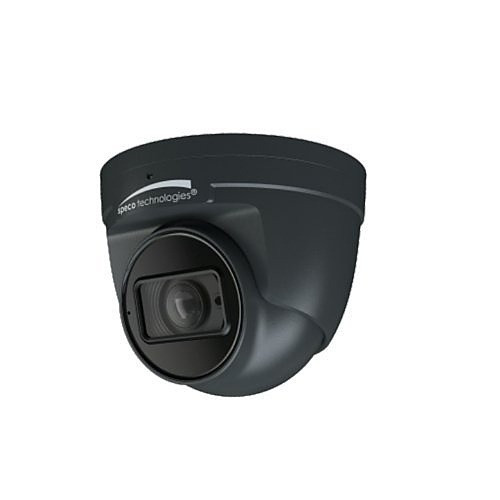
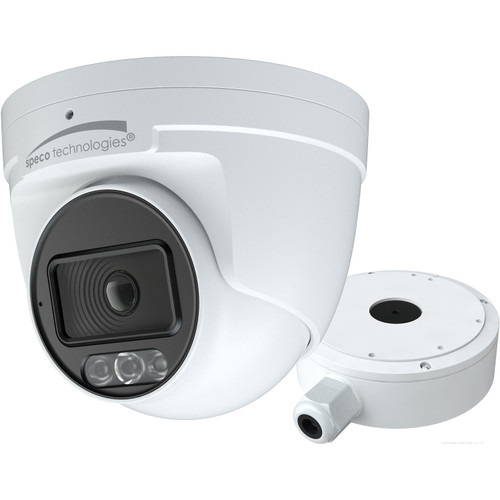
Both the Speco Technologies O4FT1M and O4LT2 are 4MP outdoor IP turret cameras sharing the same resolution class, form factor category, and environmental rating. This comparison targets installers and IT buyers evaluating which model better fits their specific deployment—whether the priority is advanced AI analytics with a motorized varifocal lens, or a lighter-weight unit with two-way audio and white-light night vision on a fixed lens. Power draw, ONVIF profile, and edge analytics depth are the primary differentiators between these two spec-adjacent cameras.
In This Guide
How do the imaging specs compare?
The O4FT1M is specified at a maximum resolution of 2576×1452 with a 1/1.8" CMOS sensor and a motorized 2.8–12mm varifocal lens, delivering adjustable field of view at commissioning or remotely without physical lens swaps. Its night-vision approach is described as a flexible intensifier with True WDR. The O4LT2 is specified at 2688×1520 with a 1/1.79" CMOS sensor and a fixed 2.8mm lens producing approximately 110° horizontal FOV; it offers WDR (not True WDR per spec) and uses white-light intensifier technology for low-light performance. The O4LT2's native pixel count is marginally higher (2688×1520 vs. 2576×1452), though both cameras are classed as 4MP and share a 30fps frame rate.
The O4FT1M supports H.265+, H.264+, and MJPEG compression—the '+' variants indicate smart-codec efficiency that can reduce bitrate compared to the base H.265/H.264 found on the O4LT2. The O4LT2 supports H.265, H.264, and MJPEG without the '+' extensions. For installations where storage or bandwidth is constrained, the O4FT1M's smart-codec compression is a meaningful advantage. Sensor size is nearly identical (1/1.8" vs. 1/1.79"), so low-light physics are comparable; the primary illumination difference is method—flexible intensifier with True WDR on the O4FT1M versus white-light intensifier with standard WDR on the O4LT2.
What about installation and environment?
Both cameras are IP67-rated for dust-tight and temporary-immersion protection, and both are rated for an identical operating temperature range of -40°F to 140°F. No IK impact rating is provided in the specs for either model. Both accept PoE and DC 12V power. The O4FT1M draws 7.0W versus 5.5W for the O4LT2—relevant for PoE switch port budgeting, particularly on dense deployments or switches with per-port power limits. The O4FT1M weighs 1.45 lbs compared to 1.0 lb for the O4LT2, a 45% weight difference that may matter on soffit or suspended ceiling mounts.
Both are white-housing turret cameras rated for outdoor use. The O4FT1M's motorized varifocal lens (2.8–12mm) requires slightly more commissioning time but eliminates the need to reposition the camera to adjust coverage angle, an advantage when the mount location is fixed and the scene geometry is uncertain at install time. The O4LT2's fixed 2.8mm lens simplifies setup but locks field of view at roughly 110° horizontal, making precise physical placement more critical.
Which fits your VMS and analytics better?
The O4FT1M is compliant with ONVIF Profile T, which includes video streaming, PTZ, metadata, and event topics—the current-generation profile designed for analytics-capable IP cameras. The O4LT2 is listed as ONVIF Profile G, which covers edge storage and recording management but is an older profile that predates analytics metadata standardization. Buyers integrating into a modern VMS with ONVIF Profile T support will get deeper metadata and event integration from the O4FT1M; Profile G is broadly interoperable but does not carry the same analytics handshake capabilities.
On edge analytics, the O4FT1M lists five engines: motion detection, line crossing, intrusion detection, face detection, and vehicle detection. The O4LT2 lists three: motion detection, line crossing, and vehicle detection—omitting intrusion detection and face detection. For perimeter or access-point applications where face detection or zone-intrusion triggers are required without a server-side VCA license, the O4FT1M is the only option of the two. Audio support also differs: the O4FT1M includes a microphone (one-way), while the O4LT2 supports two-way audio, making it preferable for intercommunication or voice-down deterrence use cases. Neither spec sheet lists onboard edge storage capability for either model.
Which should you choose: the O4FT1M or the O4LT2?
Our take: The O4FT1M is the stronger choice when analytics depth, motorized lens flexibility, and ONVIF Profile T integration are priorities. It provides two additional edge analytics engines—face detection and intrusion detection—not present on the O4LT2, uses smart-codec H.265+/H.264+ compression versus the O4LT2's standard H.265/H.264, and carries ONVIF Profile T for richer VMS metadata integration. However, it draws 7.0W versus the O4LT2's 5.5W and weighs 0.45 lbs more—factors that matter on power-limited switches or lightweight mounts. The O4LT2 is the better fit when two-way audio is required for voice-down or intercom capability, when a lighter camera body is necessary, or when ONVIF Profile G is sufficient for the target VMS. Choose the O4FT1M for analytics-driven perimeter or access-control deployments on ONVIF Profile T platforms; choose the O4LT2 where two-way audio and lower power draw are the deciding criteria.
Side-by-Side Comparison
Spec-for-spec, from manufacturer data.
| Specification | Speco Technologies O4FT1M | Speco Technologies O4LT2 |
|---|---|---|
| Resolution | 4MP (2576×1452) | 4MP (2688×1520) |
| Image Sensor | 1/1.8" CMOS | 1/1.79" CMOS |
| Lens / Focal Length | Motorized varifocal 2.8–12mm | Fixed 2.8mm (~110° H-FOV) |
| Night Vision Technology | Flexible intensifier | White-light intensifier |
| WDR | True WDR | WDR |
| Max Frame Rate | 30fps | 30fps |
| Video Compression | H.265+, H.264+, MJPEG | H.265, H.264, MJPEG |
| IP Rating | IP67 | IP67 |
| Operating Temperature | -40°F to 140°F | -40°F to 140°F |
| Power Input | PoE, DC 12V | PoE, DC 12V |
| Power Consumption | 7.0W | 5.5W |
| ONVIF Profile | Profile T | Profile G |
| Edge Analytics | Motion, Line Crossing, Intrusion, Face Detection, Vehicle | Motion, Line Crossing, Vehicle |
| Audio | Microphone (one-way) | Two-way audio |
| Weight | 1.45 lbs | 1.0 lb |
| Warranty | 3-year | 3-year |
Frequently Asked Questions
Which should you choose: the O4FT1M or the O4LT2?
The O4FT1M is the stronger choice when analytics depth, motorized lens flexibility, and ONVIF Profile T integration are priorities. It provides two additional edge analytics engines—face detection and intrusion detection—not present on the O4LT2, uses smart-codec H.265+/H.264+ compression versus the O4LT2's standard H.265/H.264, and carries ONVIF Profile T for richer VMS metadata integration. However, it draws 7.0W versus the O4LT2's 5.5W and weighs 0.45 lbs more—factors that matter on power-limited switches or lightweight mounts. The O4LT2 is the better fit when two-way audio is required for voice-down or intercom capability, when a lighter camera body is necessary, or when ONVIF Profile G is sufficient for the target VMS. Choose the O4FT1M for analytics-driven perimeter or access-control deployments on ONVIF Profile T platforms; choose the O4LT2 where two-way audio and lower power draw are the deciding criteria.
Is the O4FT1M or O4LT2 better for low-light performance?
Both cameras use intensifier-based night vision technology and share nearly identical sensor sizes (1/1.8" vs. 1/1.79" CMOS). The O4FT1M is specified with a flexible intensifier and True WDR, while the O4LT2 uses a white-light intensifier and standard WDR. Neither spec sheet provides a minimum illumination lux figure, so a direct numeric low-light comparison cannot be made from the available specifications. True WDR on the O4FT1M indicates a more capable high-dynamic-range implementation per Speco's own terminology, which may benefit high-contrast scenes.
Can I use either camera for two-way audio or intercom applications?
Only the O4LT2 supports two-way audio per the provided specifications. The O4FT1M includes a microphone for one-way audio capture only. If the deployment requires voice-down capability, guard-to-visitor communication, or any intercom function, the O4LT2 is the only viable option between the two.
Which camera works better with a modern analytics-capable VMS?
The O4FT1M carries ONVIF Profile T, the current-generation profile that standardizes video streaming, event metadata, and analytics handshake with compatible VMS platforms. The O4LT2 is listed under ONVIF Profile G, an older profile oriented toward edge recording management. For VMS platforms that leverage Profile T metadata—such as analytics events, regions of interest, or motion metadata overlays—the O4FT1M will provide deeper native integration.
More IP Camera Comparisons
Get a Second Opinion on Your Camera Choice
Share your site layout, coverage goals, and budget. Our team will validate the camera selection, flag anything we would change, and recommend products that match the use case.