
Speco Technologies N32NRE6TB vs Speco Technologies N32NRN20TB: Specification Comparison
Both the N32NRE6TB and N32NRN20TB are Speco Technologies 32-channel NVRs targeting mid-size IP camera deployments requiring 4K UHD recording with H.265 compression. They share the same channel capacity, frame rate, ONVIF compatibility, two-way audio, and PoE support, making them genuine cross-shop candidates. The primary differentiators are built-in storage capacity, declared codec support, NDAA compliance status, physical form factor, and the presence of onboard video analytics — all of which carry real operational and procurement weight.
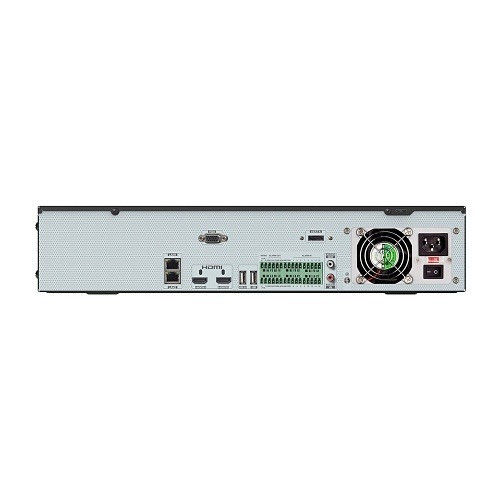
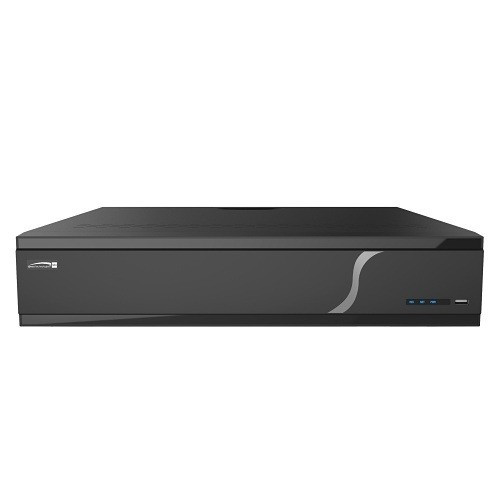
In This Guide
- How much on-board storage does each NVR provide, and what does that mean for retention?
- Which model offers built-in video analytics, and does either carry NDAA Section 889 compliance?
- How do the two units differ in physical form factor, codec support, and network integration?
- Which should you choose: the N32NRE6TB or the N32NRN20TB?
- Side-by-Side Specs
- FAQ
How much on-board storage does each NVR provide, and what does that mean for retention?
The N32NRE6TB ships with a 6TB internal hard drive. At 32 channels recording 4K H.265 footage at 20 fps, 6TB supports roughly 2–4 days of continuous retention depending on scene complexity and bit-rate settings — adequate for short-cycle overwrite loops but limiting for sites that need a full week on-box.
The N32NRN20TB ships with 20TB of built-in storage — more than 3× the N32NRE6TB's capacity. The product spec sheet explicitly projects 7–14 days of retention at standard recording rates for 32 channels. For installations where extended on-device retention is a compliance or operational requirement, the storage delta is the single largest differentiator between these two units.
Both units expose internal SATA ports (the N32NRE6TB spec lists 8 SATA ports), so either chassis can potentially be expanded with additional drives, though maximum expansion capacity is not stated in the provided specs for either model.
Which model offers built-in video analytics, and does either carry NDAA Section 889 compliance?
The N32NRE6TB specifies built-in video analytics including facial recognition, object detection, and motion analysis, as well as a People Counting function listed in its structured specs. These capabilities run on-device and eliminate the need for a separate analytics server or software license for basic intelligent search and alerting use cases.
The N32NRN20TB's provided specifications do not list any onboard video analytics features. Buyers who need facial recognition, object detection, or people counting would need to source that capability from a third-party VMS or camera-edge analytics if selecting the N32NRN20TB.
On compliance: the N32NRN20TB is explicitly stated as NDAA Section 889 compliant, which is a hard procurement requirement for U.S. federal, state, and many municipal contracts. The N32NRE6TB's provided specifications make no mention of NDAA Section 889 compliance. Buyers with government or federally-funded projects must treat this as a binary gate, not a preference.
How do the two units differ in physical form factor, codec support, and network integration?
The N32NRE6TB measures 430 mm × 453 mm × 89 mm (16.9" × 17.8" × 3.5"). The N32NRN20TB measures 15" (W) × 2.83" (H) × 13.4" (D) and is explicitly listed as rack-mount. The N32NRE6TB's mount type is not specified in the provided data, though its depth (453 mm / 17.8") exceeds standard 1U rack depth, suggesting a desktop or non-standard rack deployment.
Codec support differs slightly: the N32NRE6TB lists H.265 and H.264. The N32NRN20TB adds MJPEG to that list — relevant for legacy camera integrations that stream MJPEG rather than H.26x streams.
Both units declare ONVIF compatibility and PoE (802.3af) support. The N32NRN20TB explicitly states ONVIF Profile S & T and Gigabit Ethernet in its specs; the N32NRE6TB's network interface speed is not specified. The N32NRN20TB lists a 12VDC / 5A power supply and a gross weight of 12 lbs; equivalent power and weight data are not provided for the N32NRE6TB.
Which should you choose: the N32NRE6TB or the N32NRN20TB?
Our take: The N32NRE6TB is the stronger choice when onboard video analytics — facial recognition, object detection, people counting — are required and NDAA compliance is not a hard constraint. The N32NRN20TB is the stronger choice when storage depth, NDAA Section 889 compliance, or a clean rack-mount deployment are the deciding factors. The storage delta is concrete and large: 20TB versus 6TB means the N32NRN20TB can sustain 7–14 days of on-device 32-channel 4K retention where the N32NRE6TB will likely support only 2–4 days. The N32NRN20TB also adds MJPEG codec support for legacy camera compatibility and explicitly confirms Gigabit Ethernet and ONVIF Profile S & T. For government-adjacent or federally-funded installations, the N32NRN20TB's stated NDAA Section 889 compliance may be non-negotiable. Both carry a 3-year warranty, record 32 channels at 4K/20fps with H.265, and support two-way audio and ONVIF.
Side-by-Side Comparison
Spec-for-spec, from manufacturer data.
| Specification | Speco Technologies N32NRE6TB | Speco Technologies N32NRN20TB |
|---|---|---|
| Channel Capacity | 32 channels | 32 channels |
| Max Recording Resolution | 4K UHD (12MP per structured spec) | 4K / 8MP per channel |
| Frame Rate | 20fps | 20fps |
| Built-in Storage | 6TB | 20TB |
| Internal SATA Ports | 8 | Not specified |
| Video Compression | H.265, H.264 | H.265, H.264, MJPEG |
| Onboard Analytics | Facial recognition, object detection, motion analysis, people counting | Not specified |
| ONVIF Compatibility | Yes | ONVIF Profile S & T |
| PoE Support | PoE (802.3af) | PoE (802.3af) |
| Audio | Two-way | Two-way |
| NDAA Section 889 Compliance | Not specified | Compliant |
| Mount Type | Not specified | Rack |
| Dimensions | 430 x 453 x 89 mm (16.9" x 17.8" x 3.5") | 15" (W) x 2.83" (H) x 13.4" (D) |
| Power Supply | Not specified | 12VDC, 5A |
| Unit Weight | Not specified | 12 lbs (gross) |
| Warranty | 3-year | 3-year |
Frequently Asked Questions
Which should you choose: the N32NRE6TB or the N32NRN20TB?
The N32NRE6TB is the stronger choice when onboard video analytics — facial recognition, object detection, people counting — are required and NDAA compliance is not a hard constraint. The N32NRN20TB is the stronger choice when storage depth, NDAA Section 889 compliance, or a clean rack-mount deployment are the deciding factors. The storage delta is concrete and large: 20TB versus 6TB means the N32NRN20TB can sustain 7–14 days of on-device 32-channel 4K retention where the N32NRE6TB will likely support only 2–4 days. The N32NRN20TB also adds MJPEG codec support for legacy camera compatibility and explicitly confirms Gigabit Ethernet and ONVIF Profile S & T. For government-adjacent or federally-funded installations, the N32NRN20TB's stated NDAA Section 889 compliance may be non-negotiable. Both carry a 3-year warranty, record 32 channels at 4K/20fps with H.265, and support two-way audio and ONVIF.
Is the N32NRE6TB or N32NRN20TB better for larger or longer-retention deployments?
The N32NRN20TB is better suited to longer-retention deployments. Its 20TB of built-in storage supports an estimated 7–14 days of 32-channel 4K retention per the product spec sheet, compared to the N32NRE6TB's 6TB, which at the same channel load and resolution will deliver roughly 2–4 days before overwriting. If extended on-box retention is a site requirement, the N32NRN20TB's storage capacity is the key differentiator.
Does either NVR include built-in video analytics like facial recognition or people counting?
Yes — but only the N32NRE6TB. Its specifications list facial recognition, object detection, motion analysis, and people counting as onboard analytics features. The N32NRN20TB's provided specifications do not mention any built-in analytics. Buyers requiring intelligent search or on-device detection without a separate analytics platform or VMS add-on should factor this distinction into their selection.
Which model is compliant with NDAA Section 889 for government or public-sector projects?
The N32NRN20TB is explicitly stated as NDAA Section 889 compliant in its specifications. The N32NRE6TB's provided specifications do not reference NDAA Section 889 compliance. For any installation subject to federal, state, or municipal procurement rules that mandate NDAA-compliant equipment, the N32NRN20TB is the only confirmed-eligible option of the two based on available spec data.
Get a Second Opinion on Your Camera Choice
Share your site layout, coverage goals, and budget. Our team will validate the camera selection, flag anything we would change, and recommend products that match the use case.