
Speco Technologies APCR620L vs Speco Technologies APCR640L: Specification Comparison
Both the APCR620L and APCR640L are Speco Technologies dual-credential proximity readers designed for access control deployments. Each supports 125 kHz proximity cards alongside Bluetooth Low Energy mobile credentials, communicates via Wiegand 26-bit or OSDP, and carries an IP67 weatherproof, tamper-resistant enclosure rated for outdoor use. The comparison turns on form factor and mounting footprint, power supply specification, and the depth of interface documentation provided — all of which affect installation compatibility in commercial and light-industrial access control systems.
In This Guide
- How do the credential support and read range compare between the APCR620L and APCR640L?
- Which unit fits the available rough-in or mounting cutout at the installation site?
- Do the power requirements and environmental ratings differ in ways that affect panel wiring or outdoor suitability?
- Which should you choose: the APCR620L or the APCR640L?
- Side-by-Side Specs
- FAQ
How do the credential support and read range compare between the APCR620L and APCR640L?
Both readers support the same dual-credential stack: 125 kHz proximity cards read at up to 4 inches and Bluetooth Low Energy mobile credentials read at up to 15 feet. Neither model holds an advantage on raw read range or supported credential types — the specification is identical across both units on these axes.
The APCR620L specifies Wiegand 26-bit plus OSDP as its output protocols. The APCR640L lists Wiegand 26-bit or OSDP8. Both units also share an integrated keypad with LED feedback and audio beeper for PIN entry. Interface protocol parity means either reader can drop into an existing Wiegand or OSDP-capable panel without a credential or wiring change.
Which unit fits the available rough-in or mounting cutout at the installation site?
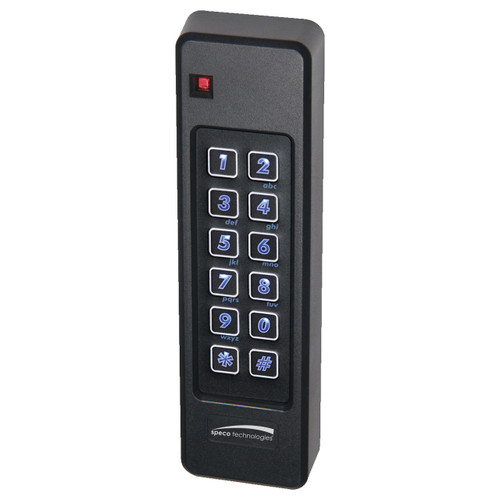
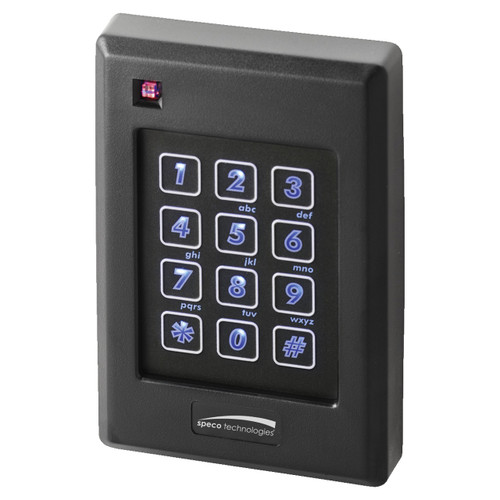
This is where the two models diverge most concretely. The APCR620L measures 1.78" W × 6.1" H × 0.91" D — a taller, narrower profile that does not correspond to a standard electrical box gang size. The APCR640L is specified as a single-gang wall mount at 3" W × 4.6" H × 0.75" D, making it a direct fit to a standard single-gang electrical box rough-in.
For retrofit or new construction where a standard single-gang box is already in place or planned, the APCR640L eliminates custom backbox work. The APCR620L's non-gang dimensions may require a proprietary or custom surface-mount backbox. Both units list Corner and Rack as mount types in the structured spec fields, though these entries appear to be catalog taxonomy artifacts rather than literal installation modes for a card reader; installers should confirm backbox requirements with Speco before ordering.
Do the power requirements and environmental ratings differ in ways that affect panel wiring or outdoor suitability?
The APCR640L carries a precise power specification: +8 to +14 VDC at 90 mA peak. This allows a system designer to size the panel power supply and wire run with confidence. The APCR620L lists only 'AC/DC' — no voltage range or current draw is provided in the available spec data. For new installations, the absence of a current draw figure on the APCR620L complicates load calculations.
Environmental ratings are equivalent: both units are rated IP67 weatherproof and tamper-resistant, and both carry the same operating temperature range of –31 °F to 150 °F (–35 °C to +66 °C). Neither model has a documented advantage in thermal or ingress protection. Both ship with a black snap-on cover as a standard color option, in addition to the listed white housing.
Which should you choose: the APCR620L or the APCR640L?
Our take: The APCR640L is the stronger choice when installation speed and panel power budgeting matter, while the APCR620L may suit sites where a non-gang footprint is already accommodated. The APCR640L's single-gang form factor (3" W × 4.6" H × 0.75" D) drops directly into a standard electrical box, whereas the APCR620L's 1.78" × 6.1" × 0.91" body requires a non-standard backbox. The APCR640L specifies +8 to +14 VDC at 90 mA peak, enabling accurate load calculations; the APCR620L provides no voltage range or current draw figure, creating ambiguity for panel design. Credential performance — 15 ft BLE, 4 in proximity, IP67, –31 °F to 150 °F, Wiegand 26-bit/OSDP — is identical on both. Specify the APCR640L for standard commercial rough-ins and any project where panel power documentation is required for inspection or warranty compliance.
Side-by-Side Comparison
Spec-for-spec, from manufacturer data.
| Specification | Speco Technologies APCR620L | Speco Technologies APCR640L |
|---|---|---|
| SKU | APCR620L | APCR640L |
| Warranty | 2 years | 2 years |
| Proximity Card Read Range | 4 inches | 4 inches |
| BLE Mobile Read Range | Up to 15 ft | Up to 15 ft |
| Credential Types | Proximity cards + BLE mobile | 125 kHz proximity + BLE mobile |
| Output Protocol | Wiegand 26-bit + OSDP | Wiegand 26-bit or OSDP8 |
| Form Factor / Mount | Non-gang: 1.78" W × 6.1" H × 0.91" D | Single-gang: 3" W × 4.6" H × 0.75" D |
| Power Supply | AC/DC (range not specified) | +8 to +14 VDC, 90 mA peak |
| Enclosure Rating | IP67 weatherproof, tamper-resistant | IP67 weatherproof, tamper-resistant |
| Operating Temp | –31 °F to 150 °F (–35 °C to +66 °C) | –31 °F to 150 °F (–35 °C to +66 °C) |
| Environment Rating | Outdoor | Outdoor (indoor covered also noted) |
| Keypad | Yes — Wiegand9 or OSDP8 output | Yes — Wiegand or OSDP8 output |
| LED Feedback | Yes | Yes |
| Audio Beeper | Yes | Yes |
| Housing Color | White (black snap-on cover included) | White (black snap-on cover included) |
| Datasheet | /content/product-datasheets/APCR620L.pdf | /content/product-datasheets/APCR640L.pdf |
Frequently Asked Questions
Which should you choose: the APCR620L or the APCR640L?
The APCR640L is the stronger choice when installation speed and panel power budgeting matter, while the APCR620L may suit sites where a non-gang footprint is already accommodated. The APCR640L's single-gang form factor (3" W × 4.6" H × 0.75" D) drops directly into a standard electrical box, whereas the APCR620L's 1.78" × 6.1" × 0.91" body requires a non-standard backbox. The APCR640L specifies +8 to +14 VDC at 90 mA peak, enabling accurate load calculations; the APCR620L provides no voltage range or current draw figure, creating ambiguity for panel design. Credential performance — 15 ft BLE, 4 in proximity, IP67, –31 °F to 150 °F, Wiegand 26-bit/OSDP — is identical on both. Specify the APCR640L for standard commercial rough-ins and any project where panel power documentation is required for inspection or warranty compliance.
Is the APCR620L or APCR640L easier to install in a standard commercial rough-in?
The APCR640L is designed as a single-gang wall mount (3" W × 4.6" H × 0.75" D) and fits a standard single-gang electrical box directly. The APCR620L measures 1.78" W × 6.1" H × 0.91" D, which does not correspond to a standard gang size and may require a custom or proprietary backbox.
Do both readers support Bluetooth mobile credentials and proximity cards?
Yes. Both the APCR620L and APCR640L support 125 kHz proximity cards at up to 4 inches and Bluetooth Low Energy mobile credentials at up to 15 feet. Credential capability, read range, and output protocols (Wiegand 26-bit and OSDP) are identical across both models based on the available specifications.
Which model provides clearer power supply specs for system design?
The APCR640L specifies +8 to +14 VDC at 90 mA peak, giving enough detail to size the power supply and calculate wire-run voltage drop. The APCR620L lists only 'AC/DC' with no voltage range or current draw figure in the available spec data, which complicates load calculations for panel design and inspection documentation.
More Access Control Reader Comparisons
- HID 5365EGP00 vs Comelit 909020116
- HID 5365EGP00 vs Speco Technologies AP500HA
- HID 5365EGP00 vs Comelit 909020113
- HID 5365EGP00 vs HID 20NKS-00-000000
- HID 5365EGP00 vs HID 40NKS-00-000000
- Comelit 909020116 vs Speco Technologies AP500HA
Access Control Reader Buying Guides
Get a Second Opinion on Your Camera Choice
Share your site layout, coverage goals, and budget. Our team will validate the camera selection, flag anything we would change, and recommend products that match the use case.