
Pelco SRXF3-12360-ES vs Pelco SRXF3-12360-I: Specification Comparison
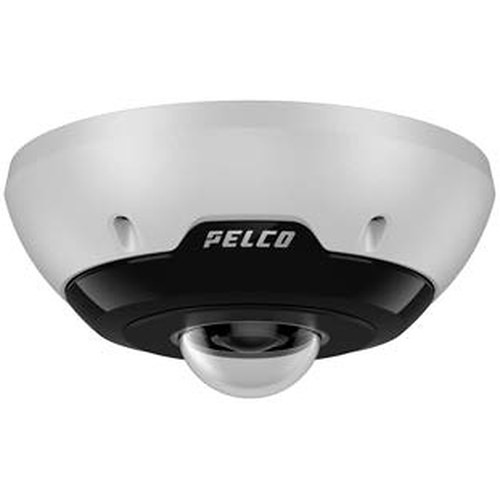
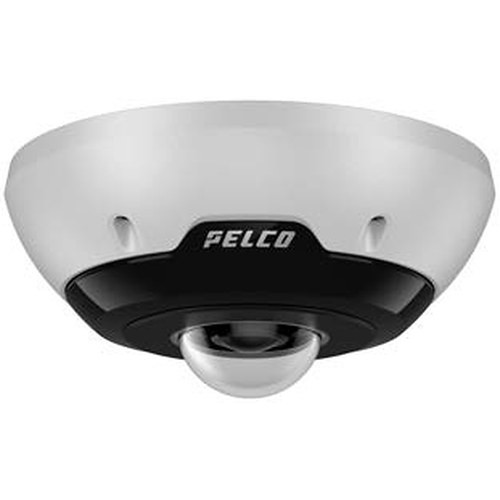
Both the Pelco SRXF3-12360-ES and SRXF3-12360-I belong to the Sarix Fisheye 3 series and share the same 12MP, 3840×2160 sensor platform, 2.7 mm f/2.5 lens, PoE+ power, and Pelco Smart Analytics engine. The comparison is therefore between the outdoor-rated (-ES) and indoor-rated (-I) variants of the same camera line — a decision driven primarily by deployment environment, ingress protection, and operating temperature range rather than imaging capability.
In This Guide
How do the imaging specs compare?
Both cameras deliver identical imaging performance on paper: 12MP resolution at 3840×2160, a 2.7 mm f/2.5 lens (with a separately listed focal length of 1.4 mm appearing in the structured spec fields for both units), a 180°/360° fisheye field of view, and a maximum frame rate of 12.5 fps at full resolution. Minimum illumination is specified as 0.10 lux for both models, and both carry WDR support (structured data indicates up to 83 dB WDR off). H.264 is listed under Video Compression in the primary spec block for both; H.265 also appears in a secondary compression field for both.
Neither model lists an active IR illuminator range — the IR Range field for the -ES reads 'None' and for the -I reads 'None (ambient light required),' consistent with a fisheye design that relies on ambient or supplemental lighting rather than built-in IR. Day/Night capability and a 0.10 lux low-light figure are stated for both, so low-light performance is spec-equivalent between the two variants.
What about installation and environment?
The most significant hardware difference is ingress protection and operating temperature. The SRXF3-12360-ES carries IP66 and IP67 ratings plus an IK10 impact rating, making it suitable for outdoor installations exposed to water jets, temporary immersion, and mechanical impact. Its operating temperature range is -40 °C to +60 °C, covering extreme cold environments. The SRXF3-12360-I is rated IP52 and IK10; IP52 provides protection against dust particles greater than 12.5 mm and dripping water at a 15° tilt — an indoor-only rating. Its operating temperature lower bound is -10 °C.
Both models share the same physical footprint (6" × 6" × 2.81"), the same PoE+ (802.3at) Class 3 power input, and the same listed mount options (wall, ceiling, pole, pendant, corner). Weight is listed identically for both at 1.001 kg (2.21 lb) with wall mount. The -ES is classified with an Outdoor environment rating; the -I carries an Indoor environment rating despite its 'Outdoor Ready: Yes' structured field — that field appears inconsistent with the IP52 rating and Indoor classification and should be verified against the manufacturer datasheet before deployment.
Which fits your VMS and analytics better?
Both cameras are spec-identical on integration: ONVIF Profile S and Profile T compliance, Pelco Smart Analytics with 8 behavior detection modes, HTTPS encryption, microSD on-board storage, and microphone support (audio input listed as 'Microphone supported' for both). The bandwidth management field references HDSM Smart Codec technology and idle scene mode for both units. Memory is listed as 4 GB RAM / 4 GB Flash for both.
There are no differentiated VMS compatibility claims between the two variants — both carry the same ONVIF profiles and the same analytics engine. Installers standardizing on Pelco VideoXpert or any ONVIF-compliant VMS will see no functional difference in integration. The choice between the two models is purely an environmental deployment decision, not an analytics or VMS-compatibility decision.
Which should you choose: the SRXF3-12360-ES or the SRXF3-12360-I?
Our take: The SRXF3-12360-ES is the stronger choice when the camera will be exposed to outdoor conditions, water ingress, or temperature extremes below -10 °C. The three concrete spec deltas that drive this: (1) IP rating — IP66/IP67 on the -ES versus IP52 on the -I, meaning the -ES withstands sustained water jets and temporary immersion while the -I tolerates only dripping water; (2) operating temperature floor — -40 °C on the -ES versus -10 °C on the -I, a 30-degree advantage for cold-climate deployments; (3) environment classification — Outdoor (-ES) versus Indoor (-I). Imaging, analytics, compression, PoE class, storage, audio, dimensions, and ONVIF compliance are spec-equivalent across both models. Specify the SRXF3-12360-I only for fully interior, climate-controlled spaces; for any application involving exterior mounting, covered parking, loading docks, or sub-freezing ambient temperatures, the -ES is the appropriate selection.
Side-by-Side Comparison
Spec-for-spec, from manufacturer data.
| Specification | Pelco SRXF3-12360-ES | Pelco SRXF3-12360-I |
|---|---|---|
| Series | Sarix Fisheye 3 | Sarix Fisheye 3 |
| Resolution | 12MP | 12MP |
| Max Resolution | 3840 × 2160 | 3840 × 2160 |
| Lens / Focal Length | 2.7 mm f/2.5 (1.4 mm listed in spec field) | 2.7 mm f/2.5 (1.4 mm listed in spec field) |
| Aperture | F2.0 | F2.0 |
| Field of View | 180° / 360° | 180° / 360° |
| Max Frame Rate | 12.5 fps @ full resolution | 12.5 fps @ full resolution |
| Min Illumination | 0.10 lux | 0.10 lux |
| IR Range | None | None (ambient light required) |
| WDR | Yes (up to 83 dB) | Yes (up to 83 dB) |
| Video Compression | H.264 / H.265 | H.264 / H.265 |
| IP Rating | IP66 / IP67 | IP52 |
| Impact Rating | IK10 | IK10 |
| Operating Temperature | -40 °C to +60 °C | -10 °C to +60 °C |
| Environment Rating | Outdoor | Indoor |
| Power Input / PoE Class | PoE+ (802.3at) / Class 3 | PoE+ (802.3at) / Class 3 |
| ONVIF Compliance | Profile S; Profile T | Profile S; Profile T |
| Analytics | Pelco Smart Analytics; 8 behaviors | Pelco Smart Analytics; 8 behaviors |
| Audio | Microphone supported | Microphone supported |
| Edge Storage | microSD | microSD |
| Dimensions | 6" × 6" × 2.81" | 6" × 6" × 2.81" |
| Weight (with wall mount) | 1.001 kg (2.21 lb) | 1.001 kg (2.21 lb) |
| Warranty | 5-year | 5-year |
Frequently Asked Questions
Which should you choose: the SRXF3-12360-ES or the SRXF3-12360-I?
The SRXF3-12360-ES is the stronger choice when the camera will be exposed to outdoor conditions, water ingress, or temperature extremes below -10 °C. The three concrete spec deltas that drive this: (1) IP rating — IP66/IP67 on the -ES versus IP52 on the -I, meaning the -ES withstands sustained water jets and temporary immersion while the -I tolerates only dripping water; (2) operating temperature floor — -40 °C on the -ES versus -10 °C on the -I, a 30-degree advantage for cold-climate deployments; (3) environment classification — Outdoor (-ES) versus Indoor (-I). Imaging, analytics, compression, PoE class, storage, audio, dimensions, and ONVIF compliance are spec-equivalent across both models. Specify the SRXF3-12360-I only for fully interior, climate-controlled spaces; for any application involving exterior mounting, covered parking, loading docks, or sub-freezing ambient temperatures, the -ES is the appropriate selection.
Is the SRXF3-12360-ES or SRXF3-12360-I better for low-light performance?
Based on the provided specifications, both models are identical in low-light performance: each lists a minimum illumination of 0.10 lux, the same WDR support (up to 83 dB), and the same Day/Night capability. Neither model includes a built-in IR illuminator — both list IR Range as 'None,' so supplemental lighting is required in true zero-lux conditions regardless of which variant is chosen.
Can the SRXF3-12360-I be used outdoors under a covered overhang?
The specifications do not recommend it. The -I carries an IP52 ingress protection rating, which covers only dripping water at up to 15° and particles larger than 12.5 mm; it is classified with an Indoor environment rating and has an operating temperature floor of -10 °C. For any exterior installation — even partially sheltered — the SRXF3-12360-ES with its IP66/IP67 rating and -40 °C lower operating temperature limit is the appropriate variant. Confirm with the manufacturer datasheet before deploying the -I in non-conditioned spaces.
Do both cameras work with the same VMS and NVR platforms?
Yes, based on the provided specifications. Both the SRXF3-12360-ES and SRXF3-12360-I carry identical integration credentials: ONVIF Profile S and Profile T compliance, Pelco Smart Analytics with 8 behavior detection modes, HTTPS encryption, and microSD edge storage. There are no differentiated VMS compatibility claims between the two variants, so any ONVIF-compliant or Pelco-native VMS that supports one model should support the other.
Get a Second Opinion on Your Camera Choice
Share your site layout, coverage goals, and budget. Our team will validate the camera selection, flag anything we would change, and recommend products that match the use case.