
Hanwha XNF-9013RV vs i-PRO S4576LMA: Specification Comparison
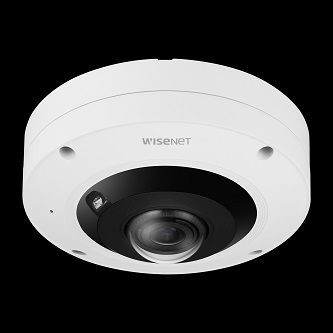
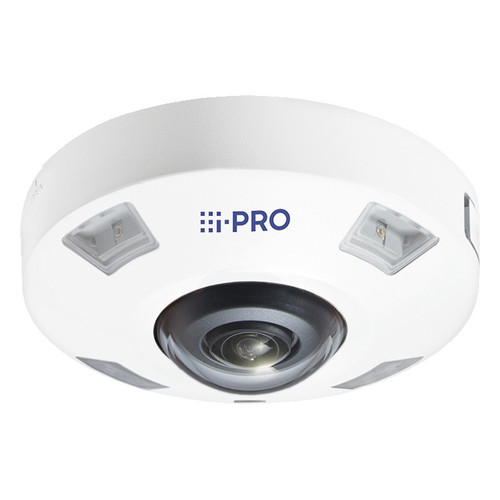
Both the Hanwha XNF-9013RV and the i-PRO WV-S4576LMA are 12MP outdoor fisheye dome cameras targeting perimeter and wide-area surveillance installations. Both deliver 360° panoramic coverage, IP66/IK10 ratings, built-in IR illumination, and ONVIF compliance — making them direct competitors in the 12MP fisheye segment. This comparison evaluates imaging performance, environmental and installation characteristics, and VMS/analytics integration based solely on published specifications for each model.
In This Guide
How do the imaging specs compare?
The XNF-9013RV uses a 1/2.3-inch 12MP CMOS sensor with a 1.08mm f/2.2 lens delivering a 187° horizontal, vertical, and diagonal field of view at 3008×3008 resolution and 30fps. Its minimum illumination is 0.39 lux in color and 0 lux with IR active. WDR is rated at 120dB via Hanwha's extremeWDR. IR range is 8m under PoE (802.3af, Class 3) and extends to 13m under PoE+ (802.3at). The WV-S4576LMA uses an approximately 1/2-inch 12MP CMOS sensor with a 1.4mm f/1.9 lens yielding a 183° horizontal and vertical field of view at 2992×2992 and 30fps. Its minimum illumination is 0.3 lux in color and 0.04 lux in black-and-white, and IR range is specified at 14m maximum. WDR is rated at a maximum of 84dB.
On low-light sensitivity, the i-PRO's 0.04 lux B&W figure provides a measurable advantage over the Hanwha's 0 lux IR-on rating, though the Hanwha reaches true 0 lux when IR is active. The Hanwha's 120dB extremeWDR substantially exceeds the i-PRO's 84dB ceiling, a meaningful gap for high-contrast scenes such as entry lobbies or parking exits. The i-PRO's wider maximum aperture (f/1.9 vs f/2.2) provides a slight passive light-gathering advantage. The Hanwha's longer 187° versus the i-PRO's 183° field of view is a minor geometric difference unlikely to affect most deployments.
What about installation and environment?
Both cameras share IP66, IK10, and NEMA 4X ratings and an operating temperature range of -40°C to +60°C, making them equally suited for harsh outdoor environments. The Hanwha XNF-9013RV accepts PoE (IEEE 802.3af, Class 3), PoE+, or 12VDC, with a maximum power draw of 12.95W; the PoE+ input unlocks the longer 13m IR range. The i-PRO WV-S4576LMA accepts DC 12V or PoE (IEEE 802.3af) and is listed as PoE Class 0; no PoE+ input is specified for this model. The Hanwha is heavier at approximately 1,170g (2.58 lb) versus the i-PRO's 880g (1.94 lb), and its footprint is slightly larger (Ø160mm vs Ø154mm). The i-PRO uniquely specifies a wind resistance rating of up to 40 m/s (~89 mph) and compliance with railway standards EN45545 and EN50155-TX, as well as an integrated anti-condensation system (Rosahl element) — none of these are documented in the Hanwha spec. The Hanwha includes a CVBS monitor output and Micro USB port for on-site installation verification; the i-PRO provides a 3.5mm VBS monitor output jack for the same purpose.
Which fits your VMS and analytics better?
Both cameras support ONVIF Profiles S, G, T, and M, providing broad VMS compatibility. The Hanwha XNF-9013RV supports SUNAPI and the Wisenet SDK natively. It offers dual microSD slots accepting up to 512GB each (1TB total edge storage), configurable audio in/out with a built-in microphone option, and up to 10 simultaneous stream profiles with 5 virtual channel support. AI analytics on the Hanwha include person, face, vehicle, and license plate detection; virtual line crossing with direction; area loitering, intrusion, enter, and exit; people counting; queue management; and heatmap — all specified as on-device capabilities. Privacy masking supports 32 polygonal zones with color or mosaic fill.
The i-PRO WV-S4576LMA runs on an Ambarella CV22 SoC and includes AI-VMD, AI people counting adapted for 360° fisheye, AI Privacy Guard for fisheye, AI scene change detection, and AI sound classification covering gunshot, yell, vehicle horn, and glass break events — the last being a differentiating capability not listed in the Hanwha spec. The i-PRO specifies 3 alarm inputs and 1 alarm output plus 1 AUX output; the Hanwha lists 2 configurable I/O ports. The i-PRO's camera title OSD is limited to 20 characters versus the Hanwha's 85. Edge storage support is listed for the i-PRO (microSD) but dual-slot capacity is not specified in the provided data.
Which should you choose: the XNF-9013RV or the S4576LMA?
Our take: The XNF-9013RV is the stronger choice when WDR performance and on-board analytics breadth are the primary decision factors; the WV-S4576LMA is the stronger choice when passive low-light sensitivity, AI sound classification, or specialized deployment environments (rail, high-wind, condensation-prone) are required. Key spec deltas: the Hanwha's 120dB extremeWDR is 36dB above the i-PRO's 84dB maximum — a substantial advantage in high-contrast lighting. The Hanwha offers 32 privacy mask zones versus the i-PRO's 8, and dual microSD slots totaling 1TB versus the i-PRO's unspecified single-slot capacity. Conversely, the i-PRO's 0.04 lux B&W minimum illumination undercuts the Hanwha's 0.39 lux color floor, and the i-PRO alone specifies AI sound classification, wind resistance to 40 m/s, and railway certifications. Installations on Wisenet VMS favor the Hanwha; deployments requiring certified rail or extreme-wind ratings require the i-PRO.
Side-by-Side Comparison
Spec-for-spec, from manufacturer data.
| Specification | Hanwha XNF-9013RV | i-PRO S4576LMA |
|---|---|---|
| Resolution | 12MP (3008×3008) | 12MP (2992×2992) |
| Image Sensor | 1/2.3" 12MP CMOS | Approx. 1/2" 12MP CMOS |
| Focal Length | 1.08mm fixed | 1.4mm fixed |
| Max Aperture | F2.2 | F1.9 |
| Field of View (H/V) | 187° / 187° | 183° / 183° |
| Min Illumination (Color) | 0.39 lux | 0.3 lux |
| Min Illumination (B&W / IR-off) | — | 0.04 lux |
| IR Range | 8m (PoE) / 13m (PoE+) | 14m max |
| Wide Dynamic Range | 120dB (extremeWDR) | 84dB max |
| Video Compression | H.265, H.264, MJPEG | H.265, H.264 |
| Max Frame Rate | 30fps | 30fps |
| Power Input / PoE Class | PoE 802.3af (Class 3), PoE+, 12VDC | PoE 802.3af (Class 0), DC 12V |
| Max Power Consumption | 12.95W | Not specified (DC 12V 1.1A stated) |
| IP Rating | IP66 | IP66, NEMA 4X (UL50) |
| IK / Impact Rating | IK10 | IK10 (50J, IEC 60068-2-75) |
| Operating Temperature | -40°C to +60°C | -40°C to +60°C |
| Edge Storage | Dual microSD, max 1TB (512GB×2) | microSD (capacity not specified) |
| Alarm I/O | 2 configurable I/O ports | 3x Alarm IN, 1x Alarm OUT, 1x AUX OUT |
| Audio | Mic in / line in / built-in mic; line out | 3.5mm mic input; 3.5mm audio output |
| AI Analytics | Person, face, vehicle, LPD, line cross, loitering, intrusion, enter/exit, people counting, queue, heatmap | AI-VMD, people counting, scene change, privacy guard, sound classification (gunshot, yell, horn, glass break) |
| ONVIF Profiles | S, G, T, M | S, G, T, M |
| Camera Title OSD | Up to 85 characters | Up to 20 characters |
| Wind Resistance | — | Up to 40 m/s (~89 mph) |
| Railway Certification | — | EN45545, EN50155-TX |
| Dimensions | Ø160 × 72mm (6.23 × 2.84") | Ø154 × 60.3mm (6-1/16 × 2-3/8") |
| Weight | 1,170g (2.58 lb) | 880g (1.94 lb) |
| Warranty | 3 years | 5 years |
Frequently Asked Questions
Which should you choose: the XNF-9013RV or the S4576LMA?
The XNF-9013RV is the stronger choice when WDR performance and on-board analytics breadth are the primary decision factors; the WV-S4576LMA is the stronger choice when passive low-light sensitivity, AI sound classification, or specialized deployment environments (rail, high-wind, condensation-prone) are required. Key spec deltas: the Hanwha's 120dB extremeWDR is 36dB above the i-PRO's 84dB maximum — a substantial advantage in high-contrast lighting. The Hanwha offers 32 privacy mask zones versus the i-PRO's 8, and dual microSD slots totaling 1TB versus the i-PRO's unspecified single-slot capacity. Conversely, the i-PRO's 0.04 lux B&W minimum illumination undercuts the Hanwha's 0.39 lux color floor, and the i-PRO alone specifies AI sound classification, wind resistance to 40 m/s, and railway certifications. Installations on Wisenet VMS favor the Hanwha; deployments requiring certified rail or extreme-wind ratings require the i-PRO.
Is the XNF-9013RV or WV-S4576LMA better for low-light performance?
It depends on the lighting scenario. The i-PRO WV-S4576LMA specifies a lower minimum illumination in black-and-white mode — 0.04 lux versus the Hanwha's 0.39 lux in color — giving it a passive low-light advantage before IR activates. However, the Hanwha XNF-9013RV reaches 0 lux when its IR illuminator is on and offers a higher WDR rating (120dB vs 84dB), making it superior in scenes with simultaneous bright and dark areas such as entryways or parking garage exits.
Can both cameras run on standard PoE switches, or do I need PoE+?
Both cameras operate on standard IEEE 802.3af PoE. The Hanwha XNF-9013RV also accepts PoE+ (802.3at) and 12VDC; using PoE+ extends its IR range from 8m to 13m. The i-PRO WV-S4576LMA is listed as PoE Class 0 and accepts DC 12V or IEEE 802.3af PoE — no PoE+ input is specified in the provided data, and its IR range of 14m is stated without a PoE/PoE+ distinction.
Which camera has more advanced built-in analytics?
Both cameras include AI-based people counting and motion detection. The Hanwha XNF-9013RV adds face detection, vehicle detection, license plate detection, virtual line crossing with direction, area loitering/intrusion/enter/exit, queue management, and heatmap analytics per its published spec. The i-PRO WV-S4576LMA adds AI sound classification (gunshot, yell, vehicle horn, glass break) and AI scene change detection, which are not listed in the Hanwha's spec sheet. The right choice depends on whether video-layer analytics breadth (Hanwha) or audio event detection (i-PRO) is more relevant to the use case.
Get a Second Opinion on Your Camera Choice
Share your site layout, coverage goals, and budget. Our team will validate the camera selection, flag anything we would change, and recommend products that match the use case.