
Hanwha QNF-9010 vs i-PRO S4576LMA: Specification Comparison
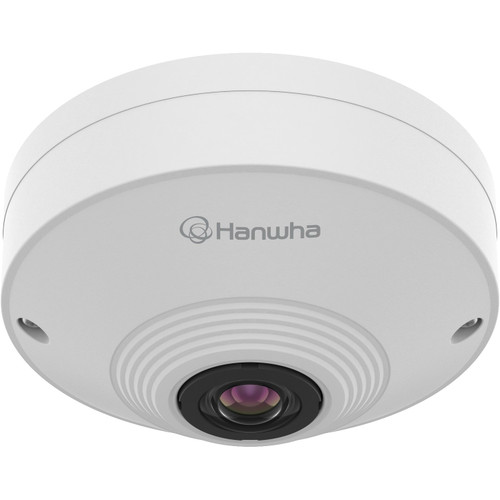
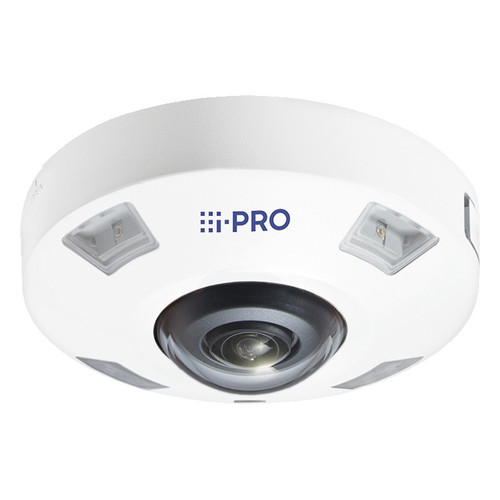
Both the Hanwha QNF-9010 and the i-PRO WV-S4576LMA are 12MP fixed fisheye dome cameras delivering 360° panoramic coverage via a single lens. They occupy the same resolution class and camera type, making them direct cross-shop candidates for installers evaluating wide-area single-sensor coverage. The key differentiators fall across deployment environment (indoor-only vs. outdoor-rated), low-light performance, dynamic range figures, AI analytics depth, and physical ruggedness—all areas where the two cameras diverge meaningfully despite sharing headline resolution.
In This Guide
How do the imaging specs compare?
Both cameras use a 12MP CMOS sensor at 30fps, but sensor size differs slightly: the QNF-9010 uses a 1/2.3" sensor while the S4576LMA uses an approximately 1/2" sensor. The QNF-9010 delivers 3008×3008 resolution with a 1.08mm F2.2 lens and a 187°×187° field of view. The S4576LMA resolves at 2992×2992 with a 1.4mm F1.9 lens and a 183°×183° field of view. The wider aperture on the i-PRO unit (F1.9 vs. F2.2) contributes to its superior low-light floor.
Low-light performance and dynamic range diverge substantially. The QNF-9010 specifies a minimum illumination of 0.39 lux (color) with no B&W figure listed and a WDR of 120dB. The S4576LMA specifies 0.3 lux (color) and 0.04 lux (B&W), and its WDR is rated at a maximum of 84dB (Super Dynamic, level 31). The QNF-9010 thus claims a higher WDR figure (120dB vs. 84dB), while the S4576LMA has the lower illumination floor—particularly in B&W mode—and adds a 14-meter IR illuminator. The QNF-9010's spec sheet lists 'Built-in IR: Yes' and an IR Distance of 0.5m, which appears to reference minimum object distance rather than an illumination range; no active IR throw distance is specified for the QNF-9010.
What about installation and environment?
The QNF-9010 is rated IP42 and is designated for indoor use only. It operates from -10°C to +40°C and is constructed of white plastic. Power is via PoE IEEE 802.3af Class 3, drawing up to 7.7W. It weighs 370g and measures Ø99×49mm. No vandal rating is specified.
The S4576LMA is rated IP66, NEMA 4X, and IK10, and is explicitly outdoor-ready. It operates across a far wider temperature range of -40°C to +60°C, incorporates an anti-condensation (Rosahl) element, and is rated for wind resistance up to 40 m/s (~89 mph). It is also EN45545 and EN50155-TX railway compliant. Power is DC 12V or PoE IEEE 802.3af. It weighs approximately 880g and measures Ø154×60.3mm. The finish is aluminum, stainless steel, and polycarbonate. The S4576LMA also carries UL 62368-1, c-UL, CE, and IEC62368-1 safety certifications; the QNF-9010's only listed certification is IP42.
Which fits your VMS and analytics better?
Both cameras support ONVIF Profile S, G, and T, ensuring broad VMS compatibility. The QNF-9010 additionally supports ONVIF Profile T and Hanwha's SUNAPI/Wisenet open platform, with declared web-viewer compatibility for Windows 7/8.1/10 and macOS 10.12–10.14. The S4576LMA adds ONVIF Profile M and mobile compatibility with iPad, iPhone, and Android terminals. The S4576LMA's SoC is specified as an Ambarella CV22; no SoC is listed for the QNF-9010.
Analytics differ in scope and AI depth. The QNF-9010 offers people counting, heatmap, defocus detection, motion detection, and tampering. The S4576LMA offers AI-VMD, AI people counting for fisheye, AI privacy guard for fisheye, AI scene change detection, and AI sound classification (gunshot, yell, vehicle horn, glass break). The S4576LMA also includes 3×alarm inputs, 1×alarm output, 1×AUX output, and 3.5mm audio in/out hardware terminals. The QNF-9010 provides no hardware alarm terminals and no audio input/output. Both support microSD edge storage; the QNF-9010 specifies up to 256GB. The QNF-9010 includes a CVBS analog output for installation alignment; the S4576LMA provides a VBS monitor output via 3.5mm jack.
Which should you choose: the QNF-9010 or the S4576LMA?
Our take: The S4576LMA is the stronger choice when the deployment is outdoors, in harsh environments, or where AI-depth analytics and hardware I/O are required. Three concrete spec deltas drive this: (1) environmental protection—IP66/NEMA 4X/IK10 vs. IP42 indoor-only, with an operating range of -40°C to +60°C vs. -10°C to +40°C; (2) low-light capability—0.04 lux B&W with a 14-meter IR illuminator vs. 0.39 lux color-only with no specified IR throw; and (3) hardware integration—3 alarm inputs, 1 alarm output, and full audio I/O vs. none on the QNF-9010. The QNF-9010 has the advantage in dynamic range (120dB WDR vs. 84dB) and is the appropriate choice for indoor ceiling deployments on Wisenet/SUNAPI-managed systems where heatmap analytics and a lower power draw (7.7W PoE Class 3) are priorities.
Side-by-Side Comparison
Spec-for-spec, from manufacturer data.
| Specification | Hanwha QNF-9010 | i-PRO S4576LMA |
|---|---|---|
| Resolution | 12MP (3008×3008) | 12MP (2992×2992) |
| Image Sensor | 1/2.3" 12MP CMOS | Approx. 1/2" 12MP CMOS |
| Lens / Focal Length | 1.08mm fixed, F2.2 | 1.4mm fixed, F1.9 |
| Field of View (H×V) | 187° × 187° | 183° × 183° |
| Min. Illumination | 0.39 lux (color) | 0.3 lux (color) / 0.04 lux (B&W) |
| IR Range | — (0.5m min object distance listed; no throw specified) | 14m max IR |
| WDR | 120dB | Max. 84dB (Super Dynamic, level 31) |
| Max Frame Rate | 30fps | 30fps |
| Video Compression | H.265, H.264, MJPEG | H.265, H.264 |
| IP Rating | IP42 | IP66, NEMA 4X |
| IK / Impact Rating | — | IK10 (50J, IEC 60068-2-75) |
| Operating Temperature | -10°C to +40°C | -40°C to +60°C |
| Power Input / PoE Class | PoE IEEE 802.3af, Class 3 (max 7.7W) | PoE IEEE 802.3af or DC 12V 1.1A |
| Audio I/O | — | 3.5mm mic input, 3.5mm audio output |
| Alarm Terminals | — | 3× Alarm IN, 1× Alarm OUT, 1× AUX OUT |
| Edge Storage | MicroSD/SDHC/SDXC up to 256GB | MicroSD (capacity not specified in provided specs) |
| ONVIF Profiles | S, G, T | S, G, T, M |
| Dimensions | Ø99 × 49mm | Ø154 × 60.3mm |
| Weight | 370g (0.82 lbs) | 880g (1.94 lbs) |
| Environment | Indoor | Outdoor / Indoor |
| Warranty | 3 years | 5 years |
Frequently Asked Questions
Which should you choose: the QNF-9010 or the S4576LMA?
The S4576LMA is the stronger choice when the deployment is outdoors, in harsh environments, or where AI-depth analytics and hardware I/O are required. Three concrete spec deltas drive this: (1) environmental protection—IP66/NEMA 4X/IK10 vs. IP42 indoor-only, with an operating range of -40°C to +60°C vs. -10°C to +40°C; (2) low-light capability—0.04 lux B&W with a 14-meter IR illuminator vs. 0.39 lux color-only with no specified IR throw; and (3) hardware integration—3 alarm inputs, 1 alarm output, and full audio I/O vs. none on the QNF-9010. The QNF-9010 has the advantage in dynamic range (120dB WDR vs. 84dB) and is the appropriate choice for indoor ceiling deployments on Wisenet/SUNAPI-managed systems where heatmap analytics and a lower power draw (7.7W PoE Class 3) are priorities.
Is the QNF-9010 or S4576LMA better for low light?
The S4576LMA has the lower illumination floor: 0.3 lux color and 0.04 lux B&W, plus a 14-meter IR illuminator. The QNF-9010 specifies 0.39 lux color only; no B&W mode or active IR throw distance is listed in its specifications. For low-light or nighttime outdoor use, the S4576LMA is the stronger performer based on available specs.
Can the S4576LMA be used outdoors while the QNF-9010 cannot?
Correct. The S4576LMA is rated IP66, NEMA 4X, and IK10, with an operating temperature range of -40°C to +60°C and wind resistance up to 40 m/s—it is explicitly outdoor-rated. The QNF-9010 is rated IP42 and is designated for indoor use only, operating from -10°C to +40°C. Installing the QNF-9010 outdoors would void its environmental rating.
Which camera offers better WDR—the QNF-9010 or the S4576LMA?
The QNF-9010 specifies 120dB WDR. The S4576LMA specifies a maximum of 84dB (Super Dynamic, level 31). On the WDR figure alone the QNF-9010 has the higher-rated dynamic range. Buyers should note that WDR measurement methodologies vary between manufacturers, so direct numeric comparison should be treated as indicative rather than definitive.
Get a Second Opinion on Your Camera Choice
Share your site layout, coverage goals, and budget. Our team will validate the camera selection, flag anything we would change, and recommend products that match the use case.