
Axis M4318-PLVE vs Hanwha XNF-9013RV: Specification Comparison
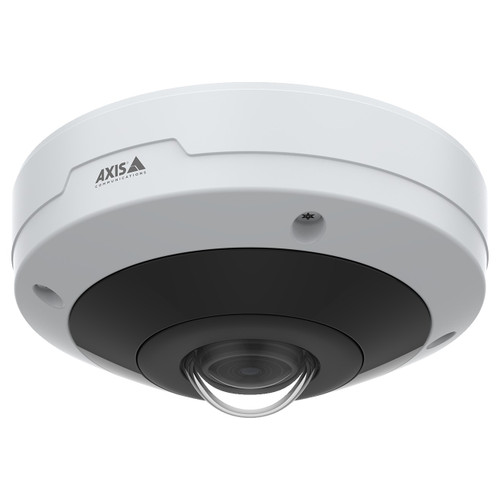
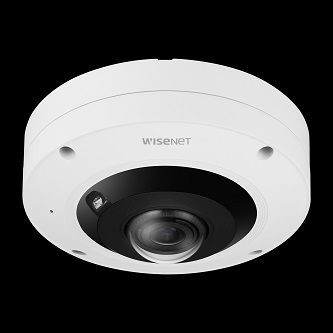
Both the Axis M4318-PLVE and the Hanwha XNF-9013RV are 12MP outdoor fisheye/panoramic dome cameras designed for wide-area coverage in a single-unit deployment. They share the same resolution class, the same sensor size, similar PoE power requirements, and comparable IP/IK environmental ratings. A buyer selecting a single-sensor 360°-class panoramic unit for perimeter, lobby, or retail coverage would reasonably cross-shop these two models.
In This Guide
How do the imaging specs compare?
Both cameras use a 1/2.3" 12MP CMOS sensor and deliver 30fps, but their native resolutions differ slightly: the Axis M4318-PLVE produces a 2992×2992 pixel image while the Hanwha XNF-9013RV outputs 3008×3008. Field of view is similarly matched—182° H×V on the Axis (1.2mm fixed stereographic lens) versus 187° H/V/D on the Hanwha (1.08mm fixed, F2.2 aperture). The Hanwha's wider FOV advantage is marginal at 5°, but its slightly longer minimum object distance of 0.5m versus a figure not stated in Axis specs is worth noting for very close-in ceiling mounts.
In low-light performance, the Axis M4318-PLVE specifies a color minimum illumination of 0.19 lux, supported by OptimizedIR (850nm) and Lightfinder technology. The Hanwha XNF-9013RV specifies 0.39 lux color with Wise IR, reaching 0 lux in IR-only mode; IR range varies by power input—8m on PoE (802.3af Class 3) and 13m on PoE+. The Axis spec sheet does not provide a discrete IR range in meters. For WDR, both claim 120dB—Axis labels it Forensic WDR and Hanwha labels it extremeWDR. The Hanwha also adds AI-based WiseNR II digital noise reduction; the Axis spec does not list an equivalent branded NR engine.
What about installation and environment?
Both cameras are rated IP66 and IK10, making them suitable for outdoor use with protection against high-pressure water jets and vandal resistance. The Hanwha XNF-9013RV additionally carries a NEMA 4X rating—confirmed in its certification listing—which the Axis M4318-PLVE spec does not claim, though the Axis does reference NEMA TS2 (2.2.7–2.2.9) and ISO 21207 compliance for traffic/vibration environments. Operating temperature ranges differ: the Axis is rated –40°C to +50°C, while the Hanwha extends to –40°C to +60°C, a 10°C advantage in hot-climate deployments.
Both cameras require PoE+ (802.3at) for full performance. The Hanwha additionally supports 12VDC input as an alternative and explicitly states a maximum power draw of 12.95W. The Axis spec does not list a discrete wattage figure in the provided data. The Hanwha specifies physical dimensions (Ø160×72mm, 1,170g / 2.58 lb) and lists accessory mount SKUs (SBP-167HMW hanging mount, SBC-160BF skin cover); the Axis spec lists mounting bracket compatibility (double-gang junction box) and mount types including pendant, corner, recessed, and rack, but does not provide a weight figure in the provided spec data.
Which fits your VMS and analytics better?
Both cameras support ONVIF Profile S/G/M, ensuring broad VMS compatibility. The Hanwha XNF-9013RV additionally lists ONVIF Profile T, SUNAPI, and Wisenet API support. The Axis M4318-PLVE supports VAPIX and an open API for software integration. For compression, Axis supports H.265, H.264, and Zipstream (its proprietary bitrate-reduction technology); Hanwha supports H.265, H.264, MJPEG, and its own WiseStream II and III smart codecs. The Hanwha supports up to 10 simultaneous streaming profiles and 5 virtual channels; Axis does not specify a profile count in the provided data.
In on-board analytics, the Hanwha XNF-9013RV includes AI-based object detection (person, face, vehicle, license plate), people counting, virtual line crossing, loitering/intrusion/enter/exit detection, queue management, and heatmap—all specified in the provided data. The Axis M4318-PLVE lists Deep Learning Processing Unit (DLPU) and Object Analytics, with multi-view dewarping (quadview, corridor, corner) outputs. For audio, the Hanwha provides a built-in microphone with selectable mic/line input, line output, and audio compression (G.711/G.726); the Axis spec references audio and I/O via portcast technology but does not specify a built-in microphone or audio output in the provided spec fields. Edge storage: the Hanwha supports dual microSD/SDHC/SDXC slots up to 1TB (512GB×2); the Axis supports a single microSD/SDHC/SDXC card with no maximum capacity stated in the provided data. RAM: Hanwha provides 4096MB RAM and 512MB Flash; Axis provides 2048MB RAM and 8192MB Flash.
Which should you choose: the M4318-PLVE or the XNF-9013RV?
Our take: The XNF-9013RV is the stronger choice when the deployment demands richer on-camera AI analytics, broader VMS protocol support, and greater environmental tolerance. Specifically: its operating temperature ceiling of 60°C beats the M4318-PLVE's 50°C by 10°C, its dual-slot edge storage reaches 1TB versus the Axis single-slot with no stated maximum, and its AI analytics engine covers person/face/vehicle/license-plate detection plus queue management and heatmap natively—compared to the Axis DLPU-based Object Analytics, which does not itemize those output classes in the provided spec data. The M4318-PLVE is the stronger choice when the installation is Axis-ecosystem-centric (VAPIX, ACAP application platform, Zipstream compression) or where the 0.19 lux color sensitivity advantage over the Hanwha's 0.39 lux matters in very dark environments. The Axis five-year warranty also exceeds the Hanwha's three-year term, a meaningful lifecycle factor in enterprise procurement.
Side-by-Side Comparison
Spec-for-spec, from manufacturer data.
| Specification | Axis M4318-PLVE | Hanwha XNF-9013RV |
|---|---|---|
| Resolution | 12MP (2992×2992) | 12MP (3008×3008) |
| Image Sensor | 1/2.3" CMOS | 1/2.3" 12MP CMOS |
| Lens / Focal Length | 1.2mm fixed stereographic | 1.08mm fixed, F2.2 |
| Horizontal Field of View | 182° | 187° |
| Min Illumination (Color) | 0.19 lux | 0.39 lux color / 0 lux IR |
| IR Range | Not stated in spec | 8m (PoE) / 13m (PoE+) |
| Wide Dynamic Range | Forensic WDR (120dB) | extremeWDR (120dB) |
| Max Frame Rate | 25/30fps | 30fps |
| Video Compression | H.265, H.264, Zipstream | H.265, H.264, MJPEG, WiseStream II/III |
| IP Rating | IP66 | IP66 |
| IK / Impact Rating | IK10 | IK10 |
| NEMA Rating | NEMA TS2 (2.2.7–2.2.9) | NEMA 4X |
| Operating Temperature | -40°C to +50°C | -40°C to +60°C |
| Power Input / PoE | PoE+ (802.3at) | PoE (802.3af Class 3), PoE+, 12VDC; max 12.95W |
| Edge Storage | Single microSD/SDHC/SDXC (max not stated) | Dual microSD/SDHC/SDXC, max 1TB (512GB×2) |
| RAM / Flash | 2048MB RAM / 8192MB Flash | 4096MB RAM / 512MB Flash |
| Audio | Via portcast (no built-in mic stated in spec) | Built-in mic; selectable mic/line in; line out |
| ONVIF Profiles | Profile S, G, M | Profile S, G, T, M |
| On-Camera Analytics | DLPU, Object Analytics | AI: person/face/vehicle/plate; people counting; heatmap; queue mgmt; loitering/intrusion |
| Weight | Not stated in spec | 1,170g (2.58 lb) |
| Warranty | 5-year | 3-year |
Frequently Asked Questions
Which should you choose: the M4318-PLVE or the XNF-9013RV?
The XNF-9013RV is the stronger choice when the deployment demands richer on-camera AI analytics, broader VMS protocol support, and greater environmental tolerance. Specifically: its operating temperature ceiling of 60°C beats the M4318-PLVE's 50°C by 10°C, its dual-slot edge storage reaches 1TB versus the Axis single-slot with no stated maximum, and its AI analytics engine covers person/face/vehicle/license-plate detection plus queue management and heatmap natively—compared to the Axis DLPU-based Object Analytics, which does not itemize those output classes in the provided spec data. The M4318-PLVE is the stronger choice when the installation is Axis-ecosystem-centric (VAPIX, ACAP application platform, Zipstream compression) or where the 0.19 lux color sensitivity advantage over the Hanwha's 0.39 lux matters in very dark environments. The Axis five-year warranty also exceeds the Hanwha's three-year term, a meaningful lifecycle factor in enterprise procurement.
Is the M4318-PLVE or XNF-9013RV better for low-light performance?
Based on the provided specs, the Axis M4318-PLVE has a lower color minimum illumination at 0.19 lux versus the Hanwha XNF-9013RV at 0.39 lux color, giving it an advantage in dimly lit environments where the IR illuminator alone is not used. However, the Hanwha reaches 0 lux in full IR mode and specifies IR range explicitly—8m on PoE, 13m on PoE+—while the Axis spec does not state an IR distance in meters. If 0-lux IR-only operation and a known IR throw distance are required, the Hanwha's spec is more explicitly defined.
Which camera supports more advanced on-camera analytics out of the box?
The Hanwha XNF-9013RV specifies a broader analytics set in the provided data: AI object detection covering person, face, vehicle, and license plate; people counting; virtual line crossing; loitering and intrusion detection; queue management; and heatmap. The Axis M4318-PLVE lists Deep Learning Processing Unit support and Object Analytics, but the specific detection classes and business intelligence outputs are not enumerated in the provided spec data. Installers requiring explicitly specified AI analytics categories with no additional licensing should favor the Hanwha based on available documentation.
Do both cameras have the same warranty, and does that affect total cost of ownership?
No. The Axis M4318-PLVE carries a five-year warranty per the provided spec, while the Hanwha XNF-9013RV carries a three-year warranty. For long-retention or critical-infrastructure deployments where replacement labor is costly, the two additional years of Axis coverage represent a concrete TCO difference that should be factored into the purchase decision alongside acquisition price.
Get a Second Opinion on Your Camera Choice
Share your site layout, coverage goals, and budget. Our team will validate the camera selection, flag anything we would change, and recommend products that match the use case.