
Hanwha XNF-9013RV vs i-PRO S4576LA: Specification Comparison
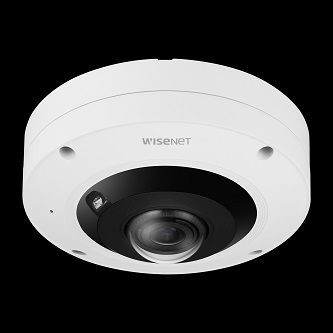
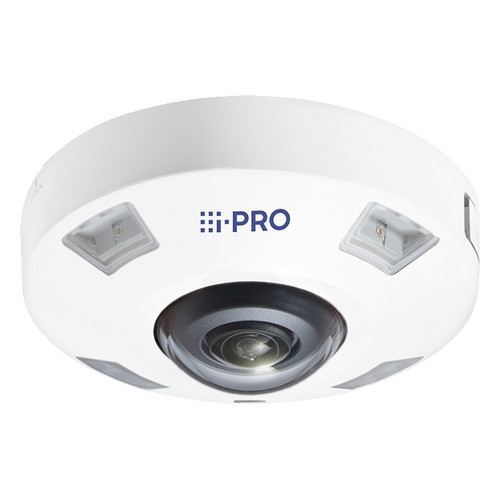
Both the Hanwha XNF-9013RV and the i-PRO WV-S4576LA are 12MP outdoor fisheye IP cameras designed for 360-degree perimeter and area surveillance. They share the same resolution class, fixed fisheye optics, IP66/IK10 ratings, and AI-assisted analytics, making them direct cross-shop candidates for integrators evaluating single-sensor panoramic coverage. This comparison is spec-driven and covers imaging performance, installation requirements, and VMS/analytics integration — the three axes most relevant to a B2B purchase decision.
In This Guide
How do the imaging specs compare?
Both cameras deliver 12MP resolution, but their sensor and optical characteristics differ in measurable ways. The XNF-9013RV uses a 1/2.3-inch CMOS sensor producing a native 3008×3008 output at up to 30fps, with a 1.08mm fixed lens and a 187°×187° angular field of view. The WV-S4576LA uses an approximately 1/2-type CMOS sensor at up to 25fps, with a 1.4mm fixed lens and a 183°×183° field of view. The Hanwha's wider AOV and shorter focal length give it a marginally broader fisheye sweep, while i-PRO's slightly longer focal length may produce marginally less geometric distortion at the edges.
In low-light performance the two cameras diverge more significantly. The XNF-9013RV specifies minimum illumination of 0.39 lux (color) and 0 lux with IR active, with Wise IR that scales to 8m on PoE (IEEE 802.3af Class 3) and extends to 13m on PoE+. The WV-S4576LA specifies 0.3 lux (color) and 0.04 lux (B&W), with a fixed IR LED range of 14m — making it somewhat more sensitive in color mode and with a longer stated IR throw. For WDR, the XNF-9013RV specifies extremeWDR at 120dB; the WV-S4576LA specifies a maximum of 84dB with WDR enabled at level 31. The Hanwha holds a clear 36dB WDR advantage for high-contrast scenes such as entrances and loading docks.
What about installation and environment?
Both cameras are rated IP66 and IK10, and both carry NEMA 4X certification, so neither has an advantage in outdoor ingress or vandal resistance. Operating temperature ranges differ: the XNF-9013RV is rated -40°C to +60°C across its full operating envelope, while the WV-S4576LA is rated -40°C to +50°C with IR on and -40°C to +60°C with IR off. In practice, installers deploying in high-ambient-temperature environments (rooftops, southern exposures) should note that the i-PRO unit's IR must be disabled above 50°C to reach the 60°C ceiling. The i-PRO additionally specifies wind resistance up to 40 m/s and railway compliance (EN50155-TX), which may be relevant for transit or infrastructure projects.
On power, the XNF-9013RV accepts PoE (IEEE 802.3af, Class 3), PoE+ (802.3at), or 12VDC, with a maximum draw of 12.95W — the PoE+ input directly enables the extended 13m IR range. The WV-S4576LA accepts DC 12V or PoE (IEEE 802.3af only) and is specified at PoE Class 0; PoE+ is not listed. Integrators using standard 802.3af switches can power either camera, but only the Hanwha can leverage PoE+ for extended IR. The XNF-9013RV ships with wall-mount compatibility and optional dedicated accessories (SBP-167HMW hanging mount, SBC-160BF skin cover). The WV-S4576LA lists wall, ceiling, and rack as mount types, and includes an anti-condensation Rosahl element — a spec absent from the Hanwha datasheet.
Which fits your VMS and analytics better?
Both cameras support ONVIF Profiles G, M, S, and T, providing broad VMS interoperability. The XNF-9013RV adds Hanwha's SUNAPI and Wisenet SDK for deeper integration with Wisenet WAVE/SSM. It supports up to 20 unicast users and up to 10 simultaneous stream profiles with 5 virtual channels. The WV-S4576LA supports up to 14 concurrent users and lists iPad/iPhone and Android mobile terminal compatibility explicitly. The i-PRO unit runs on an Ambarella CV22 SoC; the Hanwha's SoC is not specified in the provided data. The i-PRO specifies signed firmware as a security attribute; the Hanwha specifies 802.1X (EAP-TLS, EAP-LEAP), device certificates, and HTTPS/Digest authentication.
For edge analytics, the XNF-9013RV lists AI object detection (person, face, vehicle, license plate), people counting, virtual line crossing, loitering/intrusion/enter/exit, queue management, and heatmap — a broader analytics palette. The WV-S4576LA offers AI-VMD, AI people counting, AI privacy guard (fisheye-native), AI scene change detection, and AI sound classification (gunshot, yell, vehicle horn, glass break) — the audio event classification is a differentiator absent from the Hanwha spec list. Both support on-board microSD storage; the XNF-9013RV specifies dual microSD/SDHC/SDXC slots up to 1TB (512GB×2), while the WV-S4576LA lists microSD support without a stated capacity ceiling in the provided specs. Both include audio input and output.
Which should you choose: the XNF-9013RV or the S4576LA?
Our take: The XNF-9013RV is the stronger choice when high-contrast scene handling and broader AI analytics are the primary requirements, while the WV-S4576LA is preferable where audio event detection, transit/railway compliance, or deeper i-PRO VMS integration are priorities. Three concrete spec deltas: (1) WDR — Hanwha's extremeWDR at 120dB versus i-PRO's 84dB maximum is a 36dB advantage in dynamic range, directly affecting lobby, entrance, and mixed-light deployments; (2) Edge storage — the XNF-9013RV provides dual microSD slots up to 1TB versus the i-PRO's single-slot unspecified capacity, doubling redundant local retention; (3) PoE+ input — only the XNF-9013RV accepts PoE+ (802.3at), extending IR reach from 8m to 13m without a separate power run. Conversely, the WV-S4576LA's AI sound classification and EN50155 railway rating are not present in the Hanwha's provided specifications. Platform qualifier: for Wisenet WAVE/SSM ecosystems the Hanwha is the native choice; for i-PRO/Genetec deployments with audio forensics requirements, the WV-S4576LA fits more cleanly.
Side-by-Side Comparison
Spec-for-spec, from manufacturer data.
| Specification | Hanwha XNF-9013RV | i-PRO S4576LA |
|---|---|---|
| Resolution | 12MP (3008×3008) | 12MP |
| Image Sensor | 1/2.3" 12MP CMOS | Approx. 1/2-type 12MP CMOS |
| Lens / Focal Length | 1.08mm fixed fisheye | 1.4mm fixed fisheye |
| Angular Field of View (H×V) | 187° × 187° | 183° × 183° |
| Max Frame Rate | 30fps | 25fps |
| Min. Illumination (Color / B&W) | 0.39 lux / 0 lux (IR on) | 0.3 lux / 0.04 lux (IR on) |
| IR Range | 8m (PoE) / 13m (PoE+) | 14m (fixed) |
| Wide Dynamic Range | 120dB (extremeWDR) | 84dB max (WDR on, level 31) |
| Video Compression | H.265, H.264, MJPEG | H.265, H.264 |
| IP Rating | IP66 | IP66, NEMA 4X |
| IK / Impact Rating | IK10 | IK10 (50J per IEC 60068-2-75) |
| Operating Temperature | -40°C to +60°C | -40°C to +50°C (IR on); -40°C to +60°C (IR off) |
| Power Input / PoE Class | PoE 802.3af Class 3; PoE+ 802.3at; 12VDC — max 12.95W | PoE 802.3af Class 0; DC 12V 1.1A — PoE+ not specified |
| Edge Storage | Dual microSD/SDHC/SDXC, max 1TB (512GB×2) | microSD (max capacity not specified in provided data) |
| Audio | Built-in mic; mic/line input selectable; line output | Mic/line input; 3.5mm stereo output |
| AI Analytics | Object detection (person/face/vehicle/plate); people counting; line/area rules; queue; heatmap | AI-VMD; people counting; sound classification (gunshot/yell/horn/glass); privacy guard; scene change |
| ONVIF Profiles | S, G, T, M | G, M, S, T |
| Dimensions / Weight | Ø160×72mm / 1,170g (2.58 lb) | 880g (plate) / 1.3kg (bracket) — diameter not specified |
| Warranty | 3-year | 5-year |
Frequently Asked Questions
Which should you choose: the XNF-9013RV or the S4576LA?
The XNF-9013RV is the stronger choice when high-contrast scene handling and broader AI analytics are the primary requirements, while the WV-S4576LA is preferable where audio event detection, transit/railway compliance, or deeper i-PRO VMS integration are priorities. Three concrete spec deltas: (1) WDR — Hanwha's extremeWDR at 120dB versus i-PRO's 84dB maximum is a 36dB advantage in dynamic range, directly affecting lobby, entrance, and mixed-light deployments; (2) Edge storage — the XNF-9013RV provides dual microSD slots up to 1TB versus the i-PRO's single-slot unspecified capacity, doubling redundant local retention; (3) PoE+ input — only the XNF-9013RV accepts PoE+ (802.3at), extending IR reach from 8m to 13m without a separate power run. Conversely, the WV-S4576LA's AI sound classification and EN50155 railway rating are not present in the Hanwha's provided specifications. Platform qualifier: for Wisenet WAVE/SSM ecosystems the Hanwha is the native choice; for i-PRO/Genetec deployments with audio forensics requirements, the WV-S4576LA fits more cleanly.
Is the XNF-9013RV or the WV-S4576LA better for low-light performance?
It depends on the mode. The WV-S4576LA has a lower minimum color illumination (0.3 lux vs 0.39 lux) and a lower B&W floor (0.04 lux vs 0 lux with IR on for the Hanwha). However, the XNF-9013RV specifies extremeWDR at 120dB versus the i-PRO's 84dB, which is the more impactful spec in mixed or high-contrast lighting. For IR reach, the i-PRO states 14m fixed; the Hanwha reaches 13m only with PoE+ input (8m on standard PoE).
Can both cameras run on a standard 802.3af PoE switch?
Yes. Both cameras accept IEEE 802.3af PoE. However, the XNF-9013RV also accepts PoE+ (802.3at) and 12VDC; running it on PoE+ extends IR range from 8m to 13m. The WV-S4576LA is listed at PoE Class 0 and does not specify PoE+ support, so it will draw what it needs up to the 802.3af budget without requiring a PoE+ port.
Which camera has stronger AI analytics — the XNF-9013RV or the WV-S4576LA?
The two cameras offer complementary analytics rather than one being strictly stronger. The XNF-9013RV covers more object-detection classes (person, face, vehicle, license plate), plus line crossing, loitering, intrusion, enter/exit, queue management, and heatmap. The WV-S4576LA adds AI sound classification (gunshot, yell, vehicle horn, glass break) — an audio forensics capability not listed in the Hanwha's provided specs. Both include AI people counting and AI privacy guard/masking in their respective feature sets.
Get a Second Opinion on Your Camera Choice
Share your site layout, coverage goals, and budget. Our team will validate the camera selection, flag anything we would change, and recommend products that match the use case.