
Janam XT30-NTHFRMGW00 vs Zebra MC3390XR: Specification Comparison
Both the Janam XT30-NTHFRMGW00 and the Zebra MC3390XR (MC339U-GF4EG4FT) are rugged Android handheld mobile computers built around RFID and 2D barcode scanning, targeting warehouse, logistics, and inventory workflows where workers need to identify assets and read barcodes in demanding environments. Both ship with Qualcomm Snapdragon octa-core processors at 2.2 GHz, Bluetooth 5.0, 802.11ac Wi-Fi, and concrete-drop ratings at 1.5 m / 5 ft. Key divergence points are form factor philosophy, RFID capability depth, sealing, battery capacity, and OS version.
In This Guide
- Which device delivers stronger RFID range and barcode scanning capability?
- How do the two devices compare on environmental sealing, drop resilience, and battery endurance?
- Which device offers broader connectivity options and a more current software platform?
- Which should you choose: the XT30-NTHFRMGW00 or the MC3390XR?
- Side-by-Side Specs
- FAQ
Which device delivers stronger RFID range and barcode scanning capability?
The Zebra MC3390XR is purpose-built as a UHF RFID gun with a linear-polarized antenna rated at 60+ ft / 18.2+ m read range, supporting EPC Class 1 Gen2, EPC Gen2 V2, and ISO-18000-63 standards. This positions it for high-throughput, long-distance inventory sweeps — reading pallets, shelving rows, or assets across a warehouse aisle without close proximity.
The Janam XT30-NTHFRMGW00 supports RFID and NFC (NFC Forum Tag 1–5, ISO14443 Type A), but its RFID read range is not specified in the provided data. Its barcode engine is the Honeywell N6703 1D/2D imager covering Code 128, Code 39, UPC, EAN, QR Code, Data Matrix, and PDF417. The Zebra MC3390XR uses the SE4770 Standard Range Imager for barcodes. Neither datasheet specifies barcode scan range for comparison here.
For deployments where UHF RFID read range is the primary selection criterion, the Zebra MC3390XR has a documented specification (60+ ft / 18.2+ m) whereas the Janam XT30 does not. Buyers requiring NFC with ISO14443 Type A compliance will find that spec only on the Janam.
How do the two devices compare on environmental sealing, drop resilience, and battery endurance?
Both units share an identical drop rating: 1.5 m (5 ft) to concrete. Environmental sealing differs significantly. The Janam XT30-NTHFRMGW00 carries an IP67 rating, meaning it is dust-tight and withstands immersion in water up to 1 m for 30 minutes. The Zebra MC3390XR is rated IP54, which indicates protection against dust ingress (not dust-tight) and water splashing from any direction — but not submersion. For wet or dusty environments, the Janam's IP67 advantage is meaningful.
Battery capacity favors the Zebra substantially: 7,000 mAh versus the Janam's 2,900 mAh standard battery (with an optional 5,800 mAh on the Janam). The Janam specifies a hot-swappable battery, which can offset the lower baseline capacity in multi-shift operations if spare batteries are provisioned. No hot-swap specification is provided for the Zebra MC3390XR in the supplied data.
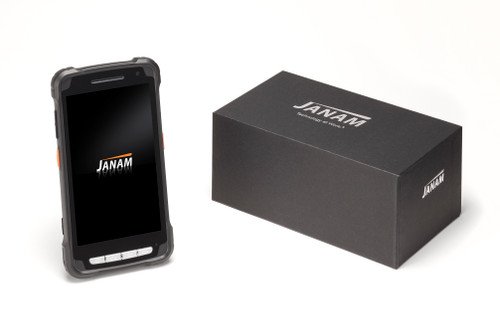
Form factor also diverges. The Zebra MC3390XR is a gun-style device (47-key alphanumeric keypad) suited to extended trigger-pull scanning sessions. The Janam XT30 is a candybar/slab handheld (9 programmable external buttons, 5-inch screen) weighing 272 g with battery. The Zebra's keypad density supports text-intensive data entry; the Janam's larger 5-inch display at 500 nits supports outdoor readability.
Which device offers broader connectivity options and a more current software platform?
The Zebra MC3390XR runs Android 10 GMS and carries FIPS and TAA compliance certifications — relevant for US federal, defense, and regulated-industry deployments where TAA-compliant hardware is mandated. The Janam XT30-NTHFRMGW00 ships with Android 9 or 11 GMS (upgradeable per spec), offering more OS flexibility at purchase. Neither device's enterprise software ecosystem (MDM compatibility, SDK availability) is detailed in the provided specifications.
Wi-Fi connectivity is broader on the Zebra: 802.11a/b/g/n/ac/d/h/i/r/k/v2/w/mc2 with 2×2 MU-MIMO, supporting advanced roaming protocols (802.11r fast BSS transition, 802.11k neighbor reports, 802.11v BSS management) that the Janam's 802.11a/b/g/n/ac spec does not enumerate. For large, multi-AP enterprise Wi-Fi environments with fast roaming requirements, the Zebra's protocol list is more complete per spec.
The Janam XT30 offers broader physical interface options: USB-C, Pogo Pin industrial connector, 3.5 mm headset jack, and an optional WWAN (GSM/LTE) module with 1 micro SIM slot plus 2 micro SAM slots — supporting cellular connectivity and smart-card/SAM security modules. The Janam also includes a 13 MP rear autofocus camera and 8 MP front camera. Camera specifications are not provided for the Zebra MC3390XR in the supplied data.
Which should you choose: the XT30-NTHFRMGW00 or the MC3390XR?
Our take: The XT30-NTHFRMGW00 is the stronger choice when IP67 sealing, cellular (WWAN/LTE) connectivity, NFC ISO14443 compliance, a larger 5-inch 500-nit display, or a hot-swappable battery architecture are required. Conversely, the MC3390XR is the stronger choice when documented long-range UHF RFID read distance (60+ ft / 18.2+ m), a high-capacity fixed 7,000 mAh battery, TAA/FIPS compliance, or advanced Wi-Fi roaming protocols (802.11r/k/v) are the priority. The Janam's IP67 outperforms the Zebra's IP54 in dust-tight and wet-immersion scenarios. The Zebra's 7,000 mAh battery is 2.4× the Janam's standard 2,900 mAh. The Zebra MC3390XR's UHF read range is explicitly specified at 60+ ft; no equivalent range figure is provided for the Janam. Buyers in US federal or regulated environments should note TAA compliance is documented only for the Zebra.
Side-by-Side Comparison
Spec-for-spec, from manufacturer data.
| Specification | Janam XT30-NTHFRMGW00 | Zebra MC3390XR |
|---|---|---|
| Operating System | Android 9 or 11 GMS (upgradeable) | Android 10 GMS |
| Processor | Qualcomm Snapdragon octa-core 2.2 GHz | Qualcomm Snapdragon 660 octa-core 2.2 GHz |
| RAM | 4 GB (3 GB optional) | 4 GB |
| Storage | 64 GB (32 GB optional) | 32 GB |
| Display | 5.0" HD 1280×720 IPS, 500 nits, Gorilla Glass | 4.0" capacitive WVGA color, Gorilla Glass |
| Barcode Engine | Honeywell N6703 1D/2D imager | Zebra SE4770 Standard Range Imager |
| RFID | RFID/NFC; NFC Forum Tag 1–5, ISO14443 Type A; range not specified | UHF RFID, linear polarized, 60+ ft / 18.2+ m; EPC Gen2 V2; ISO-18000-63 |
| Wi-Fi | 802.11a/b/g/n/ac | 802.11a/b/g/n/ac/d/h/i/r/k/v2/w/mc2; 2×2 MU-MIMO |
| Bluetooth | 5.0 BLE | 5.0 BR/EDR and BLE |
| Cellular (WWAN) | GSM/LTE optional (micro SIM) | Not specified |
| Battery | 2,900 mAh hot-swappable (5,800 mAh optional) | 7,000 mAh Li-Ion |
| Drop Rating | 1.5 m (5 ft) to concrete | 1.5 m (5 ft) to concrete |
| IP Sealing | IP67 | IP54 |
| Keypad | 9 programmable external buttons | 47-key alphanumeric |
| Camera | 13 MP rear autofocus + 8 MP front | Not specified |
| Compliance | Not specified | FIPS and TAA Compliant |
Frequently Asked Questions
Which should you choose: the XT30-NTHFRMGW00 or the MC3390XR?
The XT30-NTHFRMGW00 is the stronger choice when IP67 sealing, cellular (WWAN/LTE) connectivity, NFC ISO14443 compliance, a larger 5-inch 500-nit display, or a hot-swappable battery architecture are required. Conversely, the MC3390XR is the stronger choice when documented long-range UHF RFID read distance (60+ ft / 18.2+ m), a high-capacity fixed 7,000 mAh battery, TAA/FIPS compliance, or advanced Wi-Fi roaming protocols (802.11r/k/v) are the priority. The Janam's IP67 outperforms the Zebra's IP54 in dust-tight and wet-immersion scenarios. The Zebra's 7,000 mAh battery is 2.4× the Janam's standard 2,900 mAh. The Zebra MC3390XR's UHF read range is explicitly specified at 60+ ft; no equivalent range figure is provided for the Janam. Buyers in US federal or regulated environments should note TAA compliance is documented only for the Zebra.
Is the XT30-NTHFRMGW00 or the MC3390XR better for outdoor or wet-environment warehouse use?
Based on provided specifications, the Janam XT30-NTHFRMGW00 carries an IP67 rating (dust-tight, submersion to 1 m), while the Zebra MC3390XR is rated IP54 (limited dust protection, splash resistance only). For environments involving rain, washdowns, or heavy dust, the Janam's IP67 rating offers greater protection per spec.
Which device is better suited for long-range pallet or shelf RFID scanning?
The Zebra MC3390XR specifies a UHF RFID read range of 60+ ft / 18.2+ m with a linear-polarized antenna and EPC Gen2 V2 / ISO-18000-63 support, making it the documented choice for long-range RFID sweeps. The Janam XT30-NTHFRMGW00's RFID read range is not specified in the provided data, so a direct range comparison cannot be made from specs alone.
Do either of these devices support cellular connectivity for field use outside a Wi-Fi network?
Yes — the Janam XT30-NTHFRMGW00 supports an optional WWAN module with GSM/LTE and includes a micro SIM slot, enabling cellular data connectivity. No cellular/WWAN specification is provided for the Zebra MC3390XR in the supplied data, suggesting it is a Wi-Fi-only device per available specs.
More Mobile Computer Comparisons
- Janam XT40-ATHKRMGW00 vs Zebra MC3390XR
- Janam XT40-ATHKRMGW00 vs Zebra MC3330XR
- Janam XT40-ATHKRMGW00 vs Janam XT3-STHGBMGW01
- Janam XT40-ATHKRMGW00 vs Janam XT3-STHJBMGW00
- Janam XT3-STHGBMGW01 vs Zebra MC3390XR
- Janam XT3-STHGBMGW01 vs Zebra MC3330XR
Mobile Computer Buying Guides
Get a Second Opinion on Your Camera Choice
Share your site layout, coverage goals, and budget. Our team will validate the camera selection, flag anything we would change, and recommend products that match the use case.