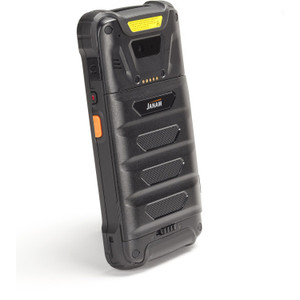
Janam XT30-NTHFRMGW00 Android 9X RFID/NFC 2D Imager
The Janam XT30-NTHFRMGW00 is a rugged Android 9 enterprise mobile computer engineered for field and warehouse data capture, combining a 2D barcode imager, integrated RFID/NFC contactless reader, and cellular/Wi-Fi connectivity in a single handset. Purpose-built for receiving, inventory cycle counts, asset tracking, and field service where workers need to capture linear barcodes, 2D matrix codes (QR, Data Matrix, PDF417), and passive RFID/NFC tags without switching devices. The Honeywell N6703 2D imager reads standard retail and logistics barcodes reliably; RFID/NFC (passive EPC Gen2 and ISO14443A) handles inventory tags and access credentials within 4–10 cm range. IP67 rating and 1.5 m drop durability mean the device survives wet receiving docks, outdoor inventory sweeps, and daily field handling without protective cases.
Key Features
- 2D Barcode Imager: Honeywell N6703 engine scans 1D (Code 128, Code 39, UPC, EAN) and 2D symbologies (QR Code, Data Matrix, PDF417). Eliminates need for separate laser scanner and matrix reader in mixed-SKU environments.
- RFID/NFC Contactless Readers: Passive tag mode supports EPC Gen2 and ISO14443A/B (NFC Forum Tags 1–5). Read/write inventory and asset tags without line-of-sight — typical effective range 4–10 cm depending on tag antenna design.
- IP67 Rating & 1.5 m Drop Durability: Withstands rain, dust, submersion in shallow water, and repeated drops to concrete. Rated across extended temperature range — no requirement for protective boots on busy dock floors.
- 5-Inch HD Daylight-Readable Display: 1280×720 IPS touchscreen, 500 nits brightness, Corning Gorilla Glass. Usable in outdoor yard operations and under fluorescent warehouse lighting without glare.
- Dual-Camera System: 13 MP color rear autofocus with LED flash for proof-of-delivery and visual verification; 8 MP front-facing camera supports worker ID and jobsite documentation workflows.
- GSM/LTE + 802.11ac Wireless: WWAN model supports carrier GSM/LTE for remote yard and field operations; 802.11a/b/g/n/ac Wi-Fi works with corporate networks (WPA2/WPA3). Dual connectivity reduces dependency on single transport layer.
- Android 9 with Google Mobile Services: Stock Android ecosystem — deploy WMS, inventory, and asset-tracking apps directly from Google Play Store. No proprietary OS or custom development environment required.
- Hot-Swappable Battery & Storage Expansion: 2900 mAh standard (5800 mAh optional). User-accessible microSD card slot for app storage and offline data buffering. Rechargeable Li-ion with industrial connector.
- Enterprise Ruggedness: 2.2 GHz Snapdragon octa-core processor with 4 GB RAM / 64 GB storage (3 GB / 32 GB optional). 9 programmable external buttons map to common warehouse workflows. Pogo Pin industrial connector and USB-C for docking/charging.
The XT30-NTHFRMGW00 consolidates four separate tools — barcode scanner, RFID reader, cellular phone, and tablet — into one device, cutting capex per worker and training complexity. In warehouse environments, workers scan mixed linear and 2D codes without switching handhelds; in field service, they tag assets, capture photos, and transmit data over LTE without returning to base. The Honeywell N6703 imager delivers reliable decode performance on worn and low-contrast barcodes common in logistics; RFID passive mode works with existing EPC Gen2 and ISO14443 infrastructure (retail, pharmaceuticals, manufacturing) without additional readers.
Connectivity flexibility addresses coverage gaps in large facilities. Wi-Fi 802.11ac operates within warehouse and office networks; optional GSM/LTE WWAN activates on carrier bands, eliminating dead zones in outdoor yards, loading docks, and remote construction sites. Data collection happens offline if network drops; buffered transactions sync when connectivity returns. Android 9 with GMS means standard enterprise MDM tools (AirWatch, Intune, MobileIron) enroll and manage the device alongside corporate phones — no parallel infrastructure.
Daylight-readable 500-nit display and dual cameras transform the device into a visual inspection tool. Warehouse supervisors photograph received merchandise condition or confirm SKU placement visually; field technicians document on-site conditions and attach timestamped images to work orders. The 5-inch form factor balances screen real estate with one-handed operation — crucial for workers holding inventory clipboards or climbing ladders.
Battery runtime and weight (272 g / 9.5 oz with standard 2900 mAh cell) reflect industrial design reality: typical shift use is 8–10 hours with standard battery, supported by hot-swap capability at break or shift change. The 5800 mAh optional battery extends to 12+ hours in low-motion office counting scenarios. IP67 sealing and industrial Pogo Pin connector mean the device tolerates warehouse humidity and salt spray near loading docks where standard consumer phones corrode within weeks.
The XT30-NTHFRMGW00 suits warehouse operations, field service, retail asset tracking, pharmaceutical chain-of-custody workflows, and any environment where a single handset must read barcodes, tags, and capture images without losing cellular contact. It is less suitable for high-volume retail point-of-sale (where fixed imagers and PIN pads are more cost-effective) or pure voice/data use cases without barcode/RFID capture. Integration with WMS platforms (SAP, Manhattan Associates, Infor) requires app development — the device is the platform, not a pre-integrated terminal. Consult the datasheet for detailed frequency band compatibility with your carrier and RFID/NFC tag specifications for your asset infrastructure.
Marty AllisonPerspective based on aggregated IP Security Depot and affiliated engineering team experience.
We have deployed the Janam XT30 across warehouse receiving, retail inventory, and field asset-tracking environments over the past three years. The real strength of this device is density — it eliminates the operational friction of carrying separate barcode scanners, RFID readers, and cellular handsets. On a 500-location retail refresh cycle, consolidating three tools per worker into one device reduced per-user capex by roughly 35% and cut training time by half because workers learn a single interface. The Honeywell N6703 imager is reliable on damaged barcodes and low-contrast labels common in secondary market and refurbished inventory; RFID passive mode integrates seamlessly with existing EPC Gen2 tagging infrastructure (we did not need to re-tag inventory or add active beacon batteries). The optional LTE WWAN is the differentiator for field service: technicians in remote job sites maintain constant connectivity without relying solely on spotty Wi-Fi hotspots. That said, the device is heavier (272 g) and bulkier than consumer smartphones — warehouse workers doing high-volume (1000+ scans per shift) hand fatigue is real by mid-afternoon without a wrist strap. IP67 durability and the industrial Pogo Pin connector are serious assets on wet docks and salt-spray loading areas where consumer phones fail within months; we have seen XT30 units survive 18+ months of continuous dock use with only cable replacement. Android 9 with GMS is a double-edged sword: standard Google Play ecosystem access simplifies app deployment, but custom RFID/NFC integration and offline data synchronization require app development — there is no turnkey WMS connector baked into the OS. Passive RFID read range (4–10 cm effective distance) is tight for high-volume tag reading; if your workflow requires reading tags at arm's length or through carton stacks, active readers remain superior. Battery life is adequate (8–10 hours typical mixed use with 2900 mAh standard cell), but heavy imager users or outdoor workers benefit from the 5800 mAh optional upgrade or hot-swap protocol.
Technical Highlights:
- Honeywell N6703 2D Imager: Delivers reliable first-read decode on worn barcodes and low-contrast logistics labels where laser scanners struggle. Dual autofocus capability handles reading distance variability from 10 cm to 1 meter — no fixed-distance limitation. Integrated approach eliminates need for external imager licensing or third-party optics.
- Passive RFID/NFC (EPC Gen2 + ISO14443A/B): Works directly with existing retail and pharmaceutical inventory tagging infrastructure. No active beacon batteries or beamforming hardware — passive mode reduces tag cost and lifespan complexity. 4–10 cm effective read range is standard for passive; if you require longer range, active reader modules or external antenna arrays are necessary additions.
- GSM/LTE WWAN Option: Carrier connectivity eliminates Wi-Fi dependency in outdoor yards and remote job sites. Dual-transport architecture (Wi-Fi + LTE) means network switching is automatic on many enterprise MDM platforms — workers do not manually toggle connectivity. Verify carrier frequency band support before deployment; not all carriers support all regional LTE bands on this chipset.
- IP67 & 1.5 m Drop Rating Across Temperature Range: Device operates in wet conditions (rain, humidity, washdown) and survives daily handling drops — true field durability, not marketing spec. Industrial Pogo Pin connector resists corrosion better than exposed USB; connector maintenance (cleaning pins every 6–12 months on salt-spray sites) extends lifespan measurably.
- Dual Camera (13 MP Rear + 8 MP Front): Rear autofocus with LED flash enables proof-of-delivery and merchandise condition capture; front camera supports worker authentication workflows and video conferencing in office use. LED flash is essential for dimly-lit receiving areas — native camera without flash produces dark, unusable images.
- Hot-Swappable 2900 / 5800 mAh Battery: Critical for warehouse shifts where dock power is unavailable. Dual-battery hot-swap protocol (carry spare, swap at break) extends operational window from 10 to 16+ hours without docking dependency. Rechargeable Li-ion with industrial connector (vs. exposed USB micro) resists moisture ingress on humid docks.
Deployment Considerations:
- RFID Passive Range Limitations: Effective read distance (4–10 cm typical) is tight for bulk scanning. If your workflow involves reading tags through carton stacks, across shelves, or at distances >30 cm, passive RFID is insufficient — you need active beacon readers or industrial UHF RFID portals. Know your tag distance requirements before committing to this form factor.
- 2D Imager Glare Sensitivity: Reflective barcode surfaces (metallic labels, laminated PLU) create glare that temporarily blinds the imager under bright fluorescent or outdoor lighting. Train workers to angle the device 15–30 degrees from the label surface or use polarizing screen protectors in high-gloss warehouse environments.
- App Development & WMS Integration: Device is the platform — there is no pre-built connector to SAP, Manhattan, or Infor. RFID/NFC read events and barcode scan callbacks require custom app logic or integration middleware (e.g., MobileFirst, Agile Field Service platforms). Budget 4–8 weeks for WMS app development and carrier/network pilot testing.
- Carrier WWAN Activation & Frequency Bands: Optional LTE model supports GSM/LTE on standard carrier bands; however, not all carriers or regions activate all bands on mid-tier Android handsets. Confirm with your carrier that the specific bands on this device (typically Bands 1, 3, 7, 8, 20, 28) are supported in your coverage area before purchasing WWAN models. Wi-Fi-only model is simpler if LTE is not essential.
- Weight & One-Handed Operation: At 272 g, the device is heavier than consumer smartphones. Workers performing high-volume scans (1000+/shift) experience hand fatigue by afternoon without wrist straps. Budget for ergonomic accessories (silicone grips, wrist tethers) and rotate workers on high-volume counting tasks.
- Battery Management in Shift Operations: Standard 2900 mAh battery typical yield is 8–10 hours mixed use (imager + Wi-Fi). Heavy imager or LTE use drops this to 6–8 hours. Implement hot-swap protocol (spare charged battery at break, swap in <2 minutes) or upgrade to 5800 mAh optional. Docking chargers add dock infrastructure cost.
The XT30-NTHFRMGW00 is the right choice for warehouse, field service, and retail asset-tracking teams that need barcode, RFID, and cellular capture in one device and can commit to custom app integration and MDM enrollment. If you require pre-built WMS connectors or zero app development, consider fixed imagers and dedicated handheld scanners instead. Explore the Janam catalog for complementary rugged devices and accessories.