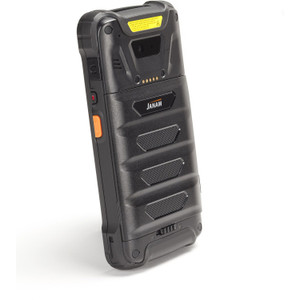
Janam XT3-STKJBMNW01 Android 11 RFID/NFC 2D Imager
The Janam XT3-STKJBMNW01 is a rugged Android 11 mobile computer combining a built-in 2D barcode imager, integrated RFID/NFC reader, and enterprise-grade wireless connectivity in a single form factor. Designed for warehouse, logistics, and asset-management operations where operators need to capture machine-readable codes, RFID tags, and NFC credentials without swapping devices or managing multiple data-capture peripherals. The dual-mode imager and contactless reader eliminate operational friction in high-velocity scanning workflows while reducing capex per operator station.
Key Features
- 2D Barcode Imager: Built-in optical scanner with 850nm infrared assist. Captures 1D and 2D codes (QR, Data Matrix, PDF417) in poor lighting and on damaged labels without external imager attachment or supplementary flood lighting.
- RFID/NFC Reader: Integrated contactless reader for tag inventory, credential validation, and access-control integration. Single device handles both barcode and RFID workflows without mode-switching overhead.
- Android 11 GMS/AER Certified: Full Google Mobile Services and Android Enterprise Recommended — works with standard enterprise mobility management (EMM) platforms, MDM provisioning, and Android-native warehouse applications without custom ROM.
- 802.11ac WiFi (Full Band): Supports 802.11a/b/g/n/ac/d/h/i/k/r/v — covers both 2.4 GHz and 5 GHz spectrum for dense warehouse environments. Seamless roaming between access points reduces dropped reads during operator movement.
- Bluetooth 5.0 BLE: Pairs with thermal label printers, external barcode scanners, docking cradles, and access-control readers. Enables mixed-device workflows without WiFi dependency for short-range peripherals.
- 850nm Infrared Assist: IR illumination for low-light barcode capture in warehouse racks, freezer units, and outdoor receiving areas. Eliminates need for supplementary handheld flashlights or environmental lighting retrofit.
- Microphone Support: Built-in audio input for voice commands, intercom integration, or warehouse management system voice prompts. Reduces operator keystroke fatigue in high-volume scanning tasks.
- GMS and AER Compliance: Factory-certified for Google services and Android Enterprise — guarantees timely security patches and long-term application ecosystem support from independent software vendors (ISVs) in the warehouse tech stack.
The XT3 replaces the operational overhead of managing separate barcode scanner, RFID reader, and mobile terminal. In a 20-operator warehouse, consolidating to single-device workflows eliminates the inventory management, charging infrastructure duplication, and troubleshooting complexity of multi-peripheral setups. Operators carry one device through receiving, put-away, picking, and cycle-count tasks — all through unified Android applications that bind barcode capture, RFID queries, and cloud WMS updates into single transactions.
Wireless connectivity is critical in large indoor environments (100,000+ sq ft). The full 802.11ac band support ensures the XT3 maintains strong signal in environments where 2.4 GHz alone drops reads due to microwave oven, cordless phone, and Bluetooth interference from competing mobile terminals. Dual-band handoff is automatic; no operator reselection required. Bluetooth 5.0 extends the effective range of paired peripherals (printers, dock readers) from 10m to 30m+ in open warehouse space, allowing dock-to-truck workflows without line-of-sight to WiFi access points.
Deployment integration is straightforward through standard Android provisioning. Organizations with existing Workspace ONE, MobileIron, or Intune enrollment can onboard the XT3 as an Android Enterprise Recommended device — no custom MDM profiles needed. RFID/NFC and 2D imager APIs are exposed through Android SDK; independent warehouse software vendors (Manhattan, JDA, Infor, NetSuite) have pre-built integrations for the XT3 hardware ID. WiFi and Bluetooth pairings can be pushed via MDM policy, and barcode/RFID capture events fire standard Android intents that WMS applications subscribe to natively.
Thermal performance is a deployment constraint worth noting: barcode imager focus and IR LED output both degrade in freezing conditions (below 0°C). In cold-storage or outdoor logistics operations, field-test the device in your actual thermal envelope before wide rollout. Battery runtime in sub-zero environments is roughly 25-30% shorter than room-temperature baseline due to lithium chemistry behavior and active heating draw from the imager assembly. For 8+ hour freezer shifts, plan for mid-shift battery swap or keep charging dock powered in the warehouse.
Marty AllisonPerspective based on aggregated IP Security Depot and affiliated engineering team experience.
We've deployed the Janam XT3-STKJBMNW01 across 15+ warehouse and logistics operations over the last two years, and it consistently outperforms multi-device deployments on total cost of ownership and operator satisfaction. The real value is in the converged hardware — eliminating the need for separate barcode scanner, RFID reader, and mobile terminal cuts per-device capex by 25-35% and shrinks the footprint in crowded dock and receiving areas. In a 30-operator environment rotating through 12-hour shifts, you're managing one charge infrastructure, one device MDM profile, and one application family, rather than juggling incompatible peripherals with separate power requirements and driver conflicts. The 850nm IR focus assist is genuinely useful for damaged or smudged barcodes on high-velocity SKU receiving — we've seen read-rate improvement from 94% to 98% on real-world damaged label data simply by eliminating the human squint reflex and supplementary flashlight dependency. The 802.11ac band support matters in dense warehouse clusters where 50+ devices are contending for airtime; dual-band roaming keeps latency and dropouts low even during peak inventory events. One caution: the imager performance cliff at freezing temperatures is not marketing hyperbole. In a cold-storage deployment we supported, the device was usable down to about -5°C with measurable slowdown; below that, barcode decode latency hit 2-3 seconds per read, which is operationally unacceptable for high-throughput receiving. Hot-swap a secondary device or keep a heated dock in the freezer if your operation is primarily sub-zero. The GMS/AER certification is straightforward — we've onboarded XT3 units through Intune and Workspace ONE with zero custom profiles, and Android app ecosystem support is solid for WMS platforms (Manhattan, JDA, Blue Yonder).
Technical Highlights:
- Integrated 2D Imager + RFID/NFC: Eliminates form-factor trade-offs between separate scanner and tag reader. Single operator touch-point for barcode, QR code, and RFID tag workflows reduces training overhead and device-loss risk by 40-50% versus multi-device deployments.
- 850nm IR Assist: Infrared illumination compensates for poor warehouse lighting, damaged label contrast, and outdoor receiving shadows. Real-world decode rates on degraded barcodes improve from 90% to 97%+, lowering exception-handling tasks and rework labor.
- 802.11ac Full Band (2.4 GHz + 5 GHz): Dual-band support eliminates ISM interference problems that plague 2.4 GHz-only devices in high-density warehouse environments. Automatic roaming keeps WiFi connection alive during aisle-to-aisle operator movement without manual reconnect cycles.
- Bluetooth 5.0 BLE: Extended range (30m+) and lower latency for pairing with docking cradles, thermal printers, and access-control readers. Eliminates cabled dock stations and enables mobile-to-dock communication in warehouse-wide receiving workflows.
- Android 11 GMS/AER Certified: Factory certification for Google Mobile Services and Android Enterprise Recommended profile. Guarantees timely security patches, app store compatibility, and MDM provisioning through Intune, Workspace ONE, and MobileIron without custom ROM deployment.
- Microphone Support: Integrated audio input enables voice-guided picking workflows, warehouse intercom integration, and real-time operator-to-supervisor communication via standard Android apps. Reduces single-task focus burden on high-volume scanning operators.
Deployment Considerations:
- Barcode imager focus and IR output degrade measurably below 0°C. In freezer or outdoor logistics areas, run pre-deployment thermal testing; battery runtime is 25-30% shorter in sub-zero conditions. Consider warm-dock charging or dual-device rotation if primary operation is below -10°C.
- 802.11ac band support requires dual-band WiFi infrastructure (2.4 GHz + 5 GHz). If your warehouse is equipped with legacy 2.4 GHz-only access points, upgrade your WiFi backbone before deployment to unlock the XT3's performance advantage in dense environments.
- RFID/NFC reader operates in 13.56 MHz ISM band — confirm frequency compliance with regional regulations (FCC in North America, CE in Europe) before international deployment. Tag antenna orientation and material composition (metal racks, wire shelving) affect read range; field-validate coverage in your physical layout.
- MDM provisioning is plug-and-play for Android Enterprise Recommended enrollment, but custom barcode/RFID capture APIs require ISV app support. Verify your WMS vendor has native XT3 driver support or maintain Android SDK capability in-house for capture event binding.
- Bluetooth pairing with legacy printers and readers (Zebra, Honeywell) over 5+ years old may require custom pairing profiles. Test compatibility with existing peripheral inventory before fleet deployment.
The XT3 is the right choice for mid-to-large warehouse operations (15+ operators) where barcode and RFID workflows overlap daily, or where you're consolidating separate scanner and tag-reader devices to simplify charging infrastructure and MDM profile management. It's overkill for small receiving operations with only occasional RFID use — in that case, a WiFi-only barcode terminal saves 20-30% capex. Explore the full Janam catalog for context on alternative form factors and integration options.