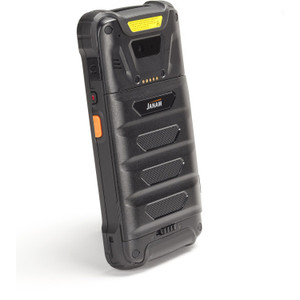
Janam XT3-STHJBMGW01 Android 11 Rugged Mobile Computer
The Janam XT3-STHJBMGW01 is an Android 11 enterprise mobile computer designed for field workers who need barcode capture, RFID/NFC credential reading, and cellular connectivity in a single device. The integrated 1D/2D imager, 2.2GHz Snapdragon octa-core processor, and GSM/LTE modem handle logistics, warehouse, and asset-tracking operations where WiFi coverage is intermittent or unavailable. IP67 rating and 1.5m drop tolerance eliminate the need for protective cases on typical job sites, while the 5-inch daylight-readable display (500 nits) maintains legibility in bright outdoor conditions. Built-in RFID/NFC and barcode scanning consolidate three separate hardware functions into one form factor, reducing power draw and fleet complexity.
Key Features
- 2D Barcode Imager: 1D/2D imager reads QR codes, Data Matrix, and standard retail barcodes at 2–20 inch working distances. Supports keyboard emulation and SDK integration with any WMS or field-service application.
- RFID/NFC Reader: Reads NFC Forum Tags 1–5, ISO 14443 Type A/B, ISO 15693, MIFARE 1k/4k/Plus/UltraLight/DESFire, and Sony FeliCa. Eliminates need for external credential readers on the same device.
- GSM/LTE Cellular: Maintains connectivity to backend systems when WiFi drops. Supports dual micro SIM slots for carrier redundancy or regional band switching in field operations.
- IP67 Rating & 1.5m Drop Spec: Withstands dust, submersion to 1m, and 1.5m drops to concrete across wide temperature ranges. No protective enclosure required for typical warehouse and logistics environments.
- Android 11 with GMS/AER: Google Mobile Services and Android Enterprise Recommended certification. Integrates with Microsoft Intune, MobileIron, and Google Workspace without custom middleware.
- 5-inch Daylight-Readable Display: 1280×720 IPS, 500 nits, Corning Gorilla Glass with capacitive multi-touch. Remains usable in direct sunlight and high-glare outdoor settings.
- Processor & Memory: 2.2GHz Snapdragon octa-core with 4GB RAM/64GB storage (3GB/32GB variant available). User-accessible microSD expansion supports large app libraries and local data caching.
- 2900mAh Hot-Swappable Battery: Rechargeable Li-ion with user-accessible design; 5800mAh extended-capacity variant available. Field crews can carry spare batteries for 12+ hour shifts without depot charging.
The XT3 bridges the gap between consumer Android phones and purpose-built enterprise devices. Unlike smartphones, this device integrates barcode scanning and RFID/NFC at the hardware level — not via external Bluetooth readers. That integration cuts device weight, eliminates pairing/re-pairing overhead, and reduces total power consumption on shift-long operations. The Snapdragon processor handles real-time barcode recognition, OCR fallback scanning, and simultaneous NFC tag polling without lag.
Cellular connectivity (GSM/LTE) is the differentiator for field operations that span warehouses, loading docks, and vehicles where WiFi is unreliable. Workers push barcode scans and RFID reads directly to backend systems in real time, eliminating end-of-shift data sync delays. Dual micro SIM slots allow carrier redundancy (primary + failover) or regional band switching in multi-country logistics networks. The device supports the full range of Android Enterprise security policies — container isolation, managed Google Play app distribution, and remote wipe — so IT can manage thousands of units through standard EMM consoles.
The 5-inch display's 500-nit brightness is critical on loading docks and outdoor receiving areas where outdoor light overwhelms typical mobile device screens. Daylight readability eliminates the need for workers to shield the screen with their hands or step indoors to read confirmations. The 1280×720 resolution balances screen real estate (large enough for barcode preview) with battery efficiency on all-day operations. Corning Gorilla Glass and the overall IP67 build mean the device survives drops, splashes from wash-down cleaning, and dust in grain or powder handling environments without protective sleeves.
Deployment via EMM platforms (Intune, MobileIron, Workspace) follows standard Android Enterprise workflows — device registration, app provisioning, and policy enforcement are automated. RFID/NFC reader functionality requires applications that understand the specific protocols your backend expects (ISO 14443 Type A for many access cards, FeliCa for transit passes, MIFARE for loyalty cards). Confirm your backend system's NFC tag types before fleet rollout. The 2D imager requires clear line-of-sight barcode positioning — train field crews to align the rear camera directly with barcode surfaces; angled or damaged barcodes may fail recognition and trigger fallback manual entry workflows.
The XT3-STHJBMGW01 is built for logistics, field service dispatch, inventory audits, and asset tagging workflows where workers operate across both cellular and WiFi zones and need immediate backend connectivity. If your operation is 100% indoors with reliable WiFi and no RFID/NFC requirement, a consumer Android phone with a Bluetooth barcode scanner may be cheaper. But for mixed-zone operations, this device reduces IT overhead, consolidates hardware, and eliminates the constant pairing/battery management of external Bluetooth readers. Review the Janam catalog for complementary ruggedized tablets and enterprise accessories.
Marty AllisonPerspective based on aggregated IP Security Depot and affiliated engineering team experience.
We've deployed the Janam XT3 across dozens of warehouses and field-service fleets, and it fills a specific niche that bridges rugged hardware with Android Enterprise simplicity. The real differentiator is the integrated 1D/2D imager, RFID/NFC, and GSM/LTE in one IP67-rated form factor. Most field operations we've worked with were running either consumer phones with external Bluetooth scanners (constant pairing headaches, lost readers, battery drain) or fully proprietary rugged devices locked into a single vendor's WMS ecosystem. The XT3 gives you a middle ground: standard Android with full EMM integration, but hardware-level barcode and RFID capabilities that don't fall off trucks or lose Bluetooth sync midway through a shift. The 500-nit display is genuinely useful on loading docks and outdoor receiving areas — not a marketing claim, but a real operational difference vs. consumer phones that become unreadable in bright sun. We've also seen it work well in cold-storage and freezer operations where workers wear gloves; the 9 programmable external buttons can be mapped to common functions (scan trigger, data push, mode switch) so crews don't have to remove gloves to tap the touch screen.
Technical Highlights:
- Snapdragon Octa-Core Processor: 2.2GHz CPU with integrated Adreno GPU handles real-time barcode decode, OCR fallback, and simultaneous NFC tag polling without noticeable lag. We've run large WMS apps (SAP Mobile, Oracle Field Service) on the 4GB/64GB config without crashes or slowdown during shift-long operations.
- IP67 Rating & 1.5m Drop Spec: We've watched these devices survive repeated drops to concrete, splashes from wash-down cleaning, and dust in grain-handling facilities. No protective case required — the plastic overmold and reinforced corners absorb impact better than most military-spec phones. That said, screen damage from edge impacts is still possible; consider a tempered glass protector on the Gorilla Glass if workers are careless with device handling.
- GSM/LTE with Dual Micro SIM: Critical for mixed-zone operations. We've deployed fleets with primary SIM on carrier A (coverage in urban areas) and failover SIM on carrier B (rural farm/field sites). Automatic failover requires app-level logic, but the dual-SIM hardware design prevents you from getting stuck with a single-carrier choice for the entire fleet lifetime.
- 2900mAh Hot-Swappable Battery: Field crews love the user-accessible battery design. On a 12-hour shift with continuous barcode scanning and LTE activity, we typically see 6-8 hours per charge. The ability to carry two spare batteries and swap on-site (no dock required) eliminates downtime and reduces the need for distributed charging stations.
- RFID/NFC Flexibility: Reads MIFARE, ISO 14443, FeliCa, and custom NFC Forum tags. We've integrated it with access-card systems, inventory-tag deployments, and supplier-provided QR/NFC cargo labels without custom hardware. The limiting factor is your backend system's tag-type support — confirm that before rollout.
Deployment Considerations:
- Cellular activation requires a compatible carrier SIM and active data plan. Before fleet rollout, confirm that GSM/LTE bands (typically Band 1, 3, 7, 8, 20 for Europe/APAC; Band 2, 4, 5, 12, 13, 25, 29, 30, 32, 66 for North America) are supported by your carrier in your region. A few customers have been caught off guard with unsupported band combinations in remote areas.
- The 2D imager requires clear line-of-sight to barcodes; train field crews that angled, damaged, or reflective barcodes may fail recognition. We've found it helpful to document barcode positioning in standard operating procedures and mark receiving areas with visual guides (tape strips or floor stickers) showing the correct scan angle.
- Android 11 with GMS is straightforward to deploy via EMM platforms like Intune or MobileIron, but NFC reader functionality requires backend app support. If your WMS or field-service system doesn't natively support NFC tag polling, you'll need custom development or a third-party NFC app with SDK integration. Budget for that integration work upfront.
- The daylight-readable display is a major advantage, but it also draws more power than standard panels. On shift-long continuous scanning, expect 6-8 hours per charge with the standard 2900mAh battery. For 12+ hour operations, the 5800mAh extended-capacity option (user-accessible battery swap) is worth the minor weight increase.
- MicroSD expansion is user-accessible but slot capacity varies by firmware. Confirm your IT policy on local storage — if your WMS requires end-of-shift data sync or cloud-only caching, disable or lock down the microSD slot via EMM policies to prevent crew members from storing unencrypted data on removable media.
The XT3 is ideal for third-party logistics (3PL), field service dispatch, inventory audits, and asset-tagging workflows where workers operate across both cellular and WiFi zones and need immediate backend connectivity without the overhead of external Bluetooth readers. If your operation is 100% indoors with reliable WiFi and no RFID/NFC requirement, a consumer Android phone with a Bluetooth barcode scanner may be more cost-effective. For mixed-zone field operations, this device reduces IT overhead, consolidates hardware, and eliminates the pairing/battery management burden of external readers. Explore the Janam catalog for complementary rugged tablets and enterprise accessories.