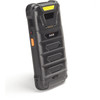
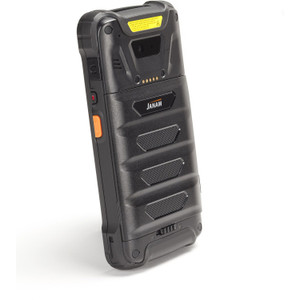
Janam XT3-STHGBMGW00 Android 9 Mobile Computer RFID/NFC 2D
The Janam XT3-STHGBMGW00 is a handheld mobile computer designed for warehouse inventory, field service operations, and access control deployments where workers capture barcodes, read contactless credentials, and maintain connectivity without tool swapping. It combines Android 9 (GMS/AER certified), a Honeywell N6703 1D/2D imager, integrated RFID/NFC support (ISO 14443 Type A/B, ISO 15693, MIFARE suite), dual-band 802.11a/b/g/n/ac Wi-Fi, and GSM/LTE cellular in a single IP67-rated form factor. The 5-inch HD IPS screen (1280×720, 500 nits, Gorilla Glass) delivers outdoor readability; 9 programmable external buttons accelerate data entry workflows. Built for environments where durability and multi-capture capability outweigh size and cost of separate readers.
Key Features
- 2D Barcode Imager: Honeywell N6703 engine. Decodes 1D (Code 128, Code 39, UPC, EAN) and 2D (QR, Data Matrix, PDF417) symbologies on a single trigger — no separate scanners required for mixed-mode inventory or field-service workflows.
- RFID/NFC Multi-Standard: Reads ISO 14443 Type A/B, ISO 15693, MIFARE 1k/4k/Plus/UltraLight/DESFire, and Sony FeliCa. Integrates directly with existing contactless badge and credential infrastructure at 13.56 MHz standard frequency.
- Cellular Connectivity: GSM/LTE WWAN module (optional configuration) — workers stay online in areas beyond Wi-Fi coverage. Confirm regional carrier band alignment before deployment.
- Android 9 with GMS and Android Enterprise: Google Mobile Services certified. AER (Android Enterprise Recommended) status ensures OTA OS updates, security patches, and EMM/MDM compliance across Intune, MobileIron, and equivalent platforms.
- IP67 Rating and 1.5m Drop Spec: Survives immersion, dust ingress, and 5ft concrete drops on all sides. Operational −20 to 60 °C; built for cold-storage, outdoor, and high-impact warehouse environments.
- Dual-Band Wi-Fi 802.11a/b/g/n/ac/d/h/i/k/r/v: 5 GHz and 2.4 GHz coverage for flexible network placement. Bluetooth 5.0 (BLE) pairs with headsets, printers, and peripheral readers.
- 5-inch HD Touchscreen, 500 nits: Gorilla Glass with 1280×720 IPS panel — readable in daylight and outdoor dock areas. Multi-touch capacitive support for app navigation and barcode preview.
- Hot-Swappable Battery: 2900 mAh standard (5800 mAh optional). Supports 8+ hour shifts on standard capacity; quick battery swap during lunch or shift change without device restart or data loss.
Processor, Memory, and Storage
The XT3-STHGBMGW00 runs a 2.2 GHz Qualcomm Snapdragon octa-core processor paired with 4 GB RAM and 64 GB internal storage (3 GB/32 GB optional for cost-reduced deployments). microSD card expansion up to 2 TB supports extended logging, barcode imagery caching, and offline app bundles. The device includes two micro SAM slots for UICC cards (if WWAN module is fitted) and supports dual-SIM failover for carrier redundancy in mission-critical field-service fleets. Storage expansion and SAM flexibility make the XT3 suitable for both inventory-dense warehouse environments and remote access-control deployments with limited cloud connectivity.
Imaging and Audio Capture
Dual cameras — 13 MP rear autofocus with LED flash, 8 MP front-facing — enable barcode image verification, damage documentation, and operator self-identification (gating entry to restricted zones or asset transfers). 850 nm infrared LED support on the rear imager allows barcode and receipt capture in low-light dock and storage areas without external lighting. Built-in microphone supports voice memo annotation, worker-to-worker comms, or integration with voice-driven inventory apps. The rear camera's LED flash serves dual duty: barcode illumination and low-light scene lighting, reducing dependence on ambient warehouse lighting rigs.
Connectivity and Data Transfer
USB-C and Pogo Pin industrial connector allow synchronized charging, data offload, and firmware updates at stationary dock stations. Wi-Fi 802.11a/b/g/n/ac dual-band and GSM/LTE cellular provide primary network paths; Bluetooth 5.0 (BLE) integrates with wireless label printers, industrial Bluetooth scanners, and mobile workforce apps. The combination of cellular and Wi-Fi fallback is critical for field-service teams or warehouse operations spanning disconnected zones — a barcode scan queues locally if the network drops and syncs on reconnect. Android Enterprise certification simplifies EMM policy deployment (app whitelisting, VPN enforcement, encryption key rotation) across fleets of 10 to 1,000+ units.
Physical Design and Environmental Durability
At 272 g (9.5 oz) including battery, the XT3 balances single-hand ruggedness with all-day wearability on a belt holster or lanyard. Dimensions (156 mm L × 82 mm W × 21 mm D) fit standard industrial holsters and vehicle dash mounts. The IP67 rating withstands spray-down cleaning and brief water immersion — common in cold-storage facilities and outdoor logistics yards. The 1.5 m drop spec to concrete ensures survival of typical floor-drop scenarios inherent to warehouse and field-service work. Nine programmable external buttons allow hardwired workflows (capture-and-transmit on button 1, next-item on button 2, return-to-home on button 3) without touchscreen navigation, reducing training time and fatigue on high-volume days.
Management and Compliance
Android Enterprise Recommended certification and Google Mobile Services (GMS) integration enable zero-touch enrollment (ZTE) in major MDM platforms: Microsoft Intune, Google Workspace, MobileIron, Jamf, and Blackberry UEM. Security patches and OS updates (upgradeable to Android 11) deploy centrally; lost-device wipe and app sandboxing are built-in. The device supports hardware-backed keystore for credential and payment app security — relevant if the device doubles as a field-POS or worker badge issuer. No custom OS or sideloading required; all deployments run factory-standard Android with audit trails for compliance in retail, healthcare, and logistics sectors.
Marty AllisonPerspective based on aggregated IP Security Depot and affiliated engineering team experience.
We've deployed the Janam XT3 across warehouse, field-service, and mixed-use access-control environments, and it sits in a sweet spot between consumer-grade Android tablets and purpose-built warehouse terminals. The integration of barcode imaging, RFID/NFC, and cellular in one device eliminates the "tool belt" problem — workers don't carry a barcode gun in one holster, an access-control reader in another, and a phone in a third. That consolidation directly reduces training complexity, increases compliance with company device policies, and cuts capex on separate peripherals. The Honeywell N6703 imager is proven; it captures everything from high-resolution QR codes on shipping labels to worn 1D codes on legacy inventory bins without manual focus or alignment. Where the XT3 shines operationally is in hybrid deployments: a warehouse that blends barcode-driven putaway logic with RFID-tagged cabinet access, for example. Or a field-service team that scans job tickets, reads customer ID cards on-site for photo verification, and stays online via cellular when the customer's Wi-Fi is unavailable or untrusted. The AER certification and GMS stack mean your IT team manages the device through standard EMM tools — no custom ROM, no vendor lock-in. Battery swaps are hot-swappable and fast; crews can keep a spare 5800 mAh battery in a locker and rotate units without powering down mid-shift. The touchscreen is bright enough for outdoor dock areas, and the 9 programmable buttons let you hardwire the most common workflows so operators don't fumble with menus under time pressure.
Technical Highlights:
- Honeywell N6703 2D Imager: Proven optical engine that decodes the full barcode alphabet (1D/2D) in a single capture. Autofocus and low-light LED support mean fewer failed scans and retries — critical on high-volume days when per-scan cycle time compounds labor cost.
- RFID/NFC Multi-Standard Stack: Supports ISO 14443 Type A/B, MIFARE, ISO 15693, and FeliCa without app-level switching. If your facility has legacy HID badges, newer MIFARE DESFire credentials, and FeliCa door readers, the XT3 reads all three — no peripheral chaining needed.
- GSM/LTE + Wi-Fi Dual-Path Connectivity: Cellular acts as failover when Wi-Fi is spotty or unavailable (outdoor yards, moving vehicles). Data queues locally on the device and syncs when the network returns — critical for supply-chain ops where "off the network" is not an option.
- Android 9 GMS/AER with MDM Push: ZTE enrollment, app whitelisting, VPN enforcement, and remote wipe all deploy from your EMM console. IT doesn't need Janam-specific tooling or training — Android Enterprise management is the baseline.
- IP67 + 1.5m Drop Spec: Survives dock spray-down, brief water immersion, and typical floor drops. Operational range −20 to 60 °C means cold-storage deployments don't require a separate device variant.
- 850 nm IR LED on Rear Camera: Enables barcode capture and damage documentation in low-light storage areas without external lighting rigs. LED flash also serves barcode illumination on bright days when shadow makes imager exposure difficult.
Deployment Considerations:
- Confirm GSM/LTE carrier bands before ordering WWAN models — Janam offers regional SKUs (North America, EMEA, APAC). A US-band device may not activate on EU carriers or vice versa. Lock in your carrier and geography at procurement.
- The 5-inch screen and 272 g weight are comfortable for all-day one-hand operation, but fit them into industrial holsters early in pilot deployments. Some old-style barcode-gun holsters won't accommodate the wider form factor.
- Hot-swap batteries are a major efficiency driver if your workforce operates split shifts or works outdoors in cold climates (Li-ion capacity drops ~5% per 10 °C below 20 °C). Budget at least one spare battery per 2–3 devices and a multi-bay charger for shift-change cycles.
- The Pogo Pin connector supports docking and data sync, but ensure dock firmware is current if you're integrating with older warehouse-management systems (WMS) that expect legacy device handshake protocols. Modern WMS (SAP, Oracle, JDA) integrate seamlessly via Android Enterprise APIs.
- Barcode image preview (using the rear camera) is invaluable for training crews on scanning distance and angle, but it increases app battery draw. Disable preview on battery-critical deployments (e.g., 12-hour outdoor days in remote zones).
- MIFARE card cloning is a theoretical vector in high-security access-control environments. If you're using the XT3 for access-control badge issuance or validation, pair it with DESFire encryption and EMV mutual authentication; plain MIFARE 1k is read-only from the XT3 but not tamper-proof at the crypto level.
The XT3 is purpose-built for mobile workers who juggle barcode capture, credential reading, and cellular-resilient data sync. If your deployment is cloud-first (all inventory data must transmit in real-time) or single-purpose (barcode only, no access control), a purpose-built warehouse terminal or a consumer tablet may be cheaper. But for hybrid workflows spanning inventory, field service, and ad-hoc access control, the XT3 consolidates capex and training overhead significantly. See the Janam catalog for complementary docking, charging, and holster options.