
i-PRO U1542LA vs Pelco SRXE4-4V9-EBT-IR1: Specification Comparison
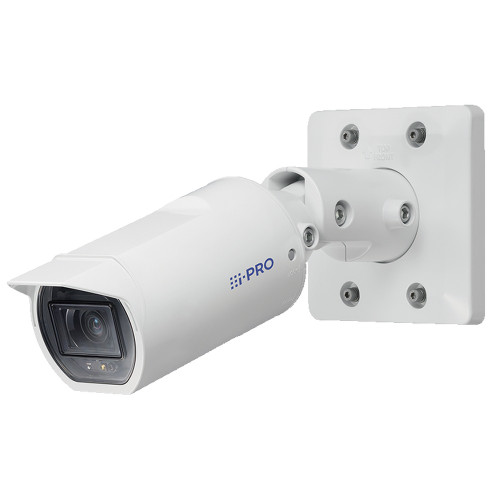
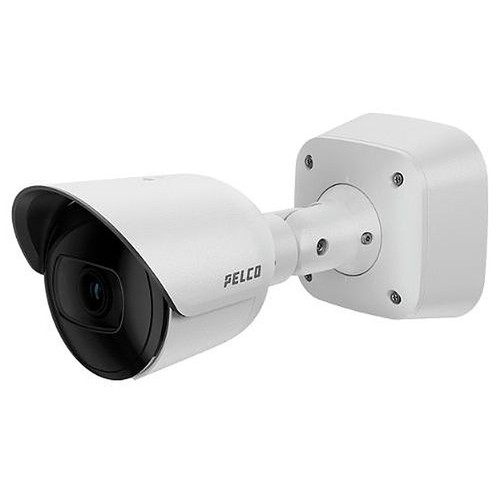
Both the i-PRO WV-U1542LA and the Pelco SRXE4-4V9-EBT-IR1 are 4MP fixed outdoor bullet cameras with motorized varifocal lenses, H.265 compression, and ONVIF compliance — placing them squarely in the same cross-shop tier for perimeter surveillance deployments. This comparison evaluates how their imaging capabilities, environmental durability, power requirements, and integration features stack up against each other, drawing exclusively from the published specifications of each model.
In This Guide
How do the imaging specs compare?
The Pelco SRXE4-4V9-EBT-IR1 carries a larger 1/1.8-inch progressive scan CMOS sensor against the i-PRO WV-U1542LA's approx. 1/2.7-inch CMOS. That larger photosite area underpins the Pelco's 0.003 lux color / 0 lux IR minimum illumination versus the i-PRO's 0.3 lux color / 0.12 lux B&W — roughly 100× lower light threshold for color. The Pelco also delivers a maximum frame rate of 60 fps compared to the i-PRO's 30 fps, and its SureVision WDR reaches a specified 130 dB; the i-PRO quotes 102 dB maximum dynamic range with Super Dynamic on at level 31.
On optics, the i-PRO uses a 2.9–7.3 mm motorized varifocal (2.5× zoom, 44–103° horizontal FOV), while the Pelco uses a 4.4–9.3 mm motorized varifocal (32–109° HFOV) — the Pelco's wide end reaches 109° but its narrow end tops out at 32°, giving it less telephoto compression. The i-PRO's DORI analysis (per provided specs) documents a Detect range of 40.7 m wide / 126.7 m tele; no DORI figures are provided for the Pelco. The i-PRO IR LED is rated to 20 m; the Pelco spec sheet cites 850 nm IR illumination with 0-lux IR capability but does not state a throw distance in the provided specifications.
What about installation and environment?
The Pelco is meaningfully more ruggedized. It is rated IP66 / IP67 / IP68 (2 m for 2 hr) / IPX9K / NEMA 4X and achieves IK11 impact resistance. The i-PRO is rated IP66 / NEMA 4X / Type 4X and IK10. Operationally, the Pelco is specified for -50°C to +65°C (with PoE+ or external power); the i-PRO operates from -30°C to +50°C — a 20°C advantage at each extreme for the Pelco. The i-PRO adds a Temish anti-condensation element and wind resistance up to 40 m/s (approx. 89 mph), neither of which is referenced in the Pelco spec data provided.
For power, the i-PRO draws 7.2 W and is powered by PoE IEEE 802.3af (PoE Class 0), compatible with standard 802.3af switches. The Pelco is specified as PoE Class 3 (802.3at / PoE+) and also accepts 12/24 Vdc — this allows higher-power operation but requires a PoE+ capable switch or injector. The i-PRO dimensions are 112.5 mm × 112.5 mm × 262 mm at 860 g; the Pelco dimensions are listed as 309 mm × 133 mm × 133 mm with no weight stated in the provided specifications.
Which fits your VMS and analytics better?
Both cameras are ONVIF compliant. The i-PRO supports ONVIF Profile G, S, and T. The Pelco supports ONVIF Profile S, T, G, and M — Profile M adds metadata transport for analytics interoperability, which the i-PRO does not list. The i-PRO's edge analytics are limited to Video Motion Detection (4 areas), Scene Change Detection (1 area), and privacy masking (up to 8 zones). The Pelco's Smart Analytics suite includes Person/Vehicle Detection, Direction Violation, Loitering, Beam Crossing, Crowd Detection, Audio Analytics, and Tamper Alert — substantially broader on-camera intelligence.
For audio, the i-PRO spec sheet lists no audio input, output, or compression — the 'Audio Support: Yes' flag and 'Audio input' field appear internally inconsistent with the hardware spec table entries which show dashes; buyers should confirm with i-PRO documentation before specifying audio. The Pelco notes microphone support. Both support microSD local storage; the Pelco additionally specifies 4 GB onboard RAM and 4 GB Flash. On cybersecurity, the Pelco lists FIPS 140-3 Level 3, TPM, and Secure Boot in addition to HTTPS and 802.1X; the i-PRO lists device certificate, user authentication, HTTPS, and 802.1X but does not cite FIPS 140-3 or TPM. The Pelco also carries NDAA Section 889 and TAA compliance designations, which are absent from the i-PRO specification data provided.
Which should you choose: the U1542LA or the SRXE4-4V9-EBT-IR1?
Our take: The SRXE4-4V9-EBT-IR1 is the stronger choice when the deployment demands extreme environmental tolerance, superior low-light performance, richer edge analytics, or compliance with NDAA/TAA and FIPS 140-3 cybersecurity mandates. Key spec deltas: the Pelco's minimum illumination of 0.003 lux color / 0 lux IR versus the i-PRO's 0.3 lux color gives it a roughly 100× low-light advantage; its operating range of -50°C to +65°C extends 20°C beyond the i-PRO's -30°C to +50°C at both ends; and its IK11 impact rating exceeds the i-PRO's IK10. The i-PRO WV-U1542LA is the better fit when the existing switch infrastructure is 802.3af-only (it draws only 7.2 W), when a documented DORI/detection-range table is required for bid compliance, or when the lower acquisition cost of a standard PoE camera matters — noting that neither price nor DORI figures for the Pelco are available in the provided specifications.
Side-by-Side Comparison
Spec-for-spec, from manufacturer data.
| Specification | i-PRO U1542LA | Pelco SRXE4-4V9-EBT-IR1 |
|---|---|---|
| Resolution | 4MP (2688 × 1520) | 4MP (2560 × 1440) |
| Image Sensor | Approx. 1/2.7-inch CMOS | 1/1.8-inch progressive scan CMOS |
| Max Frame Rate | 30 fps | 60 fps |
| Lens / Focal Length | 2.9–7.3 mm motorized varifocal (2.5×) | 4.4–9.3 mm motorized varifocal |
| Horizontal FOV | 44–103° | 32–109° |
| Minimum Illumination | 0.3 lux color / 0.12 lux B&W | 0.003 lux color / 0 lux IR |
| IR Illumination / Range | IR LED, 20 m | 850 nm IR, 0 lux (range not specified) |
| Wide Dynamic Range | Max. 102 dB (Super Dynamic On, Level 31) | 130 dB SureVision |
| IP Rating | IP66 / NEMA 4X / Type 4X | IP66 / IP67 / IP68 (2m/2hr) / IPX9K / NEMA 4X |
| Impact Rating | IK10 | IK11 |
| Operating Temperature | -30°C to +50°C | -50°C to +65°C (with PoE+ or external power) |
| Power Input / PoE Class | PoE IEEE 802.3af, Class 0, 7.2 W | PoE+ (802.3at) Class 3; also 12/24 Vdc |
| Video Compression | H.265, H.264, MJPEG | H.265, H.264, Motion JPEG |
| ONVIF Profiles | Profile G, S, T | Profile S, T, G, M |
| Edge Analytics | VMD (4 areas), Scene Change Detection (1 area) | Person/Vehicle Detection, Direction Violation, Loitering, Beam Crossing, Crowd Detection, Audio Analytics, Tamper Alert |
| Cybersecurity | HTTPS, 802.1X, device cert, user auth | FIPS 140-3 Level 3, TPM, Secure Boot, HTTPS, 802.1X |
| NDAA / TAA Compliance | — | NDAA Section 889; TAA Compliant |
| Edge Storage | microSDXC up to 512 GB | microSD; 4 GB RAM / 4 GB Flash onboard |
| Audio | Not specified in hardware spec table | Microphone supported |
| Dimensions | 112.5 mm × 112.5 mm × 262 mm | 309 mm × 133 mm × 133 mm |
| Weight | 860 g (1.90 lbs) | — |
| Warranty | 5-year | 5-year |
Frequently Asked Questions
Which should you choose: the U1542LA or the SRXE4-4V9-EBT-IR1?
The SRXE4-4V9-EBT-IR1 is the stronger choice when the deployment demands extreme environmental tolerance, superior low-light performance, richer edge analytics, or compliance with NDAA/TAA and FIPS 140-3 cybersecurity mandates. Key spec deltas: the Pelco's minimum illumination of 0.003 lux color / 0 lux IR versus the i-PRO's 0.3 lux color gives it a roughly 100× low-light advantage; its operating range of -50°C to +65°C extends 20°C beyond the i-PRO's -30°C to +50°C at both ends; and its IK11 impact rating exceeds the i-PRO's IK10. The i-PRO WV-U1542LA is the better fit when the existing switch infrastructure is 802.3af-only (it draws only 7.2 W), when a documented DORI/detection-range table is required for bid compliance, or when the lower acquisition cost of a standard PoE camera matters — noting that neither price nor DORI figures for the Pelco are available in the provided specifications.
Is the i-PRO WV-U1542LA or the Pelco SRXE4-4V9-EBT-IR1 better for low-light or nighttime coverage?
Based on provided specifications, the Pelco has a significant low-light advantage: its minimum illumination is 0.003 lux color / 0 lux IR versus the i-PRO's 0.3 lux color / 0.12 lux B&W. The Pelco also specifies 850 nm IR illumination with 0-lux IR capability. The i-PRO quotes an IR LED range of 20 m; no IR throw distance is stated in the Pelco spec data provided.
Can either camera run on a standard 802.3af PoE switch, or do I need PoE+?
The i-PRO WV-U1542LA is powered by PoE IEEE 802.3af (Class 0) at 7.2 W, so it works with any standard 802.3af switch or injector. The Pelco SRXE4-4V9-EBT-IR1 is listed as PoE Class 3 (802.3at / PoE+); it also accepts 12/24 Vdc. Deploying the Pelco on an 802.3af-only infrastructure would require verifying power budget, as Class 3 PoE+ draws up to 15.4 W.
Which camera is better suited for government or public-sector projects requiring NDAA compliance and strong cybersecurity?
The Pelco SRXE4-4V9-EBT-IR1 is specified as NDAA Section 889 and TAA Compliant and lists FIPS 140-3 Level 3, TPM, and Secure Boot in its cybersecurity feature set. The i-PRO WV-U1542LA spec data provided does not include NDAA/TAA designations or FIPS 140-3/TPM references. Buyers with federal or public-sector requirements should confirm current compliance documentation directly with each manufacturer.
Get a Second Opinion on Your Camera Choice
Share your site layout, coverage goals, and budget. Our team will validate the camera selection, flag anything we would change, and recommend products that match the use case.