
i-PRO S85402-V2L1 vs i-PRO U85402-V2L1: Specification Comparison
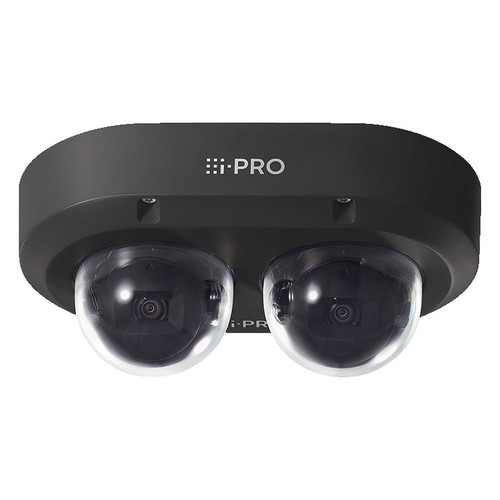
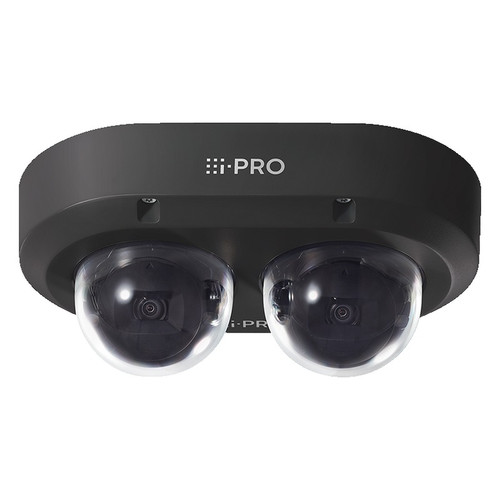
Both the WV-S85402-V2L1 and WV-U85402-V2L1 are i-PRO outdoor dual-dome IP cameras sharing the same 2×4MP (8MP total) sensor configuration, 2.5x motorized zoom lens, IK10/IP66+ enclosure, and PoE+ power — placing them squarely in the same resolution class and camera type. The meaningful differences lie in AI analytics capability, SoC generation, power draw, ONVIF profile support, and finish material. This comparison covers imaging, installation, and integration to help integrators and IT buyers determine which model fits a given deployment.
In This Guide
How do the imaging specs compare?
Both cameras use identical 2×1/2.7-type CMOS sensors at 30 fps, share a 2.9–7.3 mm (2.5x motorized zoom / motorized focus) lens with an f/2.0–f/3.0 aperture range, and produce maximum H.265/H.264 resolution of 2688×1520 per channel. Low-light minimum illumination is specified as 0.12 lux (B&W, 50IRE) on both models; no color-mode illumination figure is stated in the provided specs for the U85402-V2L1, while the S85402-V2L1 datasheet fields reference 0.21 lux color (per enriched spec fields). Wide dynamic range is identical at 108 dB max (Super Dynamic On, Level 31), and both support the same detection/observation/recognition/identification DORI distances — Wide: 45.1 m detect / 4.5 m identify; Tele: 136.5 m detect / 13.6 m identify.
IR illumination range is specified at 40 m (High mode) for both units, with the S85402-V2L1 additionally noting 30 m at 50IRE. The SoC differs: the S85402-V2L1 uses an Ambarella CV2, while the U85402-V2L1 uses an Ambarella CV22. Both support extra digital zoom up to 10.5x at 640×360 resolution, identical angular field of view (43–100° H / 24–56° V), and the same focus range of 1 m to infinity. Fog compensation (0–8 levels), adaptive black stretch (0–255), BLC/HLC (0–31), AGC (0–11), and DNR (0–255) ranges are identical across both models.
What about installation and environment?
Physical form factor and environmental ratings are nearly identical. Both measure 250 mm (D) × 150 mm (W) × 105 mm (H) with the attachment plate, weigh approximately 1.8 kg, and carry IP67/IP66 (IEC 60529), Type 4X (UL50E), NEMA 4X, IK10 (IEC 62262), wind resistance up to 40 m/s, and NEMA TS 2 (2.2.7–2.2.9) compliance. Operating temperature is –40 °C to +60 °C and humidity 10–100% (non-condensing) with Temish anti-condensation element on both. Safety certifications (UL62368-1, c-UL, CE, IEC62368-1) and EMC marks (FCC Part 15 Class A, ICES-003 Class A, EN55032 Class A, EN55035) are identical.
The one installation-relevant difference is power draw: the S85402-V2L1 is rated at 22.2 W (PoE+, IEEE 802.3at), while the U85402-V2L1 draws 18.9 W on the same PoE+ standard. Both are PoE Class 4. Installers using switches with per-port power budgets close to the 802.3at 30 W ceiling should note the 3.3 W difference when planning dense multi-camera runs. Finish materials differ — the S85402-V2L1 uses an aluminum body with PC dome; the U85402-V2L1 uses aluminum die cast with no dome material specified. Both use stainless steel screws. Mounting adjusting angles are identical (Horizontal –50° to +230°, Vertical +10° to +105°, Yaw ±90°) for both camera heads.
Which fits your VMS and analytics better?
ONVIF profile support diverges: the S85402-V2L1 supports Profiles G, M, S, and T, whereas the U85402-V2L1 supports Profiles G, S, and T only — Profile M (metadata streaming for analytics) is absent on the U model. This is significant for VMS platforms that consume AI metadata via ONVIF Profile M. Both support unicast; the S85402-V2L1 spec explicitly lists multicast under H.265/H.264, while the U85402-V2L1 spec does not list multicast in the provided data. Both support 24 simultaneous users, identical alarm inputs (3 terminals, VMD, SCD, command, audio), alarm actions (email, HTTP, TCP, SD recording), and edge storage up to 512 GB microSDXC.
AI analytics capability is the sharpest differentiator. The S85402-V2L1 specifies 'AI Video Analytics (6 types)' and AI Sound Classification (gunshot, yell, vehicle horn, glass break), with enriched spec fields referencing motion, face, people, vehicle, and occupancy detection. The U85402-V2L1 lists neither AI Video Analytics nor AI Sound Classification in its provided specs — analytics are limited to VMD (4 areas), SCD (1 area), and audio detection on/off. Audio hardware is comparable: both provide 3.5 mm stereo mic input at –48 dB and mono audio output at –20 dBV, with Off/Mic/Line/Half-duplex/Full-duplex transmission modes. Security posture is identical: FIPS 140-2 Level 3, HTTPS, IEEE 802.1X on both.
Which should you choose: the S85402-V2L1 or the U85402-V2L1?
Our take: The S85402-V2L1 is the stronger choice when edge AI analytics and ONVIF Profile M metadata streaming are required. Three concrete spec deltas support this: (1) the S85402-V2L1 carries AI Video Analytics (6 types) plus AI Sound Classification for gunshot, yell, vehicle horn, and glass break, while the U85402-V2L1 provides none of these in its supplied specs; (2) the S85402-V2L1 supports ONVIF Profile M in addition to G/S/T, enabling metadata consumption on compatible VMS platforms, whereas the U85402-V2L1 supports G/S/T only; (3) the S85402-V2L1 draws 22.2 W versus 18.9 W on the U model — a 3.3 W premium for the added processing. Where AI analytics are not required and per-port PoE budget is tighter, the U85402-V2L1 delivers the same dual-sensor imaging, identical optics, identical environmental ratings, and lower power consumption at a potentially lower price point.
Side-by-Side Comparison
Spec-for-spec, from manufacturer data.
| Specification | i-PRO S85402-V2L1 | i-PRO U85402-V2L1 |
|---|---|---|
| SKU | WV-S85402-V2L1 | WV-U85402-V2L1 |
| Total Resolution | 8MP (2×4MP) | 8MP (2×4MP) |
| Image Sensor | 2×1/2.7" CMOS | 2×1/2.7" CMOS |
| Max Frame Rate | 30 fps | 30 fps |
| Lens / Focal Length | 2.9–7.3 mm, 2.5x motorized zoom | 2.9–7.3 mm, 2.5x motorized zoom |
| Min Illumination (B&W) | 0.12 lux (50IRE, F2.0, 1/30s) | 0.12 lux (50IRE) — conditions not fully listed in spec |
| IR Range | 40 m (High) / 30 m (50IRE) | 40 m (High mode) |
| Wide Dynamic Range | 108 dB max (Super Dynamic On, Level 31) | 108 dB max (Super Dynamic On, Level 31) |
| System on Chip (SoC) | Ambarella CV2 | Ambarella CV22 |
| AI Analytics | AI Video Analytics (6 types) + AI Sound Classification (4 types) | Not specified in provided specs |
| ONVIF Profiles | G / M / S / T | G / S / T |
| Video Compression | H.265 / H.264 (CBR/VBR, Unicast/Multicast) / MJPEG | H.265 / H.264 (CBR/VBR) / MJPEG |
| IP / Dust Rating | IP67 / IP66, NEMA 4X, Type 4X | IP67 / IP66, NEMA 4X, Type 4X |
| Impact Rating | IK10 (IEC 62262) | IK10 (IEC 62262) |
| Operating Temperature | –40 °C to +60 °C | –40 °C to +60 °C |
| Power Input / PoE Class | PoE+ IEEE 802.3at, Class 4, 22.2 W | PoE+ IEEE 802.3at, Class 4, 18.9 W |
| Edge Storage | microSD 2 GB / microSDHC 4–32 GB / microSDXC 64–512 GB | microSD 2 GB / microSDHC 4–32 GB / microSDXC 64–512 GB |
| Audio I/O | 3× 3.5 mm stereo mic in (–48 dB); 3.5 mm mono out (–20 dBV) | 3.5 mm stereo mini jack in (–48 dB); 3.5 mm mono jack out, 600 Ω (–20 dBV) |
| Dimensions (w/ plate) | 250 mm (D) × 150 mm (W) × 105 mm (H) | 250 mm (D) × 150 mm (W) × 105 mm (H) |
| Weight | Approx. 1.8 kg | Approx. 1.8 kg |
| Housing Finish | Aluminum body, PC dome, stainless steel screws | Aluminum die cast, stainless steel screws — dome material not specified |
| Warranty | 3-year | 3-year |
Frequently Asked Questions
Which should you choose: the S85402-V2L1 or the U85402-V2L1?
The S85402-V2L1 is the stronger choice when edge AI analytics and ONVIF Profile M metadata streaming are required. Three concrete spec deltas support this: (1) the S85402-V2L1 carries AI Video Analytics (6 types) plus AI Sound Classification for gunshot, yell, vehicle horn, and glass break, while the U85402-V2L1 provides none of these in its supplied specs; (2) the S85402-V2L1 supports ONVIF Profile M in addition to G/S/T, enabling metadata consumption on compatible VMS platforms, whereas the U85402-V2L1 supports G/S/T only; (3) the S85402-V2L1 draws 22.2 W versus 18.9 W on the U model — a 3.3 W premium for the added processing. Where AI analytics are not required and per-port PoE budget is tighter, the U85402-V2L1 delivers the same dual-sensor imaging, identical optics, identical environmental ratings, and lower power consumption at a potentially lower price point.
Is the S85402-V2L1 or U85402-V2L1 better for low-light performance?
Based on the provided specs, both cameras share the same minimum illumination of 0.12 lux (B&W, 50IRE, F2.0, 1/30s) and the same 40 m IR LED range. Neither model has a specified advantage in raw low-light sensitivity per the supplied data. The S85402-V2L1 enriched fields reference 0.21 lux in color mode, but a comparable figure is not present in the U85402-V2L1 spec sheet provided.
Can the U85402-V2L1 replace the S85402-V2L1 on a VMS that uses ONVIF metadata?
Not directly. The S85402-V2L1 supports ONVIF Profile M, which is the profile used for AI metadata streaming (object classification, events) to compatible VMS platforms. The U85402-V2L1 supports Profiles G, S, and T only — Profile M is not listed in its provided specifications. If your VMS relies on Profile M for analytics ingestion, the U85402-V2L1 is not a drop-in replacement.
Does the higher wattage of the S85402-V2L1 matter for PoE switch planning?
It can matter on dense deployments. The S85402-V2L1 draws 22.2 W and the U85402-V2L1 draws 18.9 W — a 3.3 W difference per port. Both are within the IEEE 802.3at (PoE+) Class 4 ceiling of 30 W. On a 24-port switch with a shared power budget, substituting S-model for U-model cameras reduces the number of cameras per switch by roughly one port for every nine cameras replaced, depending on the switch's total power allocation.
Get a Second Opinion on Your Camera Choice
Share your site layout, coverage goals, and budget. Our team will validate the camera selection, flag anything we would change, and recommend products that match the use case.