
i-PRO S66700-Z3L vs i-PRO X66700-Z3LS: Specification Comparison
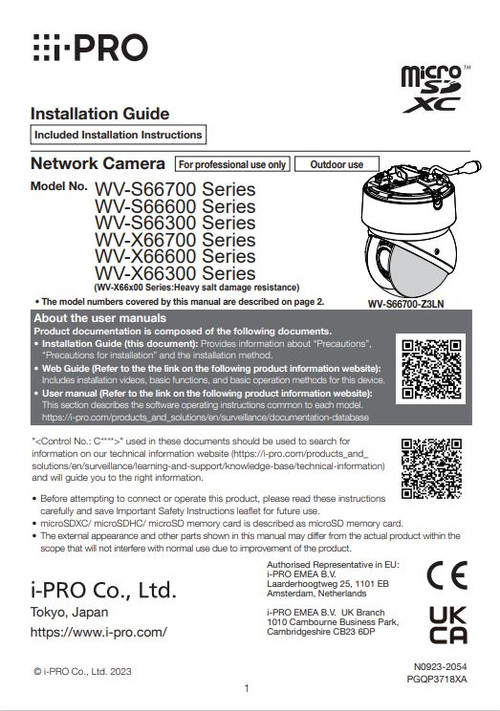
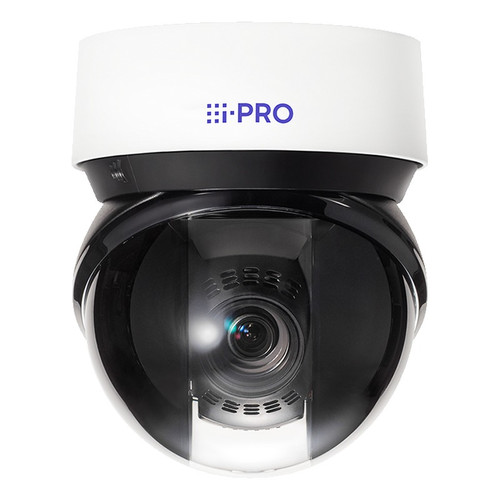
Both the i-PRO WV-S66700-Z3L and WV-X66700-Z3LS are 8MP (4K) outdoor PTZ dome cameras sharing the same optical platform — 30x motorized zoom, 280m IR, and AI analytics. They occupy the same resolution class and camera type, making them a direct cross-shop decision for installers evaluating i-PRO's S-series versus X-series PTZ lineup. Key differences emerge in operating temperature floor, network protocol depth, NEMA rating, and I/O terminal configuration rather than in core imaging performance.
In This Guide
How do the imaging specs compare?
Both cameras share an identical imaging core: a 1/2.8-type CMOS sensor with a 5.57 × 3.13 mm scanning area, 30x motorized optical zoom (4.5–135mm, F1.8–F4.7), 90x extra zoom at 1280×720, and identical DORI figures — Detect 3,519.7m tele, Identify 352.0m tele. Minimum color illumination is 0.13 lux on both; the X66700-Z3LS explicitly states 0 lux (B/W with IR) while the S66700-Z3L lists ICR as 'Off/On/Auto with IR modes,' implying the same capability but without quoting a 0 lux figure in its spec sheet. Both deliver Max 132 dB WDR (Super Dynamic On, Level 31), the same shutter range (1/30–1/10000), and 280m IR at 30IRE / 200m at 50IRE.
Pan/tilt mechanics are spec-identical: 360° endless pan, -20° to +90° tilt, manual 0.065–150°/s, preset 700°/s pan and 500°/s tilt, 256 preset positions, and the same Auto Track/Auto Pan/Preset Sequence/Patrol auto modes. Both carry an Ambarella CV22 SoC, built-in gyro-based image stabilizer, Active ClearSight, and support resolutions from 3840×2160 down to 320×180 in H.265/H.264/MJPEG. The X66700-Z3LS explicitly adds a vertical FOV figure (1.4°–37°) not present in the S66700-Z3L spec sheet; both share the same horizontal FOV of 2.5°–62°.
What about installation and environment?
Physically, the cameras are dimensionally identical (φ167mm × 205mm H, SR 77.5mm dome radius, approx. 3 kg) with the same aluminum die-cast and polycarbonate dome finish, tamper-resistant enclosure, IK10 vandal resistance, IP66 ingress protection, and wind resistance up to 40 m/s. Power draw is identical: PoE++ (IEEE 802.3bt) at 45.9W (PoE Class 6). Both carry UL/c-UL, CE, IEC62368-1, FCC Part 15 Class A, ICES-003, EN55032/EN55035, and NEMA-TS2 certifications.
The most significant installation differentiator is operating temperature. The S66700-Z3L specifies -50°C storage / -30°C power-on to +60°C operational, giving it a -50°C cold-storage advantage but the same -30°C operational floor. The X66700-Z3LS states -30°C to +60°C operational with no separate power-on caveat listed. Additionally, the X66700-Z3LS adds NEMA 4X certification (corrosion/washdown resistance) not listed for the S66700-Z3L. External I/O differs: the S66700-Z3L lists 4 alarm I/O terminals (IN1, IN2, IN3, OUT) and 4x audio inputs (3.5mm stereo mini jack, -51 to -38dB); the X66700-Z3LS lists 3 alarm I/O terminals (IN1/2/3, OUT, AUX) with single audio input and output jacks (both ø3.5mm stereo).
Which fits your VMS and analytics better?
Both cameras are ONVIF Profile G/M/S/T compliant and support H.265, H.264, and MJPEG compression with Smart Coding, up to 14 simultaneous users, and microSD/SDHC/SDXC edge storage. The X66700-Z3LS provides a substantially expanded protocol list: IPv6 support (DHCPv6, MLD), RTSP, SRTP, MQTT, NTCIP, DDNS, UPnP, SNMPv1/v2/v3, and IGMP — none of which appear in the S66700-Z3L's listed protocol set (TCP/IP, UDP/IP, HTTP/HTTPS, SMTP, DNS, NTP, SNMP, DHCP, RTP). For deployments requiring MQTT-based IoT integration, NTCIP (traffic infrastructure), or IPv6 networks, the X66700-Z3LS is the specified-capable unit.
AI analytics overlap substantially — both detect AI motion, faces, people, vehicles, and classify sound events (gunshot, yell, vehicle horn, glass break). The S66700-Z3L's spec sheet additionally lists 'non-mask status' detection in its card content, though this does not appear in the formal spec block. The X66700-Z3LS lists 'occupancy' analytics in its card content. On-board storage capability is equivalent (microSDXC up to 512GB on X66700-Z3LS explicitly stated; S66700-Z3L lists microSDXC without a stated maximum capacity). Both support G.726, G.711, and AAC-LC audio compression with full-duplex operation. Browser compatibility (Edge, Firefox, Chrome) and mobile support (iOS 8.0+, Android) are identical. The S66700-Z3L explicitly lists FIPS 140-2 Level 3 compliance; this certification is not listed in the X66700-Z3LS spec sheet.
Which should you choose: the S66700-Z3L or the X66700-Z3LS?
Our take: The X66700-Z3LS is the stronger choice when protocol depth, NEMA 4X corrosion resistance, and explicit IPv6/MQTT/NTCIP network integration matter — for example, smart-city traffic deployments or washdown-environment installs. Concretely: (1) the X66700-Z3LS carries NEMA 4X certification not listed for the S66700-Z3L; (2) it explicitly supports SRTP, MQTT, NTCIP, RTSP, and IPv6 — none appearing in the S66700-Z3L protocol list; (3) the S66700-Z3L explicitly lists FIPS 140-2 Level 3 compliance and four audio input terminals versus one on the X66700-Z3LS, making it preferable for high-security government or multi-mic deployments. Core imaging, PTZ mechanics, power, physical dimensions, and DORI ranges are spec-identical on both units. Choose the S66700-Z3L for FIPS-required or multi-channel audio installations; choose the X66700-Z3LS for corrosion-rated, protocol-rich, or IPv6 network environments.
Side-by-Side Comparison
Spec-for-spec, from manufacturer data.
| Specification | i-PRO S66700-Z3L | i-PRO X66700-Z3LS |
|---|---|---|
| Resolution | 8MP (4K) — 3840×2160 | 8MP (4K) — 3840×2160 |
| Image Sensor | Approx. 1/2.8 type CMOS; 5.57×3.13mm | Approx. 1/2.8 type CMOS; 5.57×3.13mm |
| Lens / Focal Length | 30x optical; 4.5–135mm; F1.8–F4.7 | 30x optical; 4.5–135mm; F1.8–F4.7 |
| Min Illumination | 0.13 lux (Color, 30IRE) | 0.13 lux (Color); 0 lux (B/W with IR) |
| IR Range | 280m (30IRE) / 200m (50IRE) | 280m (30IRE) / 200m (50IRE) |
| WDR / Dynamic Range | Max 132 dB (Super Dynamic On, Level 31) | Max 132 dB (Super Dynamic On, Level 31) |
| PTZ Speed (Pan / Tilt) | Preset 700°/s pan; 500°/s tilt; Manual 150°/s | Preset 700°/s pan; 500°/s tilt; Manual 150°/s |
| Video Compression | H.265, H.264, MJPEG | H.265, H.264, MJPEG |
| IP Rating | IP66 | IP66, NEMA 4X |
| IK / Impact Rating | IK10 (IEC 62262) | IK10 (IEC 62262) |
| Operating Temperature | -30°C to +60°C (Power On); storage -50°C | -30°C to +60°C |
| Power Input / PoE Class | PoE++ IEEE 802.3bt; 45.9W; Class 6 | PoE++ IEEE 802.3bt; 45.9W; Class 6 |
| Edge Storage | microSDXC (capacity not stated in spec) | microSDXC up to 512GB |
| Audio I/O | 4x audio in (3.5mm stereo); 1x audio out | 1x audio in (3.5mm stereo); 1x audio out (3.5mm stereo) |
| Network Protocols | TCP/IP, UDP, HTTP/HTTPS, SMTP, DNS, NTP, SNMP, DHCP, RTP | Adds RTSP, SRTP, MQTT, NTCIP, DDNS, UPnP, IPv6, SNMPv1/v2/v3, IGMP |
| Security Certification | FIPS 140-2 Level 3, IEEE 802.1X, HTTPS | IEEE 802.1X, HTTPS (FIPS 140-2 not listed) |
| Dimensions / Weight | φ167mm × 205mm H; approx. 3 kg | φ167mm × 205mm H; approx. 3 kg |
| Warranty | 5-year | 5-year |
Frequently Asked Questions
Which should you choose: the S66700-Z3L or the X66700-Z3LS?
The X66700-Z3LS is the stronger choice when protocol depth, NEMA 4X corrosion resistance, and explicit IPv6/MQTT/NTCIP network integration matter — for example, smart-city traffic deployments or washdown-environment installs. Concretely: (1) the X66700-Z3LS carries NEMA 4X certification not listed for the S66700-Z3L; (2) it explicitly supports SRTP, MQTT, NTCIP, RTSP, and IPv6 — none appearing in the S66700-Z3L protocol list; (3) the S66700-Z3L explicitly lists FIPS 140-2 Level 3 compliance and four audio input terminals versus one on the X66700-Z3LS, making it preferable for high-security government or multi-mic deployments. Core imaging, PTZ mechanics, power, physical dimensions, and DORI ranges are spec-identical on both units. Choose the S66700-Z3L for FIPS-required or multi-channel audio installations; choose the X66700-Z3LS for corrosion-rated, protocol-rich, or IPv6 network environments.
Is the S66700-Z3L or X66700-Z3LS better for low-light performance?
Based on the provided specs, both cameras are effectively equivalent in low-light: identical 1/2.8-type CMOS sensors, 0.13 lux minimum color illumination, 280m IR range at 30IRE, and Max 132 dB WDR. The X66700-Z3LS explicitly states 0 lux (B/W with IR); the S66700-Z3L's spec sheet does not quote a 0 lux B/W figure, though it lists ICR Auto with IR modes, implying the same behavior. Neither unit has a documented low-light advantage over the other based on the supplied specifications.
Can the X66700-Z3LS be used in corrosive or washdown environments where the S66700-Z3L cannot?
The X66700-Z3LS is listed as IP66 and NEMA 4X rated. NEMA 4X adds protection against corrosion and external washdowns beyond the standard IP66 dust/rain rating. The S66700-Z3L's spec sheet lists IP66 and NEMA-TS2 (traffic signal cabinet standard) but does not list NEMA 4X. For washdown or corrosive-environment installations, the X66700-Z3LS is the specified-capable unit based on the provided data.
Which camera is required for FIPS 140-2 compliant government deployments?
The S66700-Z3L explicitly lists FIPS 140-2 Level 3 compliance in its security specifications. The X66700-Z3LS spec sheet does not list FIPS 140-2 certification. For deployments requiring FIPS 140-2 Level 3 cryptographic validation — common in U.S. federal and DoD procurement — the S66700-Z3L is the unit with the documented certification based on the provided specifications.
Get a Second Opinion on Your Camera Choice
Share your site layout, coverage goals, and budget. Our team will validate the camera selection, flag anything we would change, and recommend products that match the use case.