
i-PRO S66700-Z3L vs i-PRO X66700-Z3S: Specification Comparison
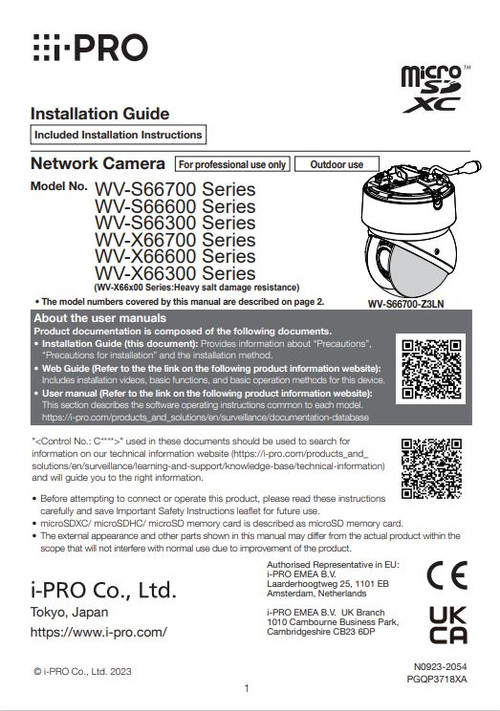
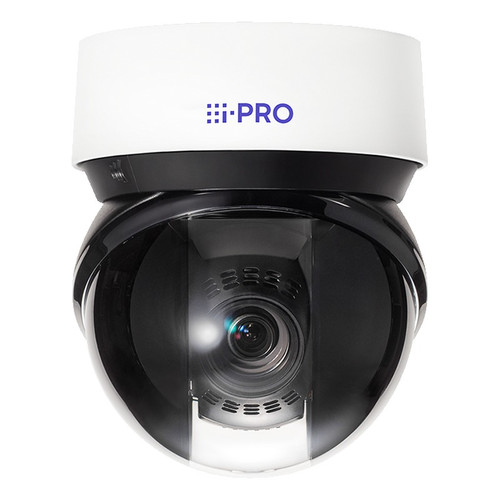
Both the i-PRO WV-S66700-Z3L and WV-X66700-Z3S are 8MP 4K outdoor PTZ dome cameras sharing the same 30x optical zoom platform and Ambarella CV22 SoC. They target the same large-area perimeter surveillance use case and are genuine cross-shop candidates. The comparison focuses on meaningful differentiators: low-light sensitivity, IR illumination range, power draw, network protocol depth, finish materials, and edge storage flexibility — areas where the two models diverge despite their shared optics and PTZ mechanics.
In This Guide
How do the imaging specs compare?
Both cameras share an identically specified 1/2.8-type CMOS sensor (5.57 × 3.13 mm scanning area), the same 4.5–135 mm focal length, F1.8–F4.7 aperture range, 30x optical zoom (extendable to 90x digital at 1280×720), and identical DORI performance: Detect 3,519.7 m, Observe 1,407.9 m, Recognize 703.9 m, Identify 352.0 m at tele. Both deliver 132 dB Super Dynamic WDR, identical BLC/HLC (0–31), DNR (0–255), Fog Compensation (0–8 levels), and the same AGC range (0–11). The S66700-Z3L specifies color minimum illumination at 0.13 Lux (30IRE); the X66700-Z3S specifies 0.1 Lux for B&W only — the S66700-Z3L provides an explicit color sensitivity figure while color minimum illumination is not stated in the X66700-Z3S spec sheet.
The most significant imaging-layer difference is IR illumination. The S66700-Z3L lists a built-in IR LED range of 280 m (30IRE) / 200 m (50IRE), making it a self-illuminating unit suited for unlit perimeters. The X66700-Z3S lists an IR distance of only 3.0 m in its spec data — consistent with a minimal IR assist rather than long-range illumination — making it dependent on external lighting for long-range night coverage. The S66700-Z3L's frame rate is listed as variable; the X66700-Z3S specifies 30 fps. Both resolve up to 3840×2160 and support the same resolution ladder down to 320×180.
What about installation and environment?
Both cameras share the same physical envelope: φ167 mm × 205 mm (H), dome radius SR 77.5 mm, and approximately 3 kg without attachment. Both are rated IP66 and IK10 and are tested to wind resistance of up to 40 m/s (~89 mph). Operating temperature is identical: −50°C to 60°C (power-on from −30°C for the S66700-Z3L; the X66700-Z3S states −50°C to 60°C without a separate power-on qualifier in the provided spec). Both require a single RJ-45 connection (10/100Base-TX) and draw power via PoE++ (IEEE 802.3bt, PoE Class 6). Power consumption differs: the S66700-Z3L draws up to 45.9 W; the X66700-Z3S draws 37.8 W — a 8.1 W delta that matters when budgeting midspan or switch port capacity.
Finish materials differ slightly: the S66700-Z3L uses aluminum die cast with a polycarbonate dome, while the X66700-Z3S adds stainless steel to its material list alongside aluminum die cast and polycarbonate. Both carry UL/c-UL (UL62368-1 / CSA C22.2 No.62368-1), CE, IEC62368-1, FCC Part 15 Class A, ICES-003 Issue 7 Class A, EN55032/55035, and NEMA-TS2 certifications. The S66700-Z3L additionally lists a tamper-resistant enclosure note; the X66700-Z3S includes the same notation. Both support the same PTZ mechanics: 360° endless pan, −20° to +90° tilt, 700°/s preset pan speed, 500°/s preset tilt speed, 256 preset positions, and Auto Track / Auto Pan / Preset Sequence / Patrol auto modes.
Which fits your VMS and analytics better?
Both cameras support ONVIF Profiles G, M, S, and T, and are compatible with Microsoft Edge, Firefox, and Google Chrome. Both support H.265, H.264, and MJPEG compression with constant bit rate, VBR, unicast, and multicast modes, Smart Coding (variable GOP 1–60 s), and JPEG at 10 quality steps. Audio compression is similar — the S66700-Z3L explicitly lists G.726 (16–128 kbps), G.711 (64 kbps), and AAC-LC (64–128 kbps); the X66700-Z3S lists G.726, G.711, and AAC-LC without per-codec bitrate detail. Audio I/O differs: the S66700-Z3L provides 4× 3.5 mm stereo mini jack inputs (−51 to −38 dB) and 1× mono 3.5 mm output (600 Ω, −20 dBV), plus 4× alarm I/O terminals (IN1, IN2, IN3, OUT); the X66700-Z3S provides 1× 3.5 mm stereo mini jack input, 1× 3.5 mm stereo mini jack output (monaural), 3× alarm IN, 1× alarm OUT, and 1× AUX OUT.
Network protocol depth is broader on the X66700-Z3S, which explicitly lists RTSP, SRTP, MQTT, NTCIP, DDNS, UPnP, IGMP, MLD, DHCPv6, SNMPv1/v2/v3, and DiffServ across both IPv4 and IPv6 stacks. The S66700-Z3L's listed protocol set includes TCP/IP, UDP/IP, HTTP/HTTPS, SMTP, DNS, NTP, SNMP, DHCP, and RTP, without enumerating RTSP, SRTP, MQTT, or NTCIP. On-board storage, the X66700-Z3S explicitly supports microSDXC cards up to 512 GB (64/128/256/512 GB stated) with Manual, Alarm, Schedule, and network-failure backup recording modes for both H.265/H.264 and JPEG. The S66700-Z3L lists microSDXC compatibility without specifying maximum supported card capacity in the provided specs. Both cameras carry AI video motion detection and AI face detection. The S66700-Z3L additionally lists vehicle detection in its AI analytics field. Both share identical AI sound classification: gunshot, yell, vehicle horn, and glass break. The S66700-Z3L includes FIPS 140-2 Level 3 and IEEE 802.1X security; the X66700-Z3S lists IEEE 802.1X within its protocol stack.
Which should you choose: the S66700-Z3L or the X66700-Z3S?
Our take: The S66700-Z3L is the stronger choice when long-range IR illumination and multi-channel audio input are priorities. Its 280 m (30IRE) built-in IR LED range dwarfs the X66700-Z3S's 3.0 m IR spec, making it operationally self-sufficient on unlit perimeters; the X66700-Z3S will require supplemental lighting for night-time long-range coverage. The S66700-Z3L also provides 4× audio inputs versus 1× on the X66700-Z3S, and adds FIPS 140-2 Level 3 certification relevant to federal or high-security deployments. Conversely, the X66700-Z3S draws 37.8 W versus 45.9 W — an 8.1 W saving per port that compounds across large deployments on tight PoE budgets. The X66700-Z3S also lists a broader explicit protocol set including RTSP, SRTP, MQTT, and NTCIP, and explicitly supports microSDXC up to 512 GB. Choose the S66700-Z3L for illumination-independent night operation and multi-input audio; choose the X66700-Z3S where power budget, protocol breadth, or confirmed high-capacity edge storage are the deciding constraints.
Side-by-Side Comparison
Spec-for-spec, from manufacturer data.
| Specification | i-PRO S66700-Z3L | i-PRO X66700-Z3S |
|---|---|---|
| Resolution | 8MP (3840×2160) | 8MP (3840×2160) |
| Image Sensor | Approx. 1/2.8-type CMOS, 5.57×3.13 mm | Approx. 1/2.8-type CMOS, 5.57×3.13 mm |
| Lens / Focal Length | 4.5–135 mm, 30x optical, 90x digital, F1.8–F4.7 | 4.5–135 mm, 30x optical, 90x digital, F1.8–F4.7 |
| Min. Illumination | 0.13 Lux color (30IRE) | 0.1 Lux B&W (color not specified in provided specs) |
| IR Illumination Range | 280 m (30IRE) / 200 m (50IRE) | 3.0 m (per provided specs) |
| WDR / Dynamic Range | Max. 132 dB (Super Dynamic On, Level 31) | Max. 132 dB (Super Dynamic On, Level 31) |
| Max Frame Rate | Variable (not specified as fixed fps) | 30 fps |
| Video Compression | H.265, H.264, MJPEG | H.265, H.264, MJPEG |
| IP Rating | IP66 | IP66 |
| Impact / Vandal Rating | IK10 (IEC 62262) | IK10 |
| Operating Temperature | −50°C to 60°C (power-on: −30°C to 60°C) | −50°C to 60°C |
| Power Input / PoE Class | PoE++ (IEEE 802.3bt) / Class 6 / 45.9 W | PoE++ (IEEE 802.3bt) / Class 6 / 37.8 W |
| Edge Storage | microSDXC (max capacity not specified in provided specs) | microSDXC up to 512 GB (64/128/256/512 GB) |
| Audio Input | 4× 3.5 mm stereo mini jack (−51 to −38 dB) | 1× 3.5 mm stereo mini jack |
| Alarm I/O | 4× (IN1, IN2, IN3, OUT) | 3× Alarm IN, 1× Alarm OUT, 1× AUX OUT |
| Security Certifications | FIPS 140-2 Level 3, IEEE 802.1X, HTTPS | IEEE 802.1X (within protocol stack), HTTPS |
| Finish / Housing Material | Aluminum die cast, polycarbonate dome | Aluminum die cast, stainless steel, polycarbonate dome |
| Dimensions (max) | φ167 mm × 205 mm (H) | φ167 mm × 205 mm (H) |
| Weight | Approx. 3 kg (without attachment) | Approx. 3 kg (without attachment) |
| Warranty | 5-year | 5-year |
Frequently Asked Questions
Which should you choose: the S66700-Z3L or the X66700-Z3S?
The S66700-Z3L is the stronger choice when long-range IR illumination and multi-channel audio input are priorities. Its 280 m (30IRE) built-in IR LED range dwarfs the X66700-Z3S's 3.0 m IR spec, making it operationally self-sufficient on unlit perimeters; the X66700-Z3S will require supplemental lighting for night-time long-range coverage. The S66700-Z3L also provides 4× audio inputs versus 1× on the X66700-Z3S, and adds FIPS 140-2 Level 3 certification relevant to federal or high-security deployments. Conversely, the X66700-Z3S draws 37.8 W versus 45.9 W — an 8.1 W saving per port that compounds across large deployments on tight PoE budgets. The X66700-Z3S also lists a broader explicit protocol set including RTSP, SRTP, MQTT, and NTCIP, and explicitly supports microSDXC up to 512 GB. Choose the S66700-Z3L for illumination-independent night operation and multi-input audio; choose the X66700-Z3S where power budget, protocol breadth, or confirmed high-capacity edge storage are the deciding constraints.
Is the S66700-Z3L or X66700-Z3S better for low-light and night surveillance without external lighting?
The S66700-Z3L is substantially better for unlit environments. Its built-in IR LEDs are rated to illuminate at 280 m (30IRE) / 200 m (50IRE). The X66700-Z3S lists an IR distance of only 3.0 m per its provided specifications, meaning it relies on external lighting for meaningful long-range night-time coverage. If IR self-sufficiency at distance is required, the S66700-Z3L is the clear choice.
Do both cameras work with the same VMS platforms via ONVIF?
Yes. Both the S66700-Z3L and X66700-Z3S support ONVIF Profiles G, M, S, and T, ensuring broad compatibility with ONVIF-conformant VMS platforms. The X66700-Z3S enumerates a wider explicit protocol list (including RTSP, SRTP, MQTT, NTCIP, and SNMPv1/v2/v3) in its provided specifications, which may matter for integration with traffic-management systems or MQTT-based IoT architectures. Standard IP surveillance VMS integrations are supported by both.
Which camera draws less power, and does it matter for PoE switch planning?
The X66700-Z3S draws 37.8 W versus the S66700-Z3L's 45.9 W — a difference of 8.1 W per port. Both require PoE++ (IEEE 802.3bt) Class 6 switches or midspans. On a 24-port deployment, the X66700-Z3S would draw approximately 194 W less in aggregate, which can meaningfully affect switch selection, UPS sizing, and rack power allocation. If power budget is constrained, the X66700-Z3S offers the same PTZ optics platform at lower per-port consumption.
Get a Second Opinion on Your Camera Choice
Share your site layout, coverage goals, and budget. Our team will validate the camera selection, flag anything we would change, and recommend products that match the use case.