
i-PRO S22500-F3L vs i-PRO X25500-V3LN: Specification Comparison
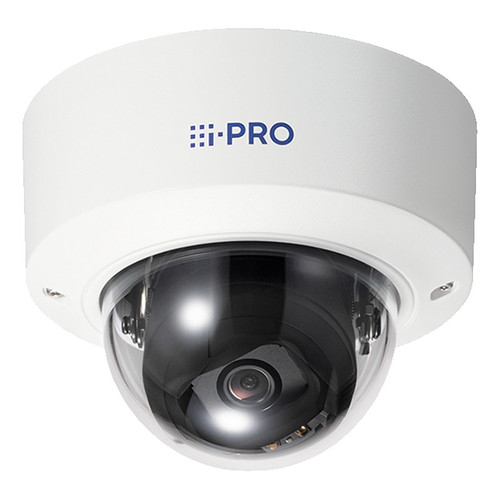
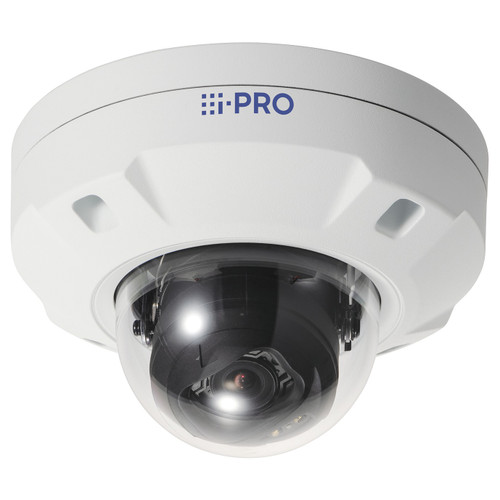
Both the i-PRO WV-S22500-F3L and WV-X25500-V3LN are fixed 5MP dome cameras sharing the same 1/2.8-type CMOS sensor and 30 fps maximum frame rate. The comparison is meaningful for integrators deciding between an IK10-rated indoor vandal dome and an IP66/NEMA 4X outdoor dome with motorized varifocal optics. Key decision axes include lens flexibility, IR reach, temperature tolerance, power budget, and AI analytics depth.
In This Guide
How do the imaging specs compare?
Both cameras use an approximately 1/2.8-type CMOS sensor with a 5.12 mm (H) × 3.84 mm (V) scanning area and deliver a maximum resolution of 3072×2304 at 30 fps with identical Super Dynamic WDR (132 dB max at Level 31), the same DNR range (0–255), and the same BLC/HLC adjustment range (0–31). The S22500-F3L uses a fixed 3.2 mm lens at f/2.0 with auto-focus and 1–3× digital extra zoom, giving a 95° horizontal field of view. The X25500-V3LN counters with a 2.9–9 mm motorized varifocal lens at f/1.3 (wide) to f/2.5 (tele), providing 3.1× optical zoom and a horizontal FOV of 33–103°, with extra zoom extending to 12.4× at reduced resolution.
Low-light performance differs: the S22500-F3L specifies 0.12 lx (color) and 0.1 lx (B&W), with IR reaching 25 m at 30 IRE. The X25500-V3LN specifies 0.02 lx (B&W with IR LED) — a 5× sensitivity advantage — and IR range of 70 m (230 ft), nearly three times the indoor model's 25 m. DORI figures also diverge significantly at tele: the X25500-V3LN achieves a Detect range of 207.4 m and Identify of 20.7 m at tele versus the S22500-F3L's fixed Detect of 56.3 m and Identify of 5.6 m. The X25500-V3LN also adds an electronic image stabilizer (On/Off, 30 fps mode only) not present on the S22500-F3L. Both carry the Ambarella SoC platform, with the S22500-F3L on CV22 and the X25500-V3LN on the newer CV52.
What about installation and environment?
The S22500-F3L is rated for indoor use with no stated IP ingress protection, an operating temperature of −10 °C to +50 °C, and humidity of 10–90% (no condensation). Its IK10 aluminum die-cast housing provides 20-joule impact resistance per IEC 62262. It draws power via PoE 802.3af (PoE Class 0) or DC 12 V at 880 mA. Physical dimensions are ø129.5 mm × 102.5 mm (H), and it weighs approximately 800 g.
The X25500-V3LN is designed for outdoor deployment with IP66/IP67 ingress protection, NEMA 4X and Type 4X (UL50E) compliance, and a dramatically wider operating temperature of −40 °C to +55 °C (power-on from −30 °C). It shares the IK10 impact rating but adds wind resistance up to 40 m/s (approx. 89 mph) and a 50 J shock spec per IEC 60068-2-75. It requires PoE+ 802.3at (Class 4) at up to 14.2 W — a higher power budget than the indoor model. The outdoor camera is physically larger at ø154 mm × 105 mm (H) and heavier at approximately 1.1 kg. Its aluminum die-cast and stainless-steel finish replaces the indoor model's polycarbonate dome.
Which fits your VMS and analytics better?
Both cameras support ONVIF Profiles G, M, S, and T; up to 14 simultaneous users; identical IPv4 and IPv6 protocol stacks (including SRTP, SFTP, MQTT, LLDP); and microSDXC edge storage up to 512 GB. Both provide 3× Alarm IN, 1× Alarm OUT, and 1× AUX OUT terminals, and share the same audio I/O connector types (3.5 mm stereo mini jack in, 3.5 mm stereo jack out). Audio compression on both includes G.726 and G.711; the X25500-V3LN explicitly adds AAC-LC. The S22500-F3L lists FIPS 140-2 Level 3 and NXP SE050F hardware security in its spec; the X25500-V3LN lists Secure Boot in product attributes but does not enumerate an equivalent FIPS certification in the provided specs.
AI analytics breadth differs: the S22500-F3L specifies AI Video Motion Detection, Face Detection, and Vehicle Detection. The X25500-V3LN specifies 'AI Video Analytics (8 detection types)' but the provided specs do not enumerate all eight types by name. Both cameras share the same four AI sound-classification categories (Gunshot, Yell, Vehicle Horn, Glass Break) and the same VMD/SCD configuration (4 VMD areas, 1 SCD area). The X25500-V3LN adds an Image Stabilizer feature absent from the S22500-F3L. Both carry a 5-year warranty and share the same UL/CE/IEC 62368-1 safety certifications, though EMC classification differs: the S22500-F3L is EN55032 Class B, while the X25500-V3LN is EN55032 Class A.
Which should you choose: the S22500-F3L or the X25500-V3LN?
Our take: The S22500-F3L is the stronger choice when the deployment is strictly indoors, PoE 802.3af infrastructure is already in place, and a wide fixed FOV (95° horizontal) covers the required area without optical zoom. The X25500-V3LN is the appropriate selection for outdoor or harsh-environment installations: it extends the IR range from 25 m to 70 m (a 2.8× increase), widens the operating temperature floor from −10 °C to −40 °C, adds IP66/IP67/NEMA 4X weatherproofing absent from the indoor model, and provides 3.1× motorized optical zoom enabling remote focal-length adjustment after installation. The trade-off is a higher power requirement (PoE+ 802.3at vs. 802.3af) and greater physical weight (1.1 kg vs. 0.8 kg). Both carry identical 5-year warranties, ONVIF G/M/S/T profiles, and 512 GB microSDXC support. Select the S22500-F3L for controlled indoor vandal-risk zones; specify the X25500-V3LN for perimeter, parking, or any environment requiring weather sealing, extended IR, or variable coverage angles.
Side-by-Side Comparison
Spec-for-spec, from manufacturer data.
| Specification | i-PRO S22500-F3L | i-PRO X25500-V3LN |
|---|---|---|
| Resolution | 5MP (3072×2304 max) | 5MP (3072×2304 max) |
| Image Sensor | Approx. 1/2.8-type CMOS | Approx. 1/2.8-type CMOS |
| Lens / Focal Length | 3.2 mm fixed, f/2.0, auto-focus | 2.9–9 mm motorized varifocal, f/1.3–2.5 |
| Optical Zoom | 1× (1–3× digital extra zoom) | 3.1× optical (up to 12.4× extra zoom) |
| Horizontal FOV | 95° | 33°–103° (wide to tele) |
| Min. Illumination | 0.12 lx (color); 0.1 lx (B&W with IR) | 0.02 lx (B&W with IR LED) |
| IR Range | 25 m (30 IRE) | 70 m (230 ft) |
| WDR (Super Dynamic) | Max. 132 dB (Level 31) | Max. 132 dB (Level 31) |
| Max Frame Rate | 30 fps | 30 fps |
| Video Compression | H.265, H.264, MJPEG | H.265, H.264, MJPEG |
| IP Rating | — (indoor; no IP ingress rating stated) | IP66 / IP67 / NEMA 4X / Type 4X |
| IK / Impact Rating | IK10 (IEC 62262) | IK10 (IEC 62262); 50 J (IEC 60068-2-75) |
| Operating Temperature | −10 °C to +50 °C | −40 °C to +55 °C (power-on: −30 °C) |
| Power Input / PoE Class | PoE 802.3af (Class 0) or DC 12 V / 880 mA | PoE+ 802.3at (Class 4) or DC 12 V / 14.2 W max |
| Edge Storage | Up to 512 GB microSDXC | Up to 512 GB microSDXC |
| ONVIF Profiles | G / M / S / T | G / M / S / T |
| AI Analytics | AI VMD, Face Detection, Vehicle Detection | AI Video Analytics (8 detection types stated) |
| Audio Compression | G.726, G.711 | G.726, G.711, AAC-LC |
| Image Stabilization | — | Yes (30 fps mode) |
| Hardware Security | FIPS 140-2 Level 3, NXP SE050F | Secure Boot (FIPS not stated in provided specs) |
| Dimensions | ø129.5 mm × 102.5 mm (H) | ø154 mm × 105 mm (H) |
| Weight | Approx. 800 g (1.77 lbs) | Approx. 1.1 kg (2.43 lbs) |
| Environment Rating | Indoor | Outdoor |
| Warranty | 5-Year | 5-Year |
Frequently Asked Questions
Which should you choose: the S22500-F3L or the X25500-V3LN?
The S22500-F3L is the stronger choice when the deployment is strictly indoors, PoE 802.3af infrastructure is already in place, and a wide fixed FOV (95° horizontal) covers the required area without optical zoom. The X25500-V3LN is the appropriate selection for outdoor or harsh-environment installations: it extends the IR range from 25 m to 70 m (a 2.8× increase), widens the operating temperature floor from −10 °C to −40 °C, adds IP66/IP67/NEMA 4X weatherproofing absent from the indoor model, and provides 3.1× motorized optical zoom enabling remote focal-length adjustment after installation. The trade-off is a higher power requirement (PoE+ 802.3at vs. 802.3af) and greater physical weight (1.1 kg vs. 0.8 kg). Both carry identical 5-year warranties, ONVIF G/M/S/T profiles, and 512 GB microSDXC support. Select the S22500-F3L for controlled indoor vandal-risk zones; specify the X25500-V3LN for perimeter, parking, or any environment requiring weather sealing, extended IR, or variable coverage angles.
Is the S22500-F3L or X25500-V3LN better for low-light performance?
Based on the provided specs, the X25500-V3LN has a significantly lower minimum illumination of 0.02 lx (B&W with IR) compared to the S22500-F3L's 0.1 lx (B&W with IR). The X25500-V3LN also provides 70 m of IR illumination versus 25 m on the S22500-F3L, making it the stronger performer in low-light and long-range night-time scenarios.
Can the X25500-V3LN be used indoors instead of the S22500-F3L?
The X25500-V3LN is rated IP66/IP67/NEMA 4X and operates from −40 °C to +55 °C, so it can physically be installed indoors. However, it requires PoE+ (802.3at, up to 14.2 W) rather than standard PoE (802.3af), so indoor PoE switches must support Class 4 ports. The S22500-F3L includes a FIPS 140-2 Level 3 hardware security element in its specs; an equivalent certification is not stated for the X25500-V3LN in the provided data — a factor for high-security indoor deployments.
Do both cameras support the same VMS integrations via ONVIF?
Yes — both the S22500-F3L and X25500-V3LN support ONVIF Profiles G, M, S, and T, the same IPv4/IPv6 protocol stack, and up to 14 simultaneous users. Any VMS platform compatible with those ONVIF profiles will work with either camera. The primary integration differences are the X25500-V3LN's AAC-LC audio codec (not listed for the S22500-F3L) and the X25500-V3LN's broader stated AI analytics scope ('8 detection types' versus the three explicitly named on the S22500-F3L).
Get a Second Opinion on Your Camera Choice
Share your site layout, coverage goals, and budget. Our team will validate the camera selection, flag anything we would change, and recommend products that match the use case.