
i-PRO S22500-F3L vs i-PRO S22500-V3LG: Specification Comparison
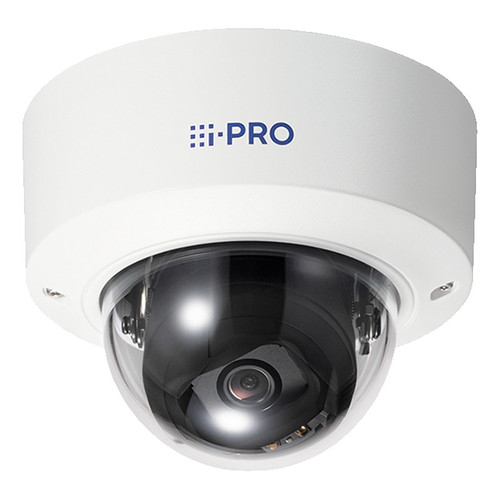
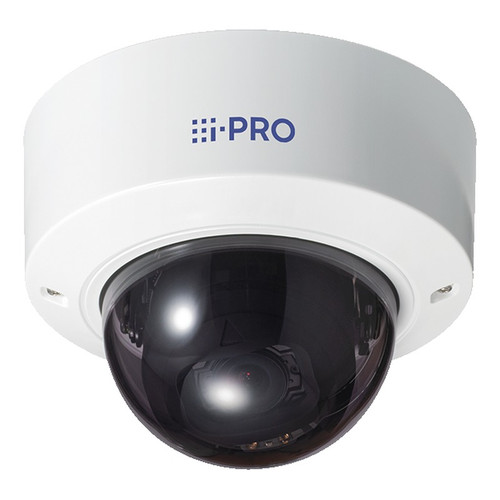
Both the WV-S22500-F3L and WV-S22500-V3LG are i-PRO 5MP IK10-rated vandal-resistant indoor dome cameras sharing the same 1/2.8-type CMOS sensor, Ambarella CV22 SoC, and 132 dB Super Dynamic WDR. The primary differentiator is optical design: the F3L ships with a fixed 3.2 mm lens while the V3LG carries a 3.1x motorized varifocal lens (2.9–9 mm). This comparison examines how that optical difference—along with low-light performance, DORI reach, and feature set—should drive the purchasing decision.
In This Guide
How do the imaging specs compare?
Both cameras resolve 5MP (3072×2304 at 30 fps) using an identical 1/2.8-type CMOS sensor with a 5.12 mm × 3.84 mm scanning area and the same Ambarella CV22 SoC, delivering up to 132 dB dynamic range with Super Dynamic enabled at level 31. The critical optical divergence is the lens: the F3L uses a fixed 3.2 mm, f/2.0 lens covering a horizontal field of view of approximately 95°, while the V3LG uses a 3.1x motorized varifocal 2.9–9 mm lens with an aperture of f/1.3 (wide) to f/2.5 (tele), spanning 105° to 33°. The V3LG's wider maximum aperture at f/1.3 gives it a measurable low-light advantage.
Low-light performance reflects that aperture difference. The F3L achieves 0.12 lx color and 0.1 lx monochrome (with 0 lx IR-assisted), while the V3LG is rated 0.15 lx color and 0.12 lx monochrome—making the F3L slightly more sensitive in passive low-light conditions. IR range is 25 m on both models. The F3L's fixed lens provides a DORI detect distance of 56.3 m, while the V3LG reaches 47.1 m (wide) or 207.4 m (tele), meaning the V3LG in tele mode dramatically extends detection range. The F3L's digital extra zoom reaches 1x–3x (at 640×360); the V3LG's motorized optical zoom extends to 3.1x–9.3x at the same resolution, with no image quality penalty for optical zoom unlike digital.
What about installation and environment?
Both cameras share an identical physical profile: ø129.5 mm × 102.5 mm (H), 800 g, aluminum die-cast body with polycarbonate dome, IK10-rated per IEC 62262 (20-joule impact resistance), and are rated for indoor use only—neither carries an IP ingress rating for outdoor installation. Operating temperature is –10°C to +50°C for both, with humidity 10–90% (no condensation). The V3LG adds a power-on temperature qualifier of 0°C to +50°C, which the F3L spec does not explicitly state.
Both cameras support DC 12V and PoE IEEE 802.3af (PoE Class 0). The V3LG spec explicitly states 12W power consumption; the F3L spec states DC12V 880mA but does not list a watt figure. Adjusting angle coverage is nearly identical: horizontal ±240°, vertical ±85°, yaw ±100° on the F3L; horizontal –240° to +120°, vertical –30° to +85°, yaw ±100° on the V3LG. A monitor output for optical adjustment is present on both (composite video). Both use RJ45 10/100Base-TX network interfaces.
Which fits your VMS and analytics better?
Both cameras are certified to ONVIF Profiles G, M, S, and T, ensuring broad VMS compatibility. Security hardening is equivalent: FIPS 140-2 Level 3, NXP SE050F secure element, IEEE 802.1X, HTTPS/SSL-TLS, SNMPv1/v2/v3, SRTP, SFTP, and MQTT are present on both. Edge storage supports microSDXC up to 512 GB on both; the V3LG additionally lists microSDHC (4–32 GB) and microSD (2 GB) compatibility explicitly. Protocol support is broader on the F3L (its IPv6 stack lists the full protocol suite including ARP, ICMP, IEEE 802.1X, DiffServ, FTP, SFTP, MQTT, LLDP), while the V3LG IPv6 spec lists only TCP/IP, UDP/IP, HTTP, HTTPS, and MQTT—a potential consideration in dual-stack enterprise environments.
AI analytics are functionally equivalent: both offer AI Video Motion Detection, Face Detection, and Vehicle Detection, plus identical AI Sound Classification (gunshot, yell, vehicle horn, glass break) and audio detection. Both support 4-area VMD, scene change detection, and up to 8 privacy zones and VIQS regions. Audio I/O is identical: 3.5 mm stereo mic input (plug-in power) and 3.5 mm stereo line output (600 Ω, –20 dBV), with G.726/G.711 compression and half/full duplex modes. Both carry a 5-year warranty and support iOS/Android mobile clients.
Which should you choose: the S22500-F3L or the S22500-V3LG?
Our take: The S22500-V3LG is the stronger choice when coverage flexibility and long-range identification are required at a single mounting point. Its 3.1x motorized optical zoom (2.9–9 mm, f/1.3–f/2.5) extends DORI identify distance to 20.7 m in tele versus the F3L's fixed 5.6 m—a 3.7× improvement—and its tele DORI detect reaches 207.4 m versus the F3L's 56.3 m, a difference of 151 m. Conversely, the F3L's f/2.0 fixed lens and rated 0.12 lx color (versus the V3LG's 0.15 lx) makes it marginally more sensitive in passive low-light wide-angle coverage, and its fixed optics eliminate motorized mechanism maintenance. Both are indoor-only, IK10, PoE Class 0, FIPS 140-2 Level 3, with identical sensor, WDR, AI analytics, and 5-year warranty. Choose the V3LG for corridors, lobbies, or transit environments where zoom-to-detail is operationally necessary; choose the F3L for fixed wide-angle coverage where lens simplicity and marginal passive low-light sensitivity take priority.
Side-by-Side Comparison
Spec-for-spec, from manufacturer data.
| Specification | i-PRO S22500-F3L | i-PRO S22500-V3LG |
|---|---|---|
| Resolution | 5MP (3072×2304) | 5MP (3072×2304) |
| Image Sensor | 1/2.8-type CMOS | 1/2.8-type CMOS |
| System on Chip | Ambarella CV22 | Ambarella CV22 |
| Lens / Focal Length | Fixed 3.2 mm | Motorized varifocal 2.9–9 mm (3.1x optical) |
| Maximum Aperture | f/2.0 | f/1.3 (wide) – f/2.5 (tele) |
| Horizontal Field of View | ~95° | 33°–105° |
| Min Illumination (Color) | 0.12 lx | 0.15 lx (30IRE) |
| Min Illumination (B&W) | 0.1 lx | 0.12 lx (F1.3) |
| IR Range | 25 m (82 ft) | 25 m (82 ft) |
| DORI Detect | 56.3 m (184.7 ft) | Wide: 47.1 m / Tele: 207.4 m |
| DORI Identify | 5.6 m (18.5 ft) | Wide: 4.7 m / Tele: 20.7 m |
| Dynamic Range (WDR) | 132 dB (Super Dynamic On, Level 31) | 132 dB (Super Dynamic On, Level 31) |
| Max Frame Rate | 30 fps | 30 fps |
| Video Compression | H.265, H.264, MJPEG | H.265, H.264, MJPEG |
| IK / Impact Rating | IK10 (IEC 62262) | IK10 (IEC 62262) |
| IP Rating | Indoor rated (no IP ingress rating stated) | Indoor rated (no IP ingress rating stated) |
| Operating Temperature | –10°C to +50°C | –10°C to +50°C (power-on: 0°C to +50°C) |
| Power Input | DC 12V 880mA or PoE (802.3af) | DC 12V / 1A or PoE (802.3af), 12W |
| PoE Class | Class 0 | Class 0 |
| Edge Storage | microSDXC up to 512 GB | microSDXC up to 512 GB; also microSDHC and microSD |
| ONVIF Profiles | G / M / S / T | G / M / S / T |
| AI Analytics | AI Motion Detection, Face Detection, Vehicle Detection | AI Motion, Face Detection, Vehicle Detection |
| AI Sound Classification | Gunshot, Yell, Vehicle horn, Glass break | Gunshot, Yell, Vehicle horn, Glass break |
| Audio I/O | 3.5mm mic in / 3.5mm line out | 3.5mm mic in / 3.5mm line out |
| Security | FIPS 140-2 Level 3, NXP SE050F | FIPS 140-2 Level 3, NXP EdgeLock SE050F |
| Dimensions | ø129.5 mm × 102.5 mm (H) | ø129.5 mm × 102.5 mm (H) |
| Weight | 800 g (1.77 lbs) | 800 g (1.77 lbs) |
| Warranty | 5 years | 5 years |
Frequently Asked Questions
Which should you choose: the S22500-F3L or the S22500-V3LG?
The S22500-V3LG is the stronger choice when coverage flexibility and long-range identification are required at a single mounting point. Its 3.1x motorized optical zoom (2.9–9 mm, f/1.3–f/2.5) extends DORI identify distance to 20.7 m in tele versus the F3L's fixed 5.6 m—a 3.7× improvement—and its tele DORI detect reaches 207.4 m versus the F3L's 56.3 m, a difference of 151 m. Conversely, the F3L's f/2.0 fixed lens and rated 0.12 lx color (versus the V3LG's 0.15 lx) makes it marginally more sensitive in passive low-light wide-angle coverage, and its fixed optics eliminate motorized mechanism maintenance. Both are indoor-only, IK10, PoE Class 0, FIPS 140-2 Level 3, with identical sensor, WDR, AI analytics, and 5-year warranty. Choose the V3LG for corridors, lobbies, or transit environments where zoom-to-detail is operationally necessary; choose the F3L for fixed wide-angle coverage where lens simplicity and marginal passive low-light sensitivity take priority.
Is the S22500-F3L or S22500-V3LG better for low-light performance?
The S22500-F3L has a slight edge in passive low-light sensitivity: it is rated 0.12 lx color and 0.1 lx monochrome versus the V3LG's 0.15 lx color and 0.12 lx monochrome. Both include 25 m IR illuminators that bring sensitivity to 0 lx in IR-assisted mode (F3L spec explicitly states 0 lx with IR; V3LG spec does not explicitly state this figure). The V3LG's f/1.3 maximum aperture at the wide end partially offsets its higher lux ratings, but on stated specifications the F3L is marginally more sensitive.
Can the S22500-V3LG cover more distance than the S22500-F3L?
Yes, significantly at tele. The V3LG in tele mode reaches a DORI detect distance of 207.4 m and DORI identify of 20.7 m. The F3L's fixed lens achieves DORI detect of 56.3 m and DORI identify of 5.6 m. At wide angle, the V3LG's DORI detect is 47.1 m—slightly less than the F3L's 56.3 m—so for pure wide-angle coverage the F3L marginally out-performs on detection range, but the V3LG's motorized zoom makes it far more versatile.
Do both cameras work with the same VMS and NVR platforms?
Yes. Both are ONVIF Profile G, M, S, and T certified, which covers the vast majority of enterprise VMS and NVR platforms. Both run on the same Ambarella CV22 SoC and share identical AI analytics capabilities (face, vehicle, AI motion detection). The one noted difference is that the F3L's IPv6 protocol stack is documented more completely in the provided specs; buyers with strict dual-stack IPv6 requirements should verify V3LG IPv6 capability with i-PRO directly, as its listed IPv6 protocols are a subset of what appears in the F3L spec.
Get a Second Opinion on Your Camera Choice
Share your site layout, coverage goals, and budget. Our team will validate the camera selection, flag anything we would change, and recommend products that match the use case.