
i-PRO MR-8C-I3-2TB-W-V1 vs i-PRO MR-8C-I3-4TB-V5: Specification Comparison
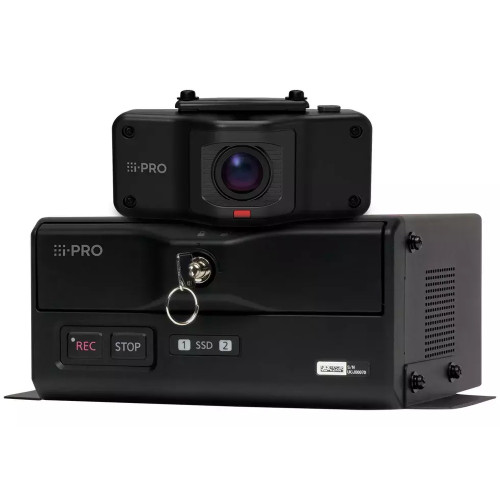
Both the i-PRO MR-8C-I3-2TB-W-V1 and MR-8C-I3-4TB-V5 are 8-channel mobile NVRs built for in-vehicle surveillance deployments such as patrol cars, transit buses, and fleet vehicles. They share the same form factor, processor class, channel count, PoE standard, and wide-voltage DC power input. The primary differentiator is onboard storage capacity — 2TB versus 4TB — along with video compression support explicitly documented for the V5 variant. This comparison helps installers and fleet operators decide which unit best fits their recording duration and budget requirements.

In This Guide
- How does storage capacity and recording capability differ between the two units?
- Are the power input and environmental ruggedization specs equivalent across both models?
- Do both units offer the same integration, PoE support, and camera compatibility?
- Which should you choose: the MR-8C-I3-2TB-W-V1 or the MR-8C-I3-4TB-V5?
- Side-by-Side Specs
- FAQ
How does storage capacity and recording capability differ between the two units?
The MR-8C-I3-2TB-W-V1 provides 2TB of onboard storage. The MR-8C-I3-4TB-V5 provides 4TB — double the capacity. Both units list microSD as a local storage type alongside their primary drive.
The MR-8C-I3-4TB-V5 explicitly lists H.265 and H.264 video compression support in its provided specifications. The MR-8C-I3-2TB-W-V1 specs do not include a compression codec entry, so no compression claim can be made for that model based on the data provided.
Both units are described as 8-channel simultaneous recording platforms. The V5 variant lists 8-channel simultaneous recording as an explicit spec field; the W-V1 references 8-channel operation in its marketing bullets but not as a discrete structured spec. For buyers prioritizing extended multi-shift or multi-day recording windows without offload, the 4TB V5 offers a direct capacity advantage.
Are the power input and environmental ruggedization specs equivalent across both models?
Both units share a wide-voltage DC input range of 9–36V, making them compatible with standard 12V and 24V vehicle electrical systems found in patrol cars, transit buses, and commercial fleet vehicles. This spec is explicitly stated for the MR-8C-I3-4TB-V5 and referenced in the marketing content for the MR-8C-I3-2TB-W-V1.
The MR-8C-I3-4TB-V5 lists 'ruggedized' storage and references suitability for extreme mobile environments as explicit spec fields. The MR-8C-I3-2TB-W-V1 references vibration resistance in its bullet points but does not carry equivalent structured ruggedization spec entries in the provided data.
Both units list a 3-year warranty. Physical dimensions of 10.24" (W) x 10.08" (D) x 3.55" (H) appear in both products' Operating System fields — a likely data-mapping artifact — suggesting identical chassis dimensions, though this should be confirmed against official datasheets. Housing color is listed as White for both models.
Do both units offer the same integration, PoE support, and camera compatibility?
Both the MR-8C-I3-2TB-W-V1 and MR-8C-I3-4TB-V5 list PoE (802.3af) as their PoE power standard, enabling direct powered-camera connections without a separate injector on supported ports.
Both units reference an Intel Core i3 processor — as a structured spec in the V5 and as a bullet reference in the W-V1 — placing them in the same processing tier for video analytics and stream management.
Both models reference third-party camera license compatibility for Vi/Transit platforms in their Battery Life and Battery spec fields (a data-mapping artifact reflecting license notes). Resolution is listed as VGA (640x480) for both units at the structured spec level; actual supported camera resolutions should be confirmed via the linked datasheets, as VGA likely reflects a minimum or legacy spec entry rather than the maximum supported resolution. No NVR management software version differences are documented in the provided specifications.
Which should you choose: the MR-8C-I3-2TB-W-V1 or the MR-8C-I3-4TB-V5?
Our take: The MR-8C-I3-2TB-W-V1 is the stronger choice when installation budgets are constrained and recording duration requirements fit within 2TB, while the MR-8C-I3-4TB-V5 is the stronger choice for deployments demanding extended continuous recording or multi-shift coverage without frequent offload. The V5 offers double the storage — 4TB versus 2TB — which directly extends on-vehicle retention before footage must be transferred or overwritten. The V5 also explicitly documents H.265 and H.264 compression support, a spec absent from the W-V1's provided data, which matters for bandwidth and storage efficiency calculations in multi-camera deployments. Both units share the same 8-channel capacity, Intel Core i3 processor class, 9–36V DC wide-voltage input, 802.3af PoE, and 3-year warranty, so the choice reduces to storage tier. Fleet operators running extended shifts, long interstate routes, or high-camera-count configurations should select the MR-8C-I3-4TB-V5; shorter patrol or shuttle deployments with regular docking and offload may find the MR-8C-I3-2TB-W-V1 sufficient.
Side-by-Side Comparison
Spec-for-spec, from manufacturer data.
| Specification | i-PRO MR-8C-I3-2TB-W-V1 | i-PRO MR-8C-I3-4TB-V5 |
|---|---|---|
| Product Type | Mobile NVR | Mobile NVR |
| Recording Channels | 8-channel | 8-channel |
| Storage Capacity | 2TB | 4TB |
| Local Storage Type | microSD | microSD |
| Processor | Intel Core i3 (bullet reference) | Intel Core i3 |
| Video Compression | — | H.265 and H.264 |
| PoE Standard | PoE (802.3af) | PoE (802.3af) |
| Power Input | 9–36V DC (bullet reference) | 9–36V DC |
| Housing Color | White | White |
| Dimensions (W x D x H) | 10.24" x 10.08" x 3.55" | 10.24" x 10.08" x 3.55" |
| Resolution (Spec Field) | VGA (640x480) | VGA (640x480) |
| Ruggedized Storage | — | Listed as ruggedized |
| Operating Environment | — | Extreme mobile environments |
| Warranty | 3 Year(s) | 3 Year(s) |
| 3rd-Party Camera License Note | Vi / Transit (referenced) | Vi / Transit (referenced) |
| Form Factor | Mobile NVR | Mobile NVR |
Frequently Asked Questions
Which should you choose: the MR-8C-I3-2TB-W-V1 or the MR-8C-I3-4TB-V5?
The MR-8C-I3-2TB-W-V1 is the stronger choice when installation budgets are constrained and recording duration requirements fit within 2TB, while the MR-8C-I3-4TB-V5 is the stronger choice for deployments demanding extended continuous recording or multi-shift coverage without frequent offload. The V5 offers double the storage — 4TB versus 2TB — which directly extends on-vehicle retention before footage must be transferred or overwritten. The V5 also explicitly documents H.265 and H.264 compression support, a spec absent from the W-V1's provided data, which matters for bandwidth and storage efficiency calculations in multi-camera deployments. Both units share the same 8-channel capacity, Intel Core i3 processor class, 9–36V DC wide-voltage input, 802.3af PoE, and 3-year warranty, so the choice reduces to storage tier. Fleet operators running extended shifts, long interstate routes, or high-camera-count configurations should select the MR-8C-I3-4TB-V5; shorter patrol or shuttle deployments with regular docking and offload may find the MR-8C-I3-2TB-W-V1 sufficient.
Is the MR-8C-I3-2TB-W-V1 or MR-8C-I3-4TB-V5 better for transit buses running extended multi-shift routes?
Based on the provided specifications, the MR-8C-I3-4TB-V5 is better suited for extended multi-shift transit operations. Its 4TB storage capacity is double that of the MR-8C-I3-2TB-W-V1's 2TB, providing more on-vehicle retention before footage must be offloaded. The V5 also explicitly lists ruggedized storage and suitability for extreme mobile environments in its spec data, whereas those characteristics appear only in the W-V1's marketing bullets and not as structured spec entries.
Do both the MR-8C-I3-2TB-W-V1 and MR-8C-I3-4TB-V5 support H.265 compression?
Only the MR-8C-I3-4TB-V5 explicitly lists H.265 and H.264 video compression in its provided specifications. The MR-8C-I3-2TB-W-V1 specs do not include a compression codec entry in the data provided, so no H.265 claim can be confirmed for that model from this source alone. Installers requiring confirmed H.265 support should consult the MR-8C-I3-2TB-W-V1 datasheet at the linked path before specifying that unit.
Are the two units mechanically interchangeable in an existing vehicle mount?
Based on the specification data provided, both units show identical dimension values — 10.24" (W) x 10.08" (D) x 3.55" (H) — though this data appears in an atypical spec field (Operating System) for both products, suggesting a possible data-mapping issue. Both are classified as Mobile NVR form factor with white housing. Physical interchangeability should be confirmed against each unit's official datasheet before assuming a direct chassis swap in an existing vehicle bracket installation.
Get a Second Opinion on Your Camera Choice
Share your site layout, coverage goals, and budget. Our team will validate the camera selection, flag anything we would change, and recommend products that match the use case.