
Honeywell CW45-X0N-BND10XG vs Unitech HT330-QA62TM3G-Z3: Specification Comparison
Both the Honeywell CW45-X0N-BND10XG and the Unitech HT330-QA62TM3G-Z3 are wrist/body-worn Android devices targeting warehouse, logistics, and field operations — a product class where buyers weigh compute power, durability, wireless stack, and battery endurance. The Honeywell is a full wearable mobile computer; the Unitech is a wearable scanner terminal with a physical keypad. Despite the sub-type difference, both are self-contained wearable data-capture units running Android that a procurement team would legitimately cross-shop for hands-free picking and scanning deployments.
In This Guide
- Which device delivers more processing power and a better user display?
- How do the two devices compare on ruggedness and wireless connectivity?
- Which unit is better suited for full-shift deployment and software integration?
- Which should you choose: the CW45-X0N-BND10XG or the HT330-QA62TM3G-Z3?
- Side-by-Side Specs
- FAQ
Which device delivers more processing power and a better user display?
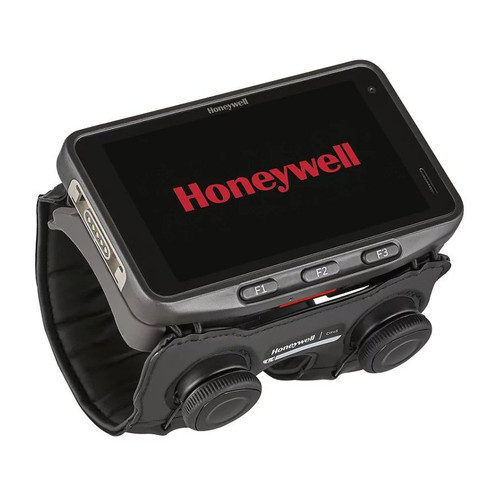
The Honeywell CW45-X0N-BND10XG is powered by a Qualcomm QCS4290 octa-core processor running at 2.0 GHz paired with 6 GB of RAM and 64 GB of onboard flash storage, with a microSD slot for expansion. Its 4.7-inch HD display is protected by Corning Gorilla Glass 5, offering a larger, higher-resolution screen suited to complex WMS interfaces and multi-app workflows.
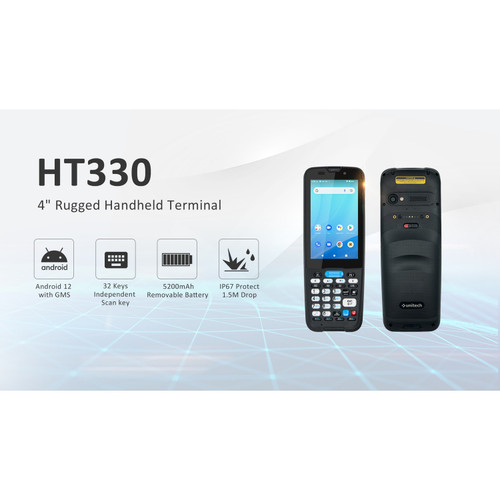
The Unitech HT330-QA62TM3G-Z3 runs on an unspecified processor with 3 GB of RAM and 32 GB of internal flash. Its 4-inch touchscreen is supplemented by a 32-key physical keypad — a meaningful ergonomic advantage for workers who prefer tactile input over virtual keyboards. However, its processor make and clock speed are not published in the available specifications, making a direct CPU comparison impossible.
For compute-intensive or display-demanding tasks, the CW45 leads on every published metric: 2× the RAM, 2× the storage, a larger display, and a named, benchmarked processor. The HT330's physical keypad offsets some of this advantage for scan-and-confirm workflows where tactile input speeds throughput.
How do the two devices compare on ruggedness and wireless connectivity?
Both units carry an IP67 ingress-protection rating, meaning both are dust-tight and survive immersion in up to 1 meter of water for 30 minutes. The Unitech HT330 additionally specifies a 1.5-meter drop-to-concrete rating; no equivalent drop specification is published for the Honeywell CW45, so a direct drop-resistance comparison cannot be made from available data.
Wireless capability diverges significantly. The Honeywell CW45-X0N-BND10XG supports WiFi 6 (802.11 a/b/g/n/ac/ax), Bluetooth 5.1 BLE, and NFC. The Unitech HT330-QA62TM3G-Z3 lists Bluetooth 5.0 as its primary pairing protocol and also notes 2.4 GHz + 5 GHz and GPS in its wireless field, but no 802.11 Wi-Fi standard (e.g., 802.11ac or ax) is specified in the available documentation — only Bluetooth connectivity to a host device is confirmed.
For facilities with dense 802.11ax Wi-Fi infrastructure or NFC badge/label workflows, the CW45's wireless stack is materially more capable. The HT330's published drop spec and GPS capability may favor outdoor or cross-dock environments where those features are prioritized over on-device Wi-Fi.
Which unit is better suited for full-shift deployment and software integration?
The Honeywell CW45-X0N-BND10XG carries a 6,800 mAh Li-Ion extended battery described as hot-swappable, enabling battery changes without powering down — a critical feature in 24/7 distribution center environments. It runs Android (non-GMS), meaning it ships without Google Mobile Services, which suits enterprise deployments under MDM control but may limit access to the Google Play Store without additional configuration.
The Unitech HT330-QA62TM3G-Z3 has a 5,200 mAh Li-ion removable battery with a published 20-hour battery life claim. It runs Android 12 — a specific, current version — making OS-level MDM policy compatibility straightforward to verify. No hot-swap specification is stated in the available data.
The CW45's 6,800 mAh capacity (31% larger than the HT330's 5,200 mAh) and confirmed hot-swap capability favor multi-shift operations. The HT330's explicit Android 12 version and 20-hour runtime claim provide deployment planners with clearer OS compatibility data. Neither product's warranty terms are specified in the provided data for the CW45; the HT330 notes only 'Manufacturer Warranty' without duration.
Which should you choose: the CW45-X0N-BND10XG or the HT330-QA62TM3G-Z3?
Our take: The CW45-X0N-BND10XG is the stronger choice when the deployment demands a self-contained, high-compute wearable computer with enterprise-grade Wi-Fi and maximum battery endurance per shift. Its Qualcomm QCS4290 octa-core at 2.0 GHz with 6 GB RAM doubles the HT330's 3 GB RAM, its 6,800 mAh hot-swappable battery exceeds the HT330's 5,200 mAh by 31%, and its WiFi 6 + Bluetooth 5.1 + NFC stack is substantially broader than the HT330's confirmed Bluetooth 5.0 pairing model. Conversely, the HT330-QA62TM3G-Z3 merits consideration in deployments where a physical 32-key keypad accelerates worker throughput, where a published 1.5 m concrete drop rating is a procurement requirement, or where pairing to an existing host device (phone or terminal) via Bluetooth is the preferred architecture. Buyers should note that the HT330's on-device Wi-Fi standard is not confirmed in available specifications, which is a gap requiring vendor clarification before finalizing a network-connected deployment.
Side-by-Side Comparison
Spec-for-spec, from manufacturer data.
| Specification | Honeywell CW45-X0N-BND10XG | Unitech HT330-QA62TM3G-Z3 |
|---|---|---|
| Product Type | Wearable Mobile Computer | Wearable Scanner Terminal |
| Operating System | Android (non-GMS) | Android 12 |
| Processor | Qualcomm QCS4290 Octa-Core 2.0 GHz | — |
| RAM | 6 GB | 3 GB |
| Internal Storage | 64 GB Flash + microSD | 32 GB Flash |
| Display Size | 4.7 in HD (Gorilla Glass 5) | 4.0 in touchscreen |
| Physical Keypad | — | 32-key |
| IP Rating | IP65/IP67 | IP67 |
| Drop Specification | — | 1.5 m to concrete |
| Wi-Fi Standard | WiFi 6 (802.11 a/b/g/n/ac/ax) | — |
| Bluetooth | 5.1 BLE | 5.0 |
| NFC | Yes | — |
| GPS | — | Yes |
| Battery Capacity | 6,800 mAh Li-Ion | 5,200 mAh Li-ion |
| Battery Removable / Hot-Swap | Hot-swappable | Removable |
| Operating Temperature | -20 to 50 °C (-4 to 122 °F) | — |
Frequently Asked Questions
Which should you choose: the CW45-X0N-BND10XG or the HT330-QA62TM3G-Z3?
The CW45-X0N-BND10XG is the stronger choice when the deployment demands a self-contained, high-compute wearable computer with enterprise-grade Wi-Fi and maximum battery endurance per shift. Its Qualcomm QCS4290 octa-core at 2.0 GHz with 6 GB RAM doubles the HT330's 3 GB RAM, its 6,800 mAh hot-swappable battery exceeds the HT330's 5,200 mAh by 31%, and its WiFi 6 + Bluetooth 5.1 + NFC stack is substantially broader than the HT330's confirmed Bluetooth 5.0 pairing model. Conversely, the HT330-QA62TM3G-Z3 merits consideration in deployments where a physical 32-key keypad accelerates worker throughput, where a published 1.5 m concrete drop rating is a procurement requirement, or where pairing to an existing host device (phone or terminal) via Bluetooth is the preferred architecture. Buyers should note that the HT330's on-device Wi-Fi standard is not confirmed in available specifications, which is a gap requiring vendor clarification before finalizing a network-connected deployment.
Is the Honeywell CW45-X0N-BND10XG or the Unitech HT330-QA62TM3G-Z3 better for a multi-shift warehouse with 24/7 operations?
The CW45-X0N-BND10XG is better suited for multi-shift 24/7 operations. Its 6,800 mAh battery is 31% larger than the HT330's 5,200 mAh, and it is specified as hot-swappable, allowing battery changes without powering down the device. The HT330 publishes a 20-hour runtime figure but does not confirm hot-swap capability in the available specifications.
Does the Unitech HT330-QA62TM3G-Z3 connect to our facility Wi-Fi network the same way the Honeywell CW45 does?
Not necessarily. The Honeywell CW45-X0N-BND10XG explicitly supports WiFi 6 (802.11 a/b/g/n/ac/ax), making it a direct infrastructure client. The Unitech HT330-QA62TM3G-Z3's available specifications confirm Bluetooth 5.0 connectivity to a host device and mention 2.4 GHz + 5 GHz in its wireless field, but no 802.11 Wi-Fi standard is formally listed. Buyers should request clarification from Unitech before assuming direct Wi-Fi network connectivity.
Which device is more rugged — the Honeywell CW45-X0N-BND10XG or the Unitech HT330-QA62TM3G-Z3?
Both carry an IP67 dust and water ingress rating. The Unitech HT330-QA62TM3G-Z3 additionally publishes a 1.5-meter drop-to-concrete specification. The Honeywell CW45-X0N-BND10XG does not include a drop-resistance figure in the provided specifications, so a direct drop-rating comparison cannot be made. For environments where drop survivability is a stated procurement criterion, the HT330 has a verifiable published figure; for the CW45, buyers should consult the full datasheet.
More Mobile Computer Comparisons
- Honeywell CW45-X0N-AND10XG vs Unitech HT730-LJ6122BG
- Honeywell CW45-X0N-AND10XG vs Unitech HT730-LJ6142BG
- Honeywell CW45-X0N-AND10XG vs Unitech HT330-QA62TM3G-Z3
- Honeywell CW45-X0N-AND10XG vs Zebra TC2205-0G1250SS-US
- Honeywell CW45-X0N-AND10XG vs Honeywell CW45-X0N-AND10SG
- Honeywell CW45-X0N-AND10XG vs Honeywell CW45-X0N-BND10XG
Mobile Computer Buying Guides
Get a Second Opinion on Your Camera Choice
Share your site layout, coverage goals, and budget. Our team will validate the camera selection, flag anything we would change, and recommend products that match the use case.