
Hanwha XRN-6420RB2 vs Hanwha PRN-6400DB4: Specification Comparison
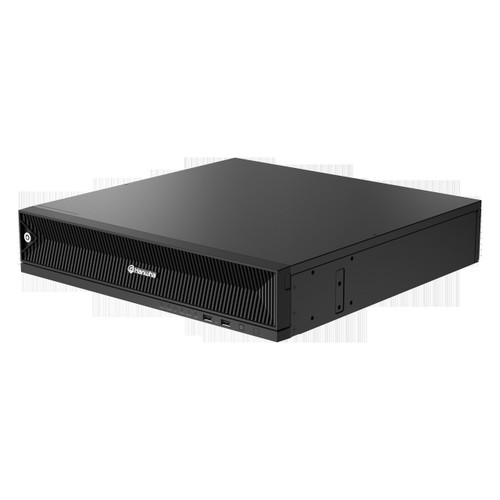
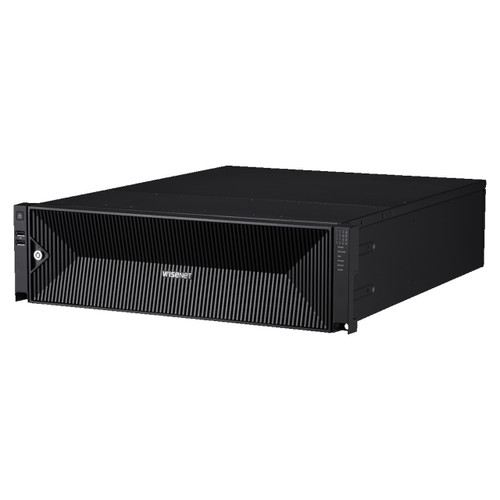
Both the Hanwha XRN-6420RB2 and the PRN-6400DB4 are 64-channel, 8K-capable rack-mount NVRs from Hanwha's Wisenet line, running embedded Linux and targeting enterprise-scale IP surveillance deployments. The comparison covers recording bandwidth and storage architecture, hardware build and power envelope, and integration and analytics capabilities — the three dimensions that most directly drive purchasing decisions at this tier. Neither unit ships with cameras; both require Wisenet or ONVIF-compatible IP cameras.
In This Guide
- Which NVR delivers higher recording bandwidth and more scalable storage?
- How do the two units compare on hardware build, power draw, and operating environment?
- Which unit offers stronger analytics, integration, and remote management capabilities?
- Which should you choose: the XRN-6420RB2 or the PRN-6400DB4?
- Side-by-Side Specs
- FAQ
Which NVR delivers higher recording bandwidth and more scalable storage?
The XRN-6420RB2 is specified at 520 Mbps in distributed mode, compared to 400 Mbps for the PRN-6400DB4 — a 30% bandwidth advantage that translates directly to more headroom for high-bitrate 4K and 8K streams across all 64 channels simultaneously.
On storage, the two units diverge significantly in raw capacity ceiling. The XRN-6420RB2 ships with 8 SATA HDD bays pre-configured at 48TB and expandable to a maximum of 80TB. The PRN-6400DB4 provides 16 SATA HDD bays in a non-RAID mode ceiling of 160TB, with hot-swap support specified. In RAID-5/6 mode, the PRN-6400DB4 organises bays as two 8-HDD arrays. Both units support RAID 5/6 and N+1 failover; the PRN-6400DB4 additionally lists ARB (Automatic Recovery Backup) support, which is not stated for the XRN-6420RB2.
The PRN-6400DB4 also supports iSCSI external storage expansion, a specification absent from the XRN-6420RB2 data provided. For deployments requiring long retention periods or multi-terabyte archive growth, the PRN-6400DB4's 160TB internal ceiling and iSCSI option are materially different from the XRN-6420RB2's 80TB maximum.
How do the two units compare on hardware build, power draw, and operating environment?
Both NVRs are rated for the same operating temperature range of 0°C to +40°C (32°F to 104°F) and both are described as Black / Metal rack-mount chassis with dual HDMI outputs. The operating humidity specification is provided only for the PRN-6400DB4 (20%–85% RH); the XRN-6420RB2 spec sheet does not state a humidity range in the data provided.
Power consumption differs notably: the PRN-6400DB4 is rated at a maximum of 285W (972.5 BTU with 16 HDDs installed), supported by dual SMPS power inlets (100–240 VAC ±10%, 50/60 Hz). No maximum wattage or power redundancy specification is provided for the XRN-6420RB2 in the data supplied, making a direct power draw comparison impossible.
The XRN-6420RB2 specifies an Intel 12th-generation processor and includes TPM 2.0, which the PRN-6400DB4 does not list. Physical weight also differs: the XRN-6420RB2 is 8.8 kg (19.4 lb) without HDDs, while the PRN-6400DB4 is approximately 14.3 kg (31.5 lb) without HDDs — consistent with the PRN-6400DB4's larger 16-bay chassis. The PRN-6400DB4 dimensions are stated as 440.0 × 132.0 × 571.1 mm; no chassis dimensions are provided for the XRN-6420RB2.
The XRN-6420RB2 is explicitly listed as NDAA-compliant with TPM 2.0 and signed firmware. The PRN-6400DB4 lists signed firmware and device certificate (Hanwha Techwin Root CA) under Security, along with IP address filtering and 802.1x, but does not state NDAA compliance in the data provided.
Which unit offers stronger analytics, integration, and remote management capabilities?
The PRN-6400DB4 is explicitly specified with AI search capabilities covering person, face (with Wisenet AI camera), vehicle, and license plate detection, including LPR for English and numeric plates on Wisenet AI/P/X cameras. The XRN-6420RB2 lists analytics as Defocus, Audio, Dynamic Event, and User Event — no AI object classification or LPR is specified in the data provided.
For remote access, the PRN-6400DB4 specifies maximum concurrent users: 10 live unicast, 20 multicast, and 3 search users. It also supports up to 112 simultaneous playback channels (64 local, 16 per remote user). The XRN-6420RB2 does not provide equivalent concurrent-user or simultaneous-playback channel counts in the data provided.
Both units support ONVIF, SUNAPI, and Wisenet mobile. The PRN-6400DB4 additionally lists WiseStream (H.265 and H.264 bandwidth-optimisation codec), fisheye dewarping (local 1CH and CMS), PTZ preset support up to 300 presets, and P2P QR-code setup. The PRN-6400DB4 web viewer is documented for Windows 10 and macOS 10.13 with Chrome, Edge, and Safari. The XRN-6420RB2 also lists Wisenet Viewer. Multi-language UI is stated for the PRN-6400DB4; not stated for the XRN-6420RB2.
Audio codec support is identical on both (G.711, G.726, AAC at 16/48 kHz, two-way). The PRN-6400DB4 specifies 64-channel network audio input; the XRN-6420RB2 states two-way audio support without a channel count. Alarm I/O is specified only for the PRN-6400DB4 (8 inputs, 4 outputs). Log capacity for the PRN-6400DB4 is 100,000 entries each for system and event logs; not stated for the XRN-6420RB2.
Which should you choose: the XRN-6420RB2 or the PRN-6400DB4?
Our take: The XRN-6420RB2 is the stronger choice when recording bandwidth and cybersecurity compliance are the primary constraints: its 520 Mbps throughput exceeds the PRN-6400DB4's 400 Mbps by 30%, its Intel 12th-gen processor and TPM 2.0 are explicitly specified, and it carries an NDAA-compliance designation not stated for the PRN-6400DB4. Conversely, the PRN-6400DB4 wins on storage scale (160TB internal versus 80TB), AI analytics (person, vehicle, face, and LPR detection versus defocus and audio events only), and chassis depth — with 16 hot-swappable bays, iSCSI expansion, dual SMPS power inlets, and a documented 285W power budget absent from the XRN-6420RB2's listed specs. For federal or NDAA-regulated deployments with high-bitrate camera mixes, the XRN-6420RB2 is preferable. For large-site deployments prioritising long retention, AI-driven search, and storage redundancy on a Wisenet AI camera infrastructure, the PRN-6400DB4 is the more capable platform.
Side-by-Side Comparison
Spec-for-spec, from manufacturer data.
| Specification | Hanwha XRN-6420RB2 | Hanwha PRN-6400DB4 |
|---|---|---|
| Product Type | NVR (Rack-mount) | NVR (Rack-mount) |
| Channel Capacity | 64 channels | 64 channels |
| Max Recording Resolution | 32MP | 32MP |
| Recording Bandwidth | 520 Mbps (distributed mode) | 400 Mbps (distributed mode) |
| Video Compression | H.265, H.264, MJPEG | H.265, H.264, MJPEG, WiseStream |
| HDD Bays | 8 SATA bays | 16 SATA bays (hot-swap) |
| Max Internal Storage | 80TB | 160TB (non-RAID mode) |
| Pre-configured Storage | 48TB | — |
| External Storage | — | iSCSI |
| RAID Support | RAID 5/6, N+1 failover | RAID 5/6, N+1 failover, ARB |
| AI Analytics | Defocus, Audio, Dynamic Event, User Event | Person, Face, Vehicle, LPR |
| Processor | Intel 12th generation | — |
| TPM / Security | TPM 2.0, Signed firmware, NDAA-compliant | Signed firmware, 802.1x, Device certificate |
| Operating Temperature | 0°C to +40°C (32°F to 104°F) | 0°C to +40°C (32°F to 104°F) |
| Max Power Draw | — | 285W (with 16 HDDs) |
| Weight (without HDD) | 8.8 kg (19.4 lb) | 14.3 kg (31.5 lb) |
| Network Ports | RJ-45 3EA (LAN/WAN, 1Gbps) | RJ-45 3EA (LAN/WAN, 1Gbps) |
| ONVIF | Yes | Yes |
| Operating System | Embedded Linux | Embedded Linux |
| Warranty | 5-Year | — |
Frequently Asked Questions
Which should you choose: the XRN-6420RB2 or the PRN-6400DB4?
The XRN-6420RB2 is the stronger choice when recording bandwidth and cybersecurity compliance are the primary constraints: its 520 Mbps throughput exceeds the PRN-6400DB4's 400 Mbps by 30%, its Intel 12th-gen processor and TPM 2.0 are explicitly specified, and it carries an NDAA-compliance designation not stated for the PRN-6400DB4. Conversely, the PRN-6400DB4 wins on storage scale (160TB internal versus 80TB), AI analytics (person, vehicle, face, and LPR detection versus defocus and audio events only), and chassis depth — with 16 hot-swappable bays, iSCSI expansion, dual SMPS power inlets, and a documented 285W power budget absent from the XRN-6420RB2's listed specs. For federal or NDAA-regulated deployments with high-bitrate camera mixes, the XRN-6420RB2 is preferable. For large-site deployments prioritising long retention, AI-driven search, and storage redundancy on a Wisenet AI camera infrastructure, the PRN-6400DB4 is the more capable platform.
Is the XRN-6420RB2 or PRN-6400DB4 better for larger deployments requiring long video retention?
The PRN-6400DB4 is better suited for long-retention deployments. It provides 16 SATA HDD bays with a maximum internal capacity of 160TB in non-RAID mode — double the XRN-6420RB2's 80TB ceiling. The PRN-6400DB4 also supports iSCSI external storage expansion, a capability not listed for the XRN-6420RB2. Both units support RAID 5/6 with N+1 failover; the PRN-6400DB4 additionally specifies ARB (Automatic Recovery Backup).
Does either NVR support AI analytics like person or vehicle detection without a separate server?
Yes, but only the PRN-6400DB4 specifies built-in AI search for person, face (with a compatible Wisenet AI camera), vehicle, and license plate detection, including LPR. The XRN-6420RB2 lists Defocus, Audio, Dynamic Event, and User Event analytics in its specifications; no AI object classification or LPR capability is stated in the data provided for that model.
Which unit is required for NDAA-compliant government or federal installations?
The XRN-6420RB2 is explicitly listed as NDAA-compliant in the specifications provided, and it includes TPM 2.0 and signed firmware. The PRN-6400DB4 lists signed firmware and a Hanwha Techwin Root CA device certificate, but NDAA compliance is not stated in its specification data. Installers serving federal or state government sites subject to NDAA Section 889 restrictions should verify current compliance status directly with Hanwha before specifying either unit.
Get a Second Opinion on Your Camera Choice
Share your site layout, coverage goals, and budget. Our team will validate the camera selection, flag anything we would change, and recommend products that match the use case.