
Hanwha XRN-6420RB2-32TB vs i-PRO NX400/3000T3: Specification Comparison
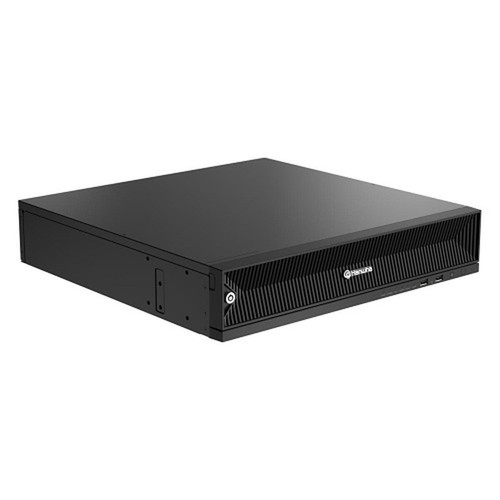
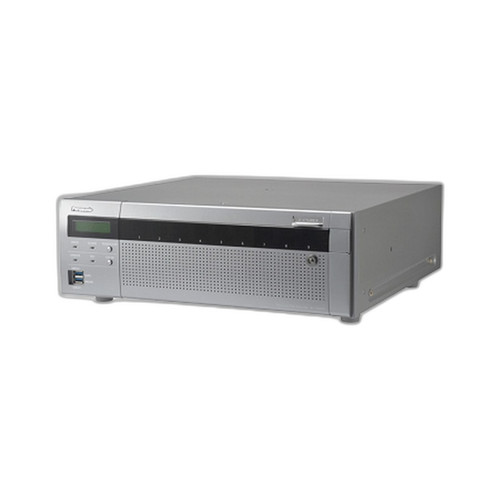
Both the Hanwha XRN-6420RB2-32TB and the i-PRO WJ-NX400/3000T3 are rack-mountable, 64-channel IP NVRs designed for enterprise and multi-site surveillance deployments. This comparison evaluates them across the three dimensions most critical to integrators and IT buyers selecting a high-channel NVR: recording capacity and storage architecture, throughput and resolution ceiling, and integration compatibility. Neither unit is an accessory or a different device class; both are directly cross-shoppable by any buyer spec'ing a 64-channel NVR solution.
In This Guide
- Which NVR gives you more usable storage and expansion headroom?
- Which NVR handles higher-resolution streams and sustained recording throughput?
- Which NVR integrates more broadly with third-party cameras and VMS platforms?
- Which should you choose: the XRN-6420RB2-32TB or the NX400/3000T3?
- Side-by-Side Specs
- FAQ
Which NVR gives you more usable storage and expansion headroom?
The XRN-6420RB2-32TB ships with 32TB factory-installed across its eight internal SATA bays and is expandable to 80TB within the chassis. That factory configuration alone is more than ten times the installed capacity of the WJ-NX400/3000T3, which ships with a single 3TB drive.
The WJ-NX400/3000T3 offsets its modest base storage with a stated maximum capacity of 324TB, implying support for external expansion enclosures or a high internal drive count — however, the provided specs do not detail the number of internal bays or the expansion method required to reach that ceiling. The Hanwha unit's 80TB in-chassis maximum is fully documented against its eight-bay architecture.
Both units support RAID. The XRN-6420RB2-32TB confirms RAID support in normal and RAID modes at 520 Mbps throughput. The WJ-NX400/3000T3 specifies RAID 0, 1, 5, and 6, and 10 — a broader declared set of RAID levels. The i-PRO unit also lists microSD as a local storage option; no equivalent is noted for the Hanwha.
Which NVR handles higher-resolution streams and sustained recording throughput?
The XRN-6420RB2-32TB is specified to record all 64 channels simultaneously at 32MP, with a maximum resolution ceiling of 20MP+ (the 32MP figure appearing in the recording channel spec). Sustained network throughput is rated at 520 Mbps in both RAID and normal operating modes. The processor is identified as Intel 12th-Generation, providing a concrete hardware anchor for these performance claims.
The WJ-NX400/3000T3 is specified at a 2MP resolution ceiling per the provided specs. No throughput figure in Mbps is provided for the i-PRO unit, and no processor generation is disclosed. Recording all 64 channels at 2MP is a materially different workload than 32MP simultaneous recording.
For deployments requiring 4K, 8K, or multi-megapixel camera streams, the Hanwha unit's resolution ceiling and documented throughput represent a significant published advantage. The i-PRO unit's resolution spec may reflect the minimum or a base configuration rather than an absolute ceiling — the provided specifications do not clarify this — but no higher figure is available to cite.
Which NVR integrates more broadly with third-party cameras and VMS platforms?
Both units declare ONVIF compliance, enabling camera-agnostic integration. The WJ-NX400/3000T3 explicitly calls out ONVIF Profile S and notes compatibility with major VMS platforms alongside i-PRO IP cameras. The XRN-6420RB2-32TB also confirms ONVIF support and runs Embedded Linux as its operating system.
The Hanwha unit lists H.265, H.264, and MJPEG compression codecs and specifies audio codec support (G.711, G.726, AAC at 16/48 kHz) along with two-way audio. It also lists onboard analytics categories including defocus, audio detection, dynamic events, and user events. Display outputs are dual HDMI (4K @ 30 Hz and Full HD @ 60 Hz), useful for on-premises monitoring walls.
The WJ-NX400/3000T3 lists H.265, H.264, and MJPEG compression. It also notes multi-site compatibility and PoE support. No display output specification, audio codec detail, or onboard analytics specification is provided in the supplied data for the i-PRO unit. The Hanwha chassis is documented at three RJ-45 ports (LAN/WAN, 1 Gbps each); no equivalent NIC count is disclosed for the i-PRO unit.
Which should you choose: the XRN-6420RB2-32TB or the NX400/3000T3?
Our take: The XRN-6420RB2-32TB is the stronger choice when the deployment demands high-resolution multi-megapixel recording, substantial factory-installed storage, and documented sustained throughput. The Hanwha unit records all 64 channels simultaneously at 32MP versus the i-PRO's specified 2MP ceiling, ships with 32TB installed versus 3TB, and sustains 520 Mbps throughput in both RAID and normal modes — a figure absent from the i-PRO's published specs. The WJ-NX400/3000T3 counters with a higher stated maximum capacity (324TB versus 80TB in-chassis) and explicitly lists five RAID configurations (0, 1, 5, 6, 10) with VMS-platform compatibility and microSD local storage. The i-PRO unit is the more appropriate selection for cost-sensitive 2MP deployments requiring flexible RAID configurations and broad VMS interoperability, or where external storage expansion beyond 80TB is a firm requirement. Platform loyalty — Hanwha Wisenet versus i-PRO ecosystem — should also factor into any camera-to-NVR compatibility evaluation.
Side-by-Side Comparison
Spec-for-spec, from manufacturer data.
| Specification | Hanwha XRN-6420RB2-32TB | i-PRO NX400/3000T3 |
|---|---|---|
| Product Type | NVR | NVR |
| Max Channels | 64 | 64 |
| Max Recording Resolution | 32MP (all 64 ch simultaneous) | 2MP |
| Installed Storage | 32TB | 3TB (1 x 3TB) |
| Max Storage Capacity | 80TB (8 internal SATA bays) | 324TB |
| RAID Support | RAID (normal and RAID modes confirmed) | RAID 0, 1, 5, 6, 10 |
| Network Throughput | 520 Mbps | — |
| Video Compression | H.265, H.264, MJPEG | H.265, H.264, MJPEG |
| ONVIF Compliance | Yes | Yes (Profile S) |
| Display Outputs | Dual HDMI (4K@30Hz + FHD@60Hz) | — |
| Audio Support | Two-way; G.711, G.726, AAC (16/48 kHz) | — |
| Processor | Intel 12th-Generation | — |
| Operating System | Embedded Linux | — |
| Network Ports | 3x RJ-45 LAN/WAN, 1 Gbps each | — |
| Power | — | 12V DC |
| Warranty | 5-Year | — |
| Operating Temperature | 0°C to +40°C | — |
| Local Storage (secondary) | — | microSD |
| VMS Compatibility | — | ONVIF Profile S; major VMS platforms |
| Weight (excl. HDD) | 8.8 kg (19.4 lb) | — |
Frequently Asked Questions
Which should you choose: the XRN-6420RB2-32TB or the NX400/3000T3?
The XRN-6420RB2-32TB is the stronger choice when the deployment demands high-resolution multi-megapixel recording, substantial factory-installed storage, and documented sustained throughput. The Hanwha unit records all 64 channels simultaneously at 32MP versus the i-PRO's specified 2MP ceiling, ships with 32TB installed versus 3TB, and sustains 520 Mbps throughput in both RAID and normal modes — a figure absent from the i-PRO's published specs. The WJ-NX400/3000T3 counters with a higher stated maximum capacity (324TB versus 80TB in-chassis) and explicitly lists five RAID configurations (0, 1, 5, 6, 10) with VMS-platform compatibility and microSD local storage. The i-PRO unit is the more appropriate selection for cost-sensitive 2MP deployments requiring flexible RAID configurations and broad VMS interoperability, or where external storage expansion beyond 80TB is a firm requirement. Platform loyalty — Hanwha Wisenet versus i-PRO ecosystem — should also factor into any camera-to-NVR compatibility evaluation.
Is the XRN-6420RB2-32TB or WJ-NX400/3000T3 better for larger deployments needing massive storage expansion?
Based on the provided specifications, the WJ-NX400/3000T3 has a higher stated maximum capacity of 324TB compared to the XRN-6420RB2-32TB's 80TB in-chassis maximum. However, the i-PRO specs do not detail the expansion method or bay count required to reach 324TB, so integrators should verify that figure with i-PRO before designing storage architecture. The Hanwha unit's 80TB ceiling is documented against its eight internal SATA bays.
Can both NVRs work with cameras from other manufacturers?
Yes. Both units declare ONVIF compliance. The WJ-NX400/3000T3 additionally specifies ONVIF Profile S and compatibility with major VMS platforms. The XRN-6420RB2-32TB confirms ONVIF support and runs Embedded Linux. Neither unit's provided specs restrict operation exclusively to its own brand's cameras, but camera compatibility matrices should be confirmed with each manufacturer for specific models.
Which NVR supports higher camera resolution streams?
The XRN-6420RB2-32TB is specified to record all 64 channels simultaneously at 32MP with a maximum resolution of 20MP+. The WJ-NX400/3000T3 is specified at 2MP per the provided specs. No higher resolution figure is available in the i-PRO documentation supplied. For deployments involving 4K, 5MP, or higher-resolution cameras, the Hanwha unit's published specifications support those workloads; the i-PRO unit's specs as provided do not.
Get a Second Opinion on Your Camera Choice
Share your site layout, coverage goals, and budget. Our team will validate the camera selection, flag anything we would change, and recommend products that match the use case.