
Hanwha XRN-6420DB4 vs Speco Technologies N64NR: Specification Comparison
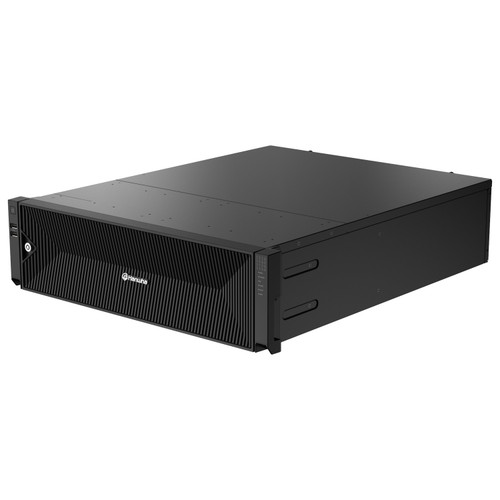
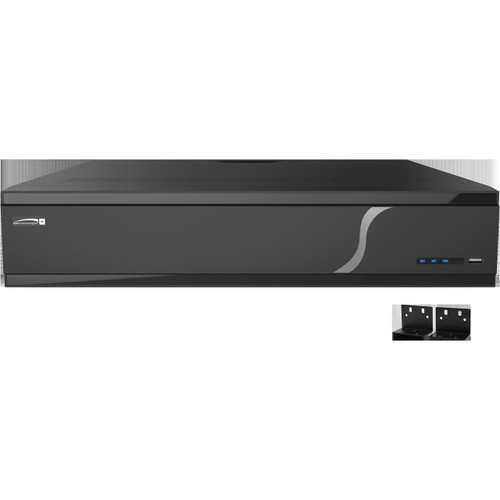
Both the Hanwha XRN-6420DB4 and the Speco Technologies N64NR are rack-mount, 64-channel network video recorders targeting mid-to-large IP camera deployments. This comparison covers the three dimensions that most directly drive purchasing decisions for enterprise-grade NVRs: recording capacity and storage architecture; resolution, compression, and bandwidth; and analytics, integration, and management capabilities. All figures are drawn strictly from the provided specifications for each unit.
In This Guide
- Which NVR offers more onboard storage capacity and redundancy options?
- How do the two units compare on recording resolution, compression efficiency, and bandwidth?
- Which unit provides broader analytics, integration, and multi-site management support?
- Which should you choose: the XRN-6420DB4 or the N64NR?
- Side-by-Side Specs
- FAQ
Which NVR offers more onboard storage capacity and redundancy options?
The XRN-6420DB4 provides 16 SATA HDD bays supporting up to 160TB of onboard storage, with hot-swap capability and RAID-5/6 support across two arrays of 8 HDDs each. It also supports iSCSI external storage expansion and ARB (Automatic Recovery Backup). Individual drive capacity is listed at up to 10TB per bay.
The N64NR specifies 8 SATA HDD bays described as expandable, but the provided specifications do not state a maximum total capacity per bay, a total TB ceiling, RAID mode support, hot-swap capability, or iSCSI expansion. No redundancy architecture is documented in the supplied specs.
For deployments where raw capacity, RAID redundancy, or external storage scaling is a requirement, the XRN-6420DB4 offers substantially more documented capability. The N64NR's expandability claim is not backed by a specified expansion mechanism or maximum figure in the provided data.
How do the two units compare on recording resolution, compression efficiency, and bandwidth?
The XRN-6420DB4 supports recording up to 32MP at 15fps (H.265 only) and 12MP at 30fps (H.265 only), scaling down to 8.3MP at 4 channels at 30fps through D1 at 64 channels at 30fps. Recording bandwidth reaches up to 520Mbps, with playback bandwidth up to 200Mbps across 64 channels simultaneously. Compression formats include H.265, H.264, and MJPEG. Local display outputs are dual HDMI: 4K at 30Hz and 1080p at 60Hz.
The N64NR specifies a maximum recording resolution of 16MP (3840x2160 / 4K UHD) at 30fps across all 64 channels simultaneously. Compression is H.265 and H.264; MJPEG is not listed. The specification does not state a total recording bandwidth figure. Local display output specifications are not provided.
The XRN-6420DB4 reaches a higher maximum sensor resolution (32MP vs. 16MP) and documents its total recording bandwidth (520Mbps). The N64NR claims 30fps at 16MP across all 64 channels, but without a stated aggregate bandwidth ceiling, that throughput cannot be independently verified from the provided specs. MJPEG fallback is only confirmed on the Hanwha unit.
Which unit provides broader analytics, integration, and multi-site management support?
The XRN-6420DB4 documents SUNAPI and ONVIF protocol support, N+1 failover, fisheye dewarping (local 1CH plus CMS), up to 300 PTZ presets, remote access via iOS and Android mobile apps, browser support across Chrome, Edge, and Safari, and compatibility with Hanwha AI cameras for object attribute analytics. It supports up to 10 simultaneous remote live unicast users and 3 simultaneous remote search users. Maximum concurrent users total 4 (1 local, 3 remote). Log capacity is 100,000 entries each for system and event logs.
The N64NR lists ONVIF support and built-in analytics: Line Crossing, People Counting, License Plate Recognition, and Vehicle Detection. A 2-year warranty is explicitly stated. Mobile app support, browser compatibility, PTZ preset count, remote user limits, failover capability, and log capacity are not specified in the provided data.
The XRN-6420DB4 provides a more fully documented integration and management profile, including dual-protocol support (SUNAPI + ONVIF), failover, and quantified user concurrency. The N64NR differentiates with four named built-in analytics functions—including LPR and vehicle detection—that are not individually listed for the Hanwha unit, though Hanwha cites AI camera compatibility without detailing which analytics execute on the recorder itself.
Which should you choose: the XRN-6420DB4 or the N64NR?
Our take: The XRN-6420DB4 is the stronger choice when maximum storage capacity, RAID redundancy, and deep Hanwha ecosystem integration are the primary requirements. On storage, the Hanwha unit delivers 16 SATA bays and up to 160TB onboard versus the N64NR's 8 bays with no documented capacity ceiling. On bandwidth, the XRN-6420DB4 specifies 520Mbps aggregate recording versus no stated figure for the N64NR. On resolution, Hanwha supports up to 32MP sensors versus N64NR's 16MP ceiling. The N64NR holds ground on built-in analytics—LPR, vehicle detection, people counting, and line crossing are explicitly recorder-resident features—and it carries a stated 2-year warranty where the Hanwha warranty term is absent from the provided specs. The XRN-6420DB4 fits large-campus deployments running Hanwha cameras with RAID and failover mandates; the N64NR suits mixed-brand 64-channel sites where recorder-side analytics reduce camera-level licensing costs.
Side-by-Side Comparison
Spec-for-spec, from manufacturer data.
| Specification | Hanwha XRN-6420DB4 | Speco Technologies N64NR |
|---|---|---|
| Product Type | NVR (Network Video Recorder) | NVR (Network Video Recorder) |
| Max Camera Channels | 64 | 64 |
| Max Recording Resolution | 32MP @ 15fps (H.265 only) | 16MP (3840x2160) @ 30fps |
| Local Display Output | Dual HDMI: 4K@30Hz + 1080p@60Hz | Not specified |
| Video Compression | H.265, H.264, MJPEG | H.265, H.264 |
| Recording Bandwidth | Up to 520 Mbps | Not specified |
| Playback Bandwidth | Up to 200 Mbps (64CH simultaneous) | Not specified |
| HDD Bays | 16 SATA (hot-swap) | 8 SATA |
| Max Onboard Storage | 160TB | Not specified |
| RAID Support | RAID-5/6 (8-HDD x 2 arrays) | Not specified |
| External Storage | iSCSI | Not specified |
| Failover | N+1 | Not specified |
| Protocols | SUNAPI, ONVIF | ONVIF |
| Built-in Analytics | Object attribute (AI camera-dependent) | Line Crossing, People Counting, LPR, Vehicle Detection |
| Max Remote Users | 10 live unicast; 3 search; 4 total | Not specified |
| Operating Temperature | 0°C to +40°C (32°F to 104°F) | 14°F to 122°F (-10°C to 50°C) |
| Warranty | Not specified | 2 years |
| Embedded OS | Linux | Not specified |
Frequently Asked Questions
Which should you choose: the XRN-6420DB4 or the N64NR?
The XRN-6420DB4 is the stronger choice when maximum storage capacity, RAID redundancy, and deep Hanwha ecosystem integration are the primary requirements. On storage, the Hanwha unit delivers 16 SATA bays and up to 160TB onboard versus the N64NR's 8 bays with no documented capacity ceiling. On bandwidth, the XRN-6420DB4 specifies 520Mbps aggregate recording versus no stated figure for the N64NR. On resolution, Hanwha supports up to 32MP sensors versus N64NR's 16MP ceiling. The N64NR holds ground on built-in analytics—LPR, vehicle detection, people counting, and line crossing are explicitly recorder-resident features—and it carries a stated 2-year warranty where the Hanwha warranty term is absent from the provided specs. The XRN-6420DB4 fits large-campus deployments running Hanwha cameras with RAID and failover mandates; the N64NR suits mixed-brand 64-channel sites where recorder-side analytics reduce camera-level licensing costs.
Is the XRN-6420DB4 or N64NR better for larger deployments requiring storage redundancy?
The XRN-6420DB4 is better documented for storage-heavy, redundancy-required deployments. It specifies 16 SATA bays (up to 160TB), hot-swap support, RAID-5/6 across dual 8-HDD arrays, iSCSI external expansion, and N+1 failover. The N64NR lists 8 SATA bays described as expandable but does not specify a capacity ceiling, RAID modes, hot-swap capability, or a failover mechanism in the provided specifications.
Does either NVR support built-in video analytics without requiring a separate analytics server?
Yes, but they approach it differently. The N64NR explicitly lists four recorder-resident analytics functions: Line Crossing, People Counting, License Plate Recognition, and Vehicle Detection. The XRN-6420DB4 lists analytics event triggers and notes compatibility with Hanwha AI cameras for object attribute data, but the provided specs do not confirm which analytics functions execute on the recorder itself versus on connected AI cameras.
Which unit is the better fit if my camera fleet is brand-agnostic and not tied to Hanwha or Speco?
Both units list ONVIF support, which is the baseline for brand-agnostic camera integration. The XRN-6420DB4 adds SUNAPI support, which is Hanwha-proprietary and primarily benefits Hanwha cameras. The N64NR's provided specs do not list a second protocol beyond ONVIF. For a mixed-brand installation without Hanwha cameras, the ONVIF compatibility is equivalent between the two units; the Hanwha's SUNAPI and deeper AI-camera features would go unused.
Get a Second Opinion on Your Camera Choice
Share your site layout, coverage goals, and budget. Our team will validate the camera selection, flag anything we would change, and recommend products that match the use case.