
Hanwha XRN-6420DB4-32TB vs Vivotek NR9682-V3: Specification Comparison
Both the Hanwha XRN-6420DB4-32TB and the Vivotek NR9682-V3 are rack-mount, 64-channel network video recorders targeting enterprise and large-site deployments. The comparison covers recording capacity and throughput, storage architecture and physical build, and integration plus display capabilities. Neither unit is an accessory or a different device class; both support H.265 compression, ONVIF, and 64-channel native operation, making them legitimate cross-shop candidates for integrators specifying a central recording platform.

In This Guide
- Which NVR delivers more recording headroom — channels, resolution ceiling, and throughput?
- How do the storage architecture, physical build, and operating environment compare?
- Which unit offers broader display, integration, and management software capabilities?
- Which should you choose: the XRN-6420DB4-32TB or the NR9682-V3?
- Side-by-Side Specs
- FAQ
Which NVR delivers more recording headroom — channels, resolution ceiling, and throughput?
The Hanwha XRN-6420DB4-32TB supports 64 channels at a stated maximum of 32MP per channel and specifies a distributed recording bandwidth of 520 Mbps with a separate 200 Mbps playback bandwidth figure. Its 12th-generation Intel processor drives dual-stream H.265/H.264/MJPEG encoding.
The Vivotek NR9682-V3 also supports 64 channels natively, expandable to 192 channels with additional licensing, and specifies a recording throughput of 512 Mbps. Its stated maximum resolution in playback decoding reaches 7680×2560 (approximately 8K width), and its H.264 decoding capability is listed at 1920×1080 @ 360 fps, with H.265 at 1920×1080 @ 180 fps. The NR9682-V3 additionally provides a 650 Mbps video throughput figure for remote clients.
On raw recording bandwidth the Hanwha edges ahead (520 Mbps vs. 512 Mbps), while the Vivotek's 192-channel expansion path and higher remote-client throughput (650 Mbps) offer more headroom for future growth. Maximum per-channel resolution is specified at 32MP for the Hanwha; the Vivotek's per-channel resolution ceiling is not explicitly stated in the provided specs beyond its 12MP catalog field, though its decoding output reaches 7680×2560.
How do the storage architecture, physical build, and operating environment compare?
The Hanwha XRN-6420DB4-32TB ships with 32TB pre-installed across an unspecified number of drives and expands to 160TB via 16 SATA bays. Dimensions are given as 3.19″ × 2.64″ × 6.48″ and weight as 2,200 g (4.85 lb) in one configuration variant. Operating temperature is listed as −10°C to +55°C (−14°F to +131°F), with a start-up floor of −30°C. Its impact rating is IK10.
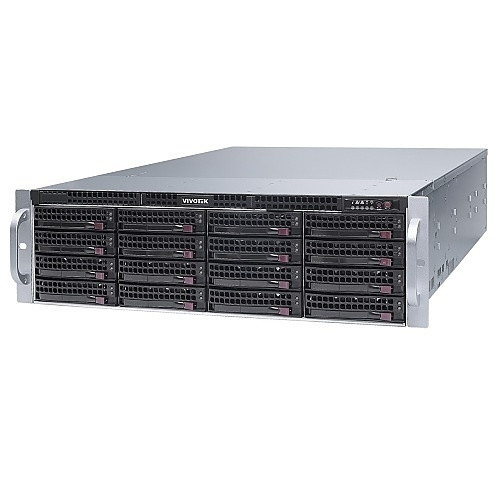
The Vivotek NR9682-V3 provides 16 hot-swappable drive trays (HDDs purchased separately); the maximum HDD capacity refers buyers to a supported-HDD list on Vivotek's website. It supports RAID 0, 1, 5, 6, 10, 50, and 60, along with seamless recording and recording-data encryption. Dimensions are 132 mm × 437 mm × 647 mm (approximately 5.2″ × 17.2″ × 25.5″) and weight is 33 kg (72.8 lb) without drives. Operating temperature is 5°C to 35°C (41°F to 95°F). Power draw reaches a maximum of 920 W with redundant 100–240 V AC input and 80 Plus Platinum certification.
The Hanwha's compact footprint and wide thermal tolerance (−10°C to +55°C) suit edge deployments or environments with limited climate control. The Vivotek is a full rackmount chassis designed for data-center or dedicated equipment-room installation, with hot-swap trays, comprehensive RAID support, and redundant platinum-rated power — features absent from the Hanwha's published specs. Storage flexibility favors the Vivotek given its RAID options; the Hanwha offers a ready-to-run advantage with 32TB pre-loaded.
Which unit offers broader display, integration, and management software capabilities?
The Hanwha XRN-6420DB4-32TB provides dual HDMI outputs: HDMI 1 at 4K/30Hz and HDMI 2 at 1080p/60Hz. It supports ONVIF Profiles S, G, T, and M, Hanwha SUNAPI (HTTP API), and the Hanwha Vision Open Platform. Analytics are listed as DetectionShot-capable. Audio is selectable I/O (mic in / line in) with line out.
The Vivotek NR9682-V3 delivers four display outputs: HDMI (4096×2160), DisplayPort (7680×4320 / 8K), DVI, and VGA. It runs Embedded Windows 10, supports ONVIF Profile S, integrates with Vivotek's Shepherd and VSS Pro software, and connects to the iViewer mobile app (iOS/Android). Management scales to 4,096 users with Basic or Windows Active Directory authentication. It supports LPR, VCA counting, Smart Search I & II, Deep Search, fisheye dewarp (eight modes), POS integration (ARCH), UPS integration, and a hardware + software watchdog. Cybersecurity management and failover are explicitly listed.
The Vivotek's Embedded Windows 10 platform provides a richer on-device software ecosystem, Active Directory integration, and a substantially broader display output set including DisplayPort 8K — versus the Hanwha's dual-HDMI-only configuration. The Hanwha supports four ONVIF profiles (S/G/T/M) against the Vivotek's Profile S only, which may matter in heterogeneous camera environments requiring Profile T or M for metadata and analytics interoperability.
Which should you choose: the XRN-6420DB4-32TB or the NR9682-V3?
Our take: The XRN-6420DB4-32TB is the stronger choice when a deployment requires a self-contained, thermally rugged recorder with pre-installed storage, the highest per-channel resolution ceiling, and broad ONVIF profile support across a mixed-camera fleet. It specifies 32MP maximum channel resolution versus the Vivotek's 12MP catalog spec, ships with 32TB ready to record, and tolerates operating temperatures down to −10°C versus the NR9682-V3's 5°C floor. The NR9682-V3 is the stronger choice when the project demands a full enterprise-storage platform: 16 hot-swappable bays with RAID 0/1/5/6/10/50/60, a 192-channel expansion license path, redundant platinum-rated power, DisplayPort 8K output, Active Directory user management for up to 4,096 accounts, and integrated failover and cybersecurity management — features not documented in the Hanwha's provided specifications. Integrators on a Hanwha Wisenet camera platform will benefit from the XRN's native API; Vivotek-platform or multi-vendor enterprise data-center deployments will favor the NR9682-V3.
Side-by-Side Comparison
Spec-for-spec, from manufacturer data.
| Specification | Hanwha XRN-6420DB4-32TB | Vivotek NR9682-V3 |
|---|---|---|
| Product Type | NVR | NVR |
| Native Channels | 64 | 64 |
| Max Channel Expansion | — | 192 (with license) |
| Max Per-Channel Resolution | 32MP | 12MP (catalog spec) |
| Recording Throughput | 520 Mbps | 512 Mbps |
| Playback Bandwidth | 200 Mbps | — |
| Remote Client Throughput | — | 650 Mbps |
| Storage (Included) | 32TB pre-installed | None (HDD sold separately) |
| Storage Bays | 16 SATA | 16 hot-swappable |
| Max Storage Expansion | 160TB | Per Vivotek HDD supported list |
| RAID Support | — | RAID 0, 1, 5, 6, 10, 50, 60 |
| Video Compression | H.265, H.264, MJPEG | H.265, H.264, MPEG4, MJPEG |
| Display Outputs | Dual HDMI (4K/30Hz + 1080p/60Hz) | HDMI 4K, DisplayPort 8K, DVI, VGA |
| ONVIF Profiles | S, G, T, M | Profile S |
| Operating Temperature | −10°C to +55°C | 5°C to 35°C |
| Warranty | 5-Year | 3-Year |
| Power Supply | — | Redundant 100–240V AC, max 920W, 80 Plus Platinum |
| Operating System | — | Embedded Windows 10 |
| User Management | — | Up to 4,096 users; Basic/Windows AD |
| Redundant Power | — | Yes |
| Impact Rating | IK10 | — |
| Weight | 2,200 g / 4.85 lb | 33 kg / 72.8 lb (without HDD) |
Frequently Asked Questions
Which should you choose: the XRN-6420DB4-32TB or the NR9682-V3?
The XRN-6420DB4-32TB is the stronger choice when a deployment requires a self-contained, thermally rugged recorder with pre-installed storage, the highest per-channel resolution ceiling, and broad ONVIF profile support across a mixed-camera fleet. It specifies 32MP maximum channel resolution versus the Vivotek's 12MP catalog spec, ships with 32TB ready to record, and tolerates operating temperatures down to −10°C versus the NR9682-V3's 5°C floor. The NR9682-V3 is the stronger choice when the project demands a full enterprise-storage platform: 16 hot-swappable bays with RAID 0/1/5/6/10/50/60, a 192-channel expansion license path, redundant platinum-rated power, DisplayPort 8K output, Active Directory user management for up to 4,096 accounts, and integrated failover and cybersecurity management — features not documented in the Hanwha's provided specifications. Integrators on a Hanwha Wisenet camera platform will benefit from the XRN's native API; Vivotek-platform or multi-vendor enterprise data-center deployments will favor the NR9682-V3.
Is the XRN-6420DB4-32TB or the NR9682-V3 better for larger deployments that may need to add channels over time?
The NR9682-V3 has a documented expansion path to 192 channels via licensing, which the Hanwha XRN-6420DB4-32TB's provided specifications do not mention. If future channel growth beyond 64 is a requirement, the Vivotek is the only unit of the two with a confirmed expansion mechanism in the supplied spec data.
Which NVR is a better fit for installations outside a climate-controlled equipment room?
The Hanwha XRN-6420DB4-32TB specifies an operating temperature range of −10°C to +55°C (with a start-up floor of −30°C) and carries an IK10 impact rating, making it more tolerant of edge or industrial environments. The Vivotek NR9682-V3 is rated only to 5°C–35°C and does not list an impact rating in the provided specifications.
Does either NVR support RAID, and does one come with storage pre-installed?
The Vivotek NR9682-V3 explicitly supports RAID 0, 1, 5, 6, 10, 50, and 60 across 16 hot-swappable bays; drives are purchased separately and maximum capacity depends on Vivotek's supported-HDD list. The Hanwha XRN-6420DB4-32TB ships with 32TB pre-installed and expands to 160TB across 16 SATA bays, but RAID capability is not stated in the provided specifications.
Get a Second Opinion on Your Camera Choice
Share your site layout, coverage goals, and budget. Our team will validate the camera selection, flag anything we would change, and recommend products that match the use case.