
Hanwha XRN-426S-1T vs QNAP VS-2204-PRO: Specification Comparison
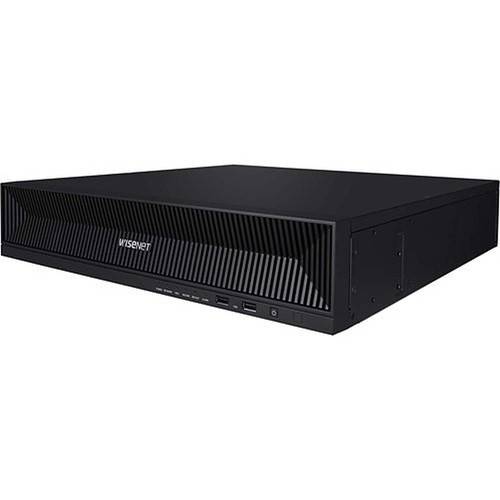
Both the Hanwha XRN-426S-1T and the QNAP VS-2204-PRO+ are 4-channel NVR recorders that a security integrator or IT buyer might evaluate for a small-site IP camera deployment. The Hanwha is a purpose-built embedded NVR with integrated PoE+ ports and a pre-installed 1 TB drive, while the QNAP is a PC-architecture tower NVR requiring separate drive installation and an external PoE switch. This comparison examines recording capability, physical infrastructure requirements, and software ecosystem fit across both platforms.
In This Guide
- Which NVR delivers higher recording resolution and what compression formats does each support?
- What switching and power infrastructure does each unit require, and how do they differ in storage and physical build?
- How do the two platforms differ in VMS compatibility, analytics, and monitoring scalability?
- Which should you choose: the XRN-426S-1T or the VS-2204-PRO?
- Side-by-Side Specs
- FAQ
Which NVR delivers higher recording resolution and what compression formats does each support?
The Hanwha XRN-426S-1T records all 4 channels at up to 8 MP at 30 fps using H.265 as its primary codec, with backward compatibility for H.264 and MJPEG. H.265 delivers roughly 50% bitrate reduction versus H.264 at equivalent quality, directly extending usable storage life on the included 1 TB drive. Audio compression is specified as G.711, G.726, and AAC at 16/48 kHz.
The QNAP VS-2204-PRO+ also supports up to 8-megapixel recording across its 4 channels, but its listed codec set is H.264, MPEG-4, M-JPEG, and MxPEG — H.265 is not listed in the provided specifications. Frame-rate performance is specified as up to 30 fps at D1 or VGA resolution; whether 30 fps is sustained at the 8 MP ceiling is not stated in the provided specs. No audio compression formats are listed for the QNAP.
What switching and power infrastructure does each unit require, and how do they differ in storage and physical build?
The Hanwha XRN-426S-1T integrates four 802.3at PoE+ ports (plus one 1 Gbps WAN port), so cameras connect and receive power directly from the NVR without an external switch or injector. A 1 TB drive comes pre-installed. An additional microSD slot provides a secondary local storage tier. The unit weighs 660 g, is finished in black metal, and is rated for 0 °C to 40 °C operation. Wall and pole mounting are specified.
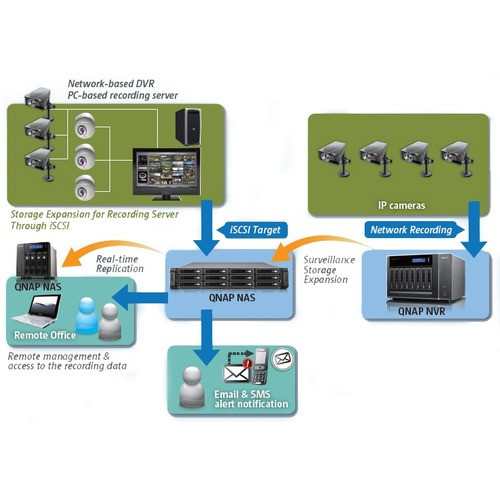
The QNAP VS-2204-PRO+ is a tower-form unit with two 3.5"/2.5" hot-swappable, lockable SATA bays — drives are not included. It provides two Gigabit Ethernet LAN ports and five USB 2.0 ports; no PoE ports are listed, meaning a separate PoE switch is required to power IP cameras. The unit draws 25 W from a 100–240 V AC supply (60 W rated output), generates 34.2 dB of noise from a 70 mm fan, and weighs 1.74 kg net. Operating temperature is identical at 0–40 °C.
How do the two platforms differ in VMS compatibility, analytics, and monitoring scalability?
The Hanwha XRN-426S-1T declares compatibility with ONVIF, SUNAPI (Hanwha's proprietary API), and Wisenet Viewer. AI Search analytics are listed but are explicitly restricted to Wisenet AI cameras only. The operating system is embedded Linux. VMS interoperability beyond the listed protocols is not specified in the provided data.
The QNAP VS-2204-PRO+ runs on a dual-core Intel Atom processor, which enables a broader display mode set: up to 42-channel remote monitoring view and multi-server aggregation of up to 128 channels — significantly beyond what the local 4-channel record limit implies. Playback is capped at 4-channel simultaneously. The platform supports MxPEG (Mobotix-native codec), suggesting broader third-party camera compatibility than the Hanwha's Wisenet-centric analytics layer. No specific VMS protocol certifications (e.g., ONVIF profile) are listed in the provided QNAP specifications.
Which should you choose: the XRN-426S-1T or the VS-2204-PRO?
Our take: The XRN-426S-1T is the stronger choice when the deployment is a clean 4-camera Wisenet or ONVIF installation where simplified cabling and immediate commissioning are priorities. Three concrete spec deltas drive this: first, it ships with H.265 compression versus the QNAP's H.264/MPEG-4/MJPEG set — a meaningful storage and bandwidth advantage at 8 MP. Second, its four integrated 802.3at PoE+ ports eliminate the cost and rack space of a separate PoE switch that the QNAP requires. Third, it includes a pre-installed 1 TB drive, whereas the QNAP ships driveless. The QNAP VS-2204-PRO+ is the better fit when the buyer needs hot-swappable drive redundancy, multi-server aggregation up to 128 channels, MxPEG camera support, or an x86 platform that can run additional QNAP applications alongside surveillance. H.265 support on the QNAP is not confirmed by the provided specifications.
Side-by-Side Comparison
Spec-for-spec, from manufacturer data.
| Specification | Hanwha XRN-426S-1T | QNAP VS-2204-PRO |
|---|---|---|
| Channels | 4 | 4 |
| Max Recording Resolution | 8 MP | 8 MP (spec listed; fps at 8MP not stated) |
| Max Frame Rate | 30 fps | Up to 30 fps at D1/VGA |
| Video Compression | H.265; H.264; MJPEG | H.264; MPEG-4; M-JPEG; MxPEG |
| H.265 Support | Yes | Not listed in provided specs |
| Integrated PoE Ports | 4 × PoE+ (802.3at) | None listed |
| LAN Ports | 4 × PoE+ (10/100) + 1 × 1 Gbps WAN | 2 × Gigabit RJ-45 |
| Included Storage | 1 TB pre-installed | None (2 hot-swap bays, driveless) |
| Drive Bays | — | 2 × 3.5"/2.5" SATA hot-swap lockable |
| Local Expansion Storage | microSD slot | 2 SATA bays |
| Form Factor | NVR (wall/pole mount) | Tower |
| Operating Temperature | 0°C to 40°C | 0°C to 40°C |
| Weight | 660 g (1.45 lb) | 1.74 kg (net) |
| Power Consumption | Not listed in provided specs | 25 W |
| Multi-Server Monitoring | Not listed in provided specs | Up to 128 channels |
| Warranty | 5-Year | Not listed in provided specs |
Frequently Asked Questions
Which should you choose: the XRN-426S-1T or the VS-2204-PRO?
The XRN-426S-1T is the stronger choice when the deployment is a clean 4-camera Wisenet or ONVIF installation where simplified cabling and immediate commissioning are priorities. Three concrete spec deltas drive this: first, it ships with H.265 compression versus the QNAP's H.264/MPEG-4/MJPEG set — a meaningful storage and bandwidth advantage at 8 MP. Second, its four integrated 802.3at PoE+ ports eliminate the cost and rack space of a separate PoE switch that the QNAP requires. Third, it includes a pre-installed 1 TB drive, whereas the QNAP ships driveless. The QNAP VS-2204-PRO+ is the better fit when the buyer needs hot-swappable drive redundancy, multi-server aggregation up to 128 channels, MxPEG camera support, or an x86 platform that can run additional QNAP applications alongside surveillance. H.265 support on the QNAP is not confirmed by the provided specifications.
Do I still need a separate PoE switch if I buy the XRN-426S-1T or the VS-2204-PRO+?
No for the Hanwha XRN-426S-1T — it has four built-in 802.3at PoE+ ports that power and connect cameras directly. Yes for the QNAP VS-2204-PRO+ — its two LAN ports are standard Gigabit Ethernet only; no PoE capability is listed in the provided specifications, so a separate PoE switch or injectors are required.
Is the XRN-426S-1T or the VS-2204-PRO+ better for larger deployments that might grow beyond 4 cameras?
The QNAP VS-2204-PRO+ has a stated multi-server monitoring capability of up to 128 channels, meaning it can aggregate feeds from multiple servers into one interface, which supports growth beyond 4 cameras at the management layer. The Hanwha XRN-426S-1T is specified as a 4-channel unit; no channel-expansion or multi-server aggregation capability is listed in the provided specifications.
Which unit supports H.265 recording to save storage space?
Only the Hanwha XRN-426S-1T lists H.265 as a supported compression codec. The QNAP VS-2204-PRO+ lists H.264, MPEG-4, M-JPEG, and MxPEG in the provided specifications; H.265 is not listed. Buyers with bandwidth or storage constraints at 8 MP should note this difference.
Get a Second Opinion on Your Camera Choice
Share your site layout, coverage goals, and budget. Our team will validate the camera selection, flag anything we would change, and recommend products that match the use case.