
Hanwha XRN-420S-2TB vs QNAP VS-2204-PRO: Specification Comparison
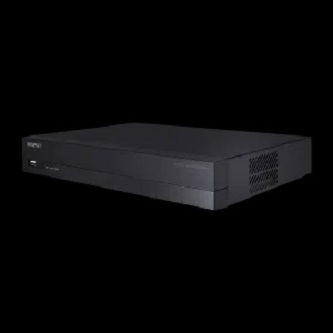
Both the Hanwha XRN-420S-2TB and the QNAP VS-2204-PRO+ are 4-channel network video recorders positioned for small-site IP camera deployments. The Hanwha is a purpose-built standalone NVR with integrated PoE+ switching and AI-capable analytics, while the QNAP is a PC-architecture tower NVR appliance relying on an Intel Atom processor and external camera power infrastructure. This comparison evaluates recording capability and codec support, power delivery and physical deployment, and platform integration and analytics across both units.
In This Guide
- How do recording resolution, frame rate, and codec efficiency compare between the two units?
- What are the differences in PoE power delivery, storage capacity, and physical deployment requirements?
- How do the two units differ in VMS compatibility, camera ecosystem integration, and analytics capability?
- Which should you choose: the XRN-420S-2TB or the VS-2204-PRO?
- Side-by-Side Specs
- FAQ
How do recording resolution, frame rate, and codec efficiency compare between the two units?
The Hanwha XRN-420S-2TB specifies H.265 compression across all 4 channels at up to 8MP, with a stated aggregate frame rate of 120fps at 8MP. H.265 delivers roughly half the bitrate of H.264 at equivalent quality, directly reducing storage consumption over time.
The QNAP VS-2204-PRO+ supports H.264, MPEG-4, M-JPEG, and MxPEG but does not list H.265 in its published specifications. Its recorded frame rate ceiling is stated as 30fps at D1 or VGA resolution, with megapixel recording listed up to 8MP — however, no per-channel frame rate at 8MP is specified. The Hanwha's 120fps aggregate at full 8MP resolution represents a material throughput advantage over the QNAP's documented 30fps ceiling at standard definition.
What are the differences in PoE power delivery, storage capacity, and physical deployment requirements?
The Hanwha XRN-420S-2TB includes an integrated 4-port PoE (802.3af) switch with a 50W total PoE budget, meaning cameras can be powered directly from the NVR without a separate PoE switch or injectors. Onboard storage capacity is specified at up to 6TB, with additional local storage via a microSD slot. The unit is wall-mountable with a white housing.
The QNAP VS-2204-PRO+ provides 2 x hot-swappable, lockable 3.5"/2.5" SATA drive bays and 2 x Gigabit Ethernet LAN ports, but includes no integrated PoE capability — camera power must be supplied by an external PoE switch or individual injectors. Its power supply outputs 60W total with 25W system consumption. The unit is a tower form factor measuring 150 x 102 x 216 mm and weighing 1.74 kg net, with a 34.2 dB noise rating. Maximum raw storage capacity is constrained by the 2-bay configuration; no maximum storage figure is stated in the supplied specifications.
How do the two units differ in VMS compatibility, camera ecosystem integration, and analytics capability?
The Hanwha XRN-420S-2TB lists ONVIF, SUNAPI (Hanwha's proprietary API), and Axis Camera Station as supported VMS and protocol integrations. Analytics capabilities include AI Search (restricted to Wisenet AI cameras), Object Attribute detection, Video Analytics, and Motion Detection. The ONVIF listing confirms interoperability with third-party cameras beyond the Hanwha ecosystem, though AI Search requires Wisenet AI-compatible hardware.
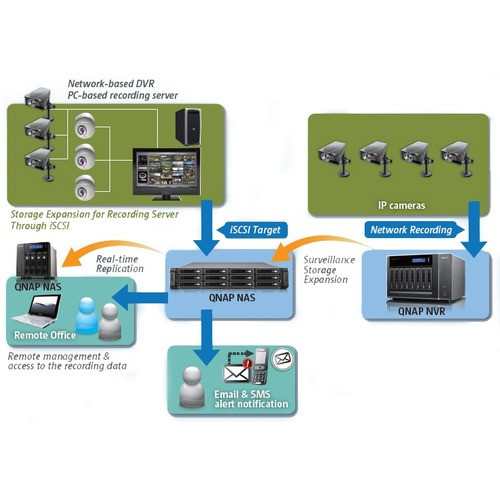
The QNAP VS-2204-PRO+ specifies support for up to 128-channel multi-server monitoring and remote display modes spanning up to 42 channels, indicating a scalable monitoring architecture beyond a single appliance. However, no VMS compatibility list, ONVIF declaration, or analytics features are stated in the provided specifications for the QNAP unit. The QNAP's dual Gigabit LAN ports suggest potential network redundancy or throughput bonding capability, but no specific configuration is documented in the supplied specs.
Which should you choose: the XRN-420S-2TB or the VS-2204-PRO?
Our take: The XRN-420S-2TB is the stronger choice when the installation requires integrated PoE camera power, H.265 recording efficiency, and built-in analytics on a wall-mounted appliance. Three concrete spec deltas support this: first, the Hanwha includes a 50W 4-port PoE switch while the QNAP requires external camera power infrastructure; second, the Hanwha records at H.265 up to 120fps aggregate at 8MP versus the QNAP's documented ceiling of H.264 at 30fps at D1/VGA; third, the Hanwha specifies ONVIF and SUNAPI compatibility plus four defined analytics modes, while no VMS protocols or analytics are listed in the QNAP's supplied specifications. The QNAP VS-2204-PRO+ may suit environments already running QNAP storage infrastructure, requiring hot-swap drive redundancy, or needing multi-server aggregated monitoring up to 128 channels — capabilities not addressed in the Hanwha's published specs. Buyers should verify current QNAP H.265 and ONVIF support directly with QNAP, as those specs are absent from the provided data.
Side-by-Side Comparison
Spec-for-spec, from manufacturer data.
| Specification | Hanwha XRN-420S-2TB | QNAP VS-2204-PRO |
|---|---|---|
| Channels | 4 | 4 |
| Max Recording Resolution | 8MP | 8MP (spec listed; fps at 8MP not stated) |
| Video Compression | H.265 | H.264 / MPEG-4 / M-JPEG / MxPEG |
| Aggregate Frame Rate | 120fps @ 8MP | 30fps @ D1 or VGA (8MP fps not specified) |
| Integrated PoE Ports | 4 x PoE (802.3af) | — |
| PoE Power Budget | 50W total | — |
| Storage Bays / Capacity | Up to 6TB (spec stated) | 2 x 3.5"/2.5" SATA hot-swap (max capacity not stated) |
| Local Storage Expansion | microSD | — |
| LAN Ports | — | 2 x Gigabit RJ-45 |
| VMS / Protocol Compatibility | ONVIF, SUNAPI, Axis Camera Station | — |
| Analytics | AI Search (Wisenet AI only); Object Attribute; Video Analytics; Motion Detection | — |
| Form Factor | Wall-mount NVR | Tower |
| Power Supply Output | — | 60W |
| System Power Consumption | — | 25W |
| Noise Level | — | 34.2 dB |
| Warranty | 5-Year | — |
Frequently Asked Questions
Which should you choose: the XRN-420S-2TB or the VS-2204-PRO?
The XRN-420S-2TB is the stronger choice when the installation requires integrated PoE camera power, H.265 recording efficiency, and built-in analytics on a wall-mounted appliance. Three concrete spec deltas support this: first, the Hanwha includes a 50W 4-port PoE switch while the QNAP requires external camera power infrastructure; second, the Hanwha records at H.265 up to 120fps aggregate at 8MP versus the QNAP's documented ceiling of H.264 at 30fps at D1/VGA; third, the Hanwha specifies ONVIF and SUNAPI compatibility plus four defined analytics modes, while no VMS protocols or analytics are listed in the QNAP's supplied specifications. The QNAP VS-2204-PRO+ may suit environments already running QNAP storage infrastructure, requiring hot-swap drive redundancy, or needing multi-server aggregated monitoring up to 128 channels — capabilities not addressed in the Hanwha's published specs. Buyers should verify current QNAP H.265 and ONVIF support directly with QNAP, as those specs are absent from the provided data.
Do I still need a separate PoE switch if I buy the XRN-420S-2TB or the VS-2204-PRO+?
No for the XRN-420S-2TB — it includes an integrated 4-port PoE (802.3af) switch with a 50W total budget, so up to 4 cameras can be powered directly from the NVR. Yes for the VS-2204-PRO+ — its specifications list no PoE capability, so a separate PoE switch or per-camera injectors are required to power IP cameras.
Which unit supports more modern video compression, and does it matter for storage costs?
The XRN-420S-2TB specifies H.265 compression. H.265 typically reduces storage consumption by approximately 50% compared to H.264 at the same resolution and quality level, meaning longer retention on the same drive capacity. The VS-2204-PRO+ lists H.264, MPEG-4, M-JPEG, and MxPEG in its supplied specifications — H.265 is not listed. Buyers planning to archive high-resolution footage over extended periods will find the H.265-capable Hanwha more storage-efficient based on the provided specs.
Can either of these NVRs work with cameras from other manufacturers, or are they locked to their own brands?
The XRN-420S-2TB explicitly lists ONVIF compatibility, which is the industry-standard interoperability protocol, as well as SUNAPI and Axis Camera Station integration. Its AI Search analytics are noted as requiring Wisenet AI cameras specifically, but basic recording is not limited to Hanwha cameras. The VS-2204-PRO+'s supplied specifications do not state ONVIF support or list compatible camera brands — buyers should confirm third-party camera compatibility directly with QNAP before purchasing.
Get a Second Opinion on Your Camera Choice
Share your site layout, coverage goals, and budget. Our team will validate the camera selection, flag anything we would change, and recommend products that match the use case.