
Hanwha XNV-8020R vs i-PRO X22500-V3L: Specification Comparison
This comparison covers two 5 MP fixed indoor/outdoor dome IP cameras aimed at integrators and IT buyers evaluating mid-range analytics-capable surveillance. The Hanwha XNV-8020R is a weatherproof outdoor dome rated IP66/IP67, while the i-PRO WV-X22500-V3L is an AI-focused indoor dome with a motorized varifocal lens and FIPS 140-2 Level 3 security certification. Both deliver 5 MP resolution at 30 fps with onboard edge analytics, alarm I/O, and microSD storage up to 512 GB, making them legitimate cross-shop candidates for different deployment scenarios.
In This Guide
How do the imaging specs compare?
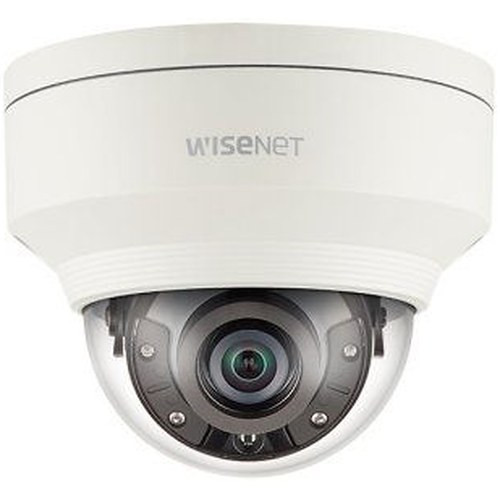
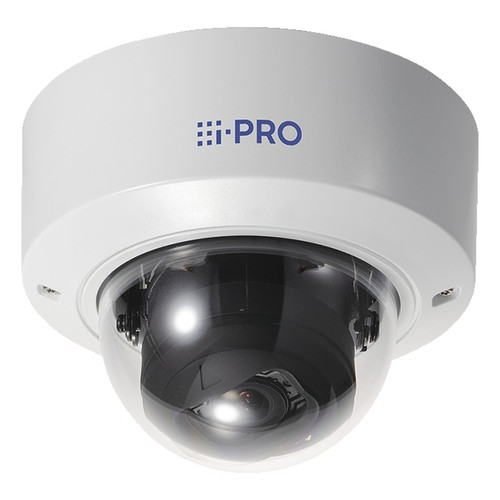
The XNV-8020R uses a 1/1.8-inch 6 MP CMOS sensor outputting 5 MP (2560×1920) at 30 fps with a fixed 3.7 mm lens at F1.6, yielding a 97.5° horizontal field of view. Its minimum illumination is 0.16 lux color and 0 lux with IR, with an IR range of 30 m (98 ft). WDR is rated at 120 dB. Digital image stabilization is supported via a built-in gyro sensor, and defog is handled by a built-in optical filter. The WV-X22500-V3L uses a smaller 1/2.8-inch CMOS (5.12×3.84 mm scanning area) outputting 3072×1728 at 30 fps. Its motorized varifocal lens spans 2.9–9 mm (3.1× optical zoom, up to 12.4× extra zoom) with a horizontal FOV of 33°–105°. Minimum illumination is 0.02 lux in B&W with IR, and IR range extends to 70 m (230 ft). Super Dynamic WDR reaches 132 dB at maximum setting. The i-PRO model's sensor is physically smaller but achieves significantly better low-light sensitivity and longer IR throw, while the Hanwha's larger sensor and fixed wide-angle lens suit broad-area outdoor coverage.
The Hanwha offers 32 polygonal privacy mask zones with color and mosaic options versus the i-PRO's 8 zones. The XNV-8020R supports SSNRV digital noise reduction; the WV-X22500-V3L provides a 0–255 adjustable DNR range. Both support ICR-based day/night switching and BLC/HLC. The i-PRO adds Adaptive Black Stretch (0–255) and adjustable Fog Compensation (0–8 levels), whereas the Hanwha uses a built-in optical defog filter. Aperture on the i-PRO varies from F1.3 (wide) to F2.5 (tele), giving it a low-light advantage at wide angle despite the smaller sensor.
What about installation and environment?
The XNV-8020R is rated IP66/IP67 and IK10, making it suitable for outdoor installation with full dust exclusion and water immersion resistance. Its operating temperature spans -30°C to +55°C (-22°F to +131°F), covering harsh cold climates. Power is via PoE (IEEE 802.3af, Class 3, max 9 W) or 12 VDC (max 8 W). The dome housing is aluminum/ivory, weighing 615 g with a Ø120×97.5 mm footprint. It provides a CVBS output and Micro USB port for installation alignment without a network connection.
The WV-X22500-V3L carries only an IK10 impact rating; no IP weatherproofing rating is specified in the provided data, and the camera is designated for indoor use. Its operating temperature is -10°C to +50°C, a narrower range unsuitable for cold outdoor environments. Power requires PoE+ (Class 4, 14 W) or DC 12 V — the higher power budget supports the motorized zoom and longer IR. The unit is slightly larger at Ø129.5×102.5 mm and heavier at 820 g. The motorized varifocal lens (2.9–9 mm) simplifies remote aiming and focus during commissioning without ladder access.
Which fits your VMS and analytics better?
Both cameras support ONVIF Profile S and G; the i-PRO WV-X22500-V3L additionally supports ONVIF Profile T and M, broadening compatibility with metadata-capable VMS platforms. The XNV-8020R exposes Wisenet SUNAPI and the Wisenet open platform for Hanwha-ecosystem integrations, while the i-PRO is built around the Ambarella CV52 SoC and supports MQTT, SFTP, LLDP, SRTP, and DiffServ — protocols absent from the Hanwha's listed stack. The Hanwha camera supports up to 20 unicast streams across 10 profiles; the i-PRO allows up to 14 simultaneous users.
Edge analytics differ in scope and approach. The XNV-8020R includes loitering, directional detection, fog detection, digital auto-tracking, sound classification, heatmap, people counting, queue management, and tampering — a broad Wisenet analytics suite with business intelligence outputs. The WV-X22500-V3L delivers AI-driven motion, face, people, and vehicle detection via the CV52 SoC, plus AI sound classification (gunshot, yell, vehicle horn, glass break) and Scene Change Detection. The i-PRO camera adds VIQS (variable image quality on specified zones, up to 8 areas). Audio on the Hanwha uses a 3.5 mm selectable mic/line input; the i-PRO uses a 3.5 mm stereo jack for input and output. Both offer microSD storage up to 512 GB. The i-PRO holds a clear security edge with FIPS 140-2 Level 3 certification, Secure Boot, and Signed Firmware — features absent from the Hanwha spec sheet.
Which should you choose: the XNV-8020R or the X22500-V3L?
Our take: The XNV-8020R is the stronger choice when deploying in outdoor or temperature-extreme environments where weatherproofing and wide-angle fixed coverage are the priority. Its IP66/IP67 rating and -30°C operating floor make it viable in climates where the WV-X22500-V3L — rated for indoor use only with a -10°C lower limit — cannot be installed. The Hanwha also delivers a 97.5° fixed horizontal FOV versus the i-PRO's 33°–105° varifocal range, suiting wide open-area coverage without lens adjustment. Conversely, the WV-X22500-V3L is the better fit for indoor high-security or federal-adjacent deployments requiring FIPS 140-2 Level 3, Secure Boot, and Signed Firmware, none of which appear in the Hanwha spec sheet. The i-PRO also extends IR range to 70 m versus the Hanwha's 30 m, achieves 132 dB WDR versus 120 dB, and supports ONVIF Profile T/M for richer metadata VMS integration. Platform preference — Wisenet SUNAPI versus Ambarella CV52/MQTT — should be the tiebreaker for mixed-fleet sites.
Side-by-Side Comparison
Spec-for-spec, from manufacturer data.
| Specification | Hanwha XNV-8020R | i-PRO X22500-V3L |
|---|---|---|
| Resolution | 5MP (2560×1920) | 5MP (3072×1728) |
| Image Sensor | 1/1.8" 6MP CMOS | Approx. 1/2.8" CMOS (5.12×3.84 mm) |
| Lens / Focal Length | 3.7 mm fixed | 2.9–9 mm motorized varifocal (3.1× optical) |
| Horizontal FOV | 97.5° | 33°–105° |
| Min. Illumination | 0.16 lux color / 0 lux IR | 0.02 lux B&W with IR |
| IR Range | 30 m (98 ft) | 70 m (230 ft) |
| WDR | 120 dB | 132 dB (Super Dynamic max) |
| Max Frame Rate | 30 fps | 30 fps |
| Video Compression | H.265 / H.264 / MJPEG | H.265 / H.264 / MJPEG |
| IP Rating | IP66/IP67 | Not rated (indoor only) |
| IK / Impact Rating | IK10 | IK10 |
| Operating Temperature | -30°C to +55°C | -10°C to +50°C |
| Power Input / PoE Class | PoE IEEE 802.3af Class 3 / 12 VDC (max 9 W) | PoE+ Class 4 / DC 12 V (14 W) |
| Edge Storage | microSD/SDHC/SDXC 2-slot up to 512 GB | microSDXC up to 512 GB |
| ONVIF Profiles | S / G | S / G / T / M |
| Alarm I/O | 1 in / 1 out | 2 in / 1 out / 1 aux |
| Dimensions | Ø120.0 × 97.5 mm | Ø129.5 × 102.5 mm |
| Weight | 615 g (1.36 lb) | 820 g (1.9 lb) |
| Warranty | 3-year | 5-year |
| FIPS / Secure Boot | Not specified | FIPS 140-2 Level 3 / Secure Boot / Signed Firmware |
Frequently Asked Questions
Which should you choose: the XNV-8020R or the X22500-V3L?
The XNV-8020R is the stronger choice when deploying in outdoor or temperature-extreme environments where weatherproofing and wide-angle fixed coverage are the priority. Its IP66/IP67 rating and -30°C operating floor make it viable in climates where the WV-X22500-V3L — rated for indoor use only with a -10°C lower limit — cannot be installed. The Hanwha also delivers a 97.5° fixed horizontal FOV versus the i-PRO's 33°–105° varifocal range, suiting wide open-area coverage without lens adjustment. Conversely, the WV-X22500-V3L is the better fit for indoor high-security or federal-adjacent deployments requiring FIPS 140-2 Level 3, Secure Boot, and Signed Firmware, none of which appear in the Hanwha spec sheet. The i-PRO also extends IR range to 70 m versus the Hanwha's 30 m, achieves 132 dB WDR versus 120 dB, and supports ONVIF Profile T/M for richer metadata VMS integration. Platform preference — Wisenet SUNAPI versus Ambarella CV52/MQTT — should be the tiebreaker for mixed-fleet sites.
Is the XNV-8020R or WV-X22500-V3L better for low light?
The WV-X22500-V3L reaches 0.02 lux minimum illumination in B&W with IR and has an IR range of 70 m, compared to the XNV-8020R's 0.16 lux color minimum and 30 m IR range. For low-light performance and long-distance IR coverage, the i-PRO has a measurable advantage on both counts.
Can either camera be installed outdoors in a cold climate?
Only the XNV-8020R is rated for outdoor use. It carries IP66/IP67 weatherproofing and operates down to -30°C. The WV-X22500-V3L has no IP weatherproofing rating in the provided specifications and is designated for indoor environments with a -10°C lower operating limit.
Which camera is better suited for a government or high-security network?
The WV-X22500-V3L holds FIPS 140-2 Level 3 certification and includes Secure Boot and Signed Firmware — security features commonly required in federal and high-security deployments. The XNV-8020R does not list these certifications in its specifications, though it does support 802.1X EAP-TLS/EAP-LEAP and HTTPS/SSL authentication.
Get a Second Opinion on Your Camera Choice
Share your site layout, coverage goals, and budget. Our team will validate the camera selection, flag anything we would change, and recommend products that match the use case.