
Hanwha XNO-6020R vs i-PRO X15300-V3L: Specification Comparison
Both the Hanwha XNO-6020R and the i-PRO WV-X15300-V3L are 2MP outdoor bullet IP cameras targeting commercial and industrial surveillance installations. The comparison covers imaging performance, environmental hardening, and VMS/analytics integration. Despite sharing resolution class and form factor, they differ substantially in lens type, IR range, dynamic range rating, AI capabilities, and PoE power class — factors that will drive the decision for most installers and IT buyers.
In This Guide
How do the imaging specs compare?
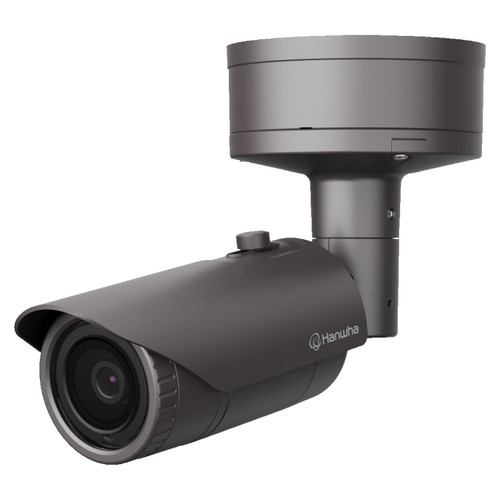
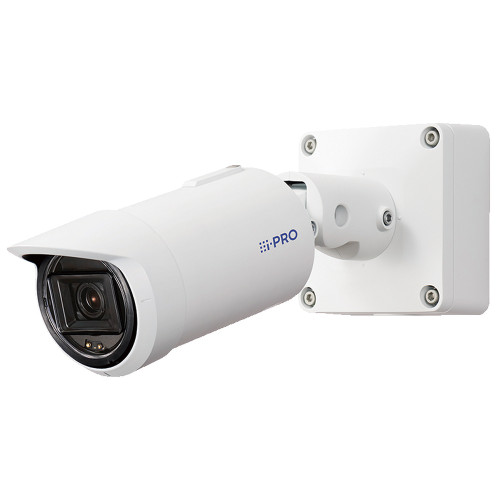
Both cameras use an approximately 1/2.8-inch 2MP CMOS sensor delivering 1920×1080 at up to 60 fps. The Hanwha XNO-6020R uses a fixed 4mm lens at F1.4 with an 88.6° horizontal field of view and a minimum color illumination of 0.015 lux (0 lux in B/W with IR active); its built-in IR illuminator reaches 30m (98ft). The i-PRO WV-X15300-V3L uses a motorized 2.9–9mm varifocal lens (3.1x optical zoom, extendable to 9.3x digital) with an aperture range of F1.3 (wide) to F2.5 (tele), a horizontal FOV of 37°–117°, and a minimum color illumination of 0.007 lux (0.005 lux B/W, 0 lux with IR); its IR illuminator reaches 70m (230ft). The i-PRO unit's longer IR throw and lower lux floor give it a measurable low-light advantage over the Hanwha.
On dynamic range, the Hanwha XNO-6020R is rated at 150dB WDR via its SSDR processing, while the i-PRO WV-X15300-V3L achieves a maximum of 144dB through its Super Dynamic mode (level 0–31). The Hanwha therefore holds a 6dB advantage on published WDR figures. The i-PRO adds Adaptive Black Stretch and a configurable Fog Compensation mode (levels 0–8); the Hanwha lists both Defog support and DWDR in addition to WDR. The i-PRO also includes a gyro-sensor-based Image Stabilizer, whereas the Hanwha offers Digital Image Stabilization.
What about installation and environment?
Both cameras carry IP66/IP67 and NEMA 4X ingress protection ratings, and both meet IK10 impact resistance. The i-PRO WV-X15300-V3L adds a wind resistance rating of up to 40 m/s (~89 mph), which the Hanwha XNO-6020R does not list. Operating temperature ranges differ: the Hanwha is rated –30°C to +55°C, while the i-PRO is rated –40°C to +55°C (with a power-on lower limit of –30°C), giving the i-PRO a broader cold-start specification. The Hanwha accepts PoE IEEE 802.3af (Class 3, max 9.7W) or 12VDC (max 8.8W). The i-PRO requires PoE+ (IEEE 802.3at, 14W, Class 4), which means existing 802.3af-only switches will need upgrading or a PoE injector. Body material for the Hanwha is aluminum; the i-PRO uses aluminum die cast, stainless steel, and PC resin. The i-PRO is heavier (approx. 2.5kg / 5.6 lbs vs. 1.22kg / 2.69 lbs) and physically larger (133×133×383mm vs. Ø70×296mm).
Which fits your VMS and analytics better?
Both cameras support ONVIF Profiles S, G, and T; the i-PRO WV-X15300-V3L additionally supports ONVIF Profile M. Both encode H.265, H.264, and MJPEG with CBR/VBR bitrate control. The Hanwha supports up to 10 simultaneous streaming profiles and unicast to 20 users; the i-PRO supports up to 14 simultaneous users. The Hanwha offers SRTP and SNMPv1/v2c/v3; the i-PRO additionally lists MQTT, SFTP, and Secure Boot with signed firmware (FIPS 140-2 Level 3 certified). The i-PRO holds UL 62368-1, c-UL, CE, FCC Part 15 Class A, and ICES-003 safety/EMC listings; equivalent certifications are not listed in the provided Hanwha spec sheet.
On analytics, the Hanwha XNO-6020R includes a broad on-camera suite: Defocus detection, Directional detection, Fog detection, Face detection, Motion detection, Digital auto tracking, Appear/Disappear, Enter/Exit, Loitering, Tampering, Virtual line, Audio detection, Sound classification, People counting, Queue management, and Heatmap — 16 named functions. The i-PRO WV-X15300-V3L lists AI video detection, VMD (4 areas), Scene Change Detection, Audio Detection, and AI Sound Classification (Gunshot, Yell, Vehicle horn, Glass break); specific AI video analytics functions beyond facial recognition are described as an 'AI video detection suite' without itemized granularity in the provided spec. Both cameras offer a microSD/SDXC edge storage slot supporting up to 512GB. Audio I/O: the Hanwha provides a mic/line combo input (2.5VDC bias) and line output; the i-PRO provides a 3.5mm stereo mic input and a 3.5mm mono output. The i-PRO also provides 3 alarm inputs and 1 alarm output plus 1 AUX output vs. the Hanwha's 1 alarm input and 1 alarm output. Warranty is 3 years for the Hanwha and 5 years for the i-PRO.
Which should you choose: the XNO-6020R or the X15300-V3L?
Our take: The XNO-6020R is the stronger choice when budget, PoE infrastructure, and a rich on-camera analytics suite are the primary drivers — it runs on standard 802.3af Class 3 power (9.7W max vs. 14W PoE+), publishes a higher 150dB WDR rating vs. the i-PRO's 144dB, and ships with 16 named on-camera analytics functions including People Counting, Queue Management, and Heatmap. The WV-X15300-V3L is the stronger choice when long-range identification, extreme cold environments, or compliance-grade security are required: its IR throws 70m vs. 30m, its operating floor reaches –40°C vs. –30°C, and it carries FIPS 140-2 Level 3 certification, Secure Boot, and signed firmware — critical for government and critical-infrastructure deployments. Its 3.1x optical zoom also enables post-install FOV adjustment without a lens swap. Factor in the PoE+ switch requirement and a heavier, larger housing before specifying the i-PRO in retrofit projects.
Side-by-Side Comparison
Spec-for-spec, from manufacturer data.
| Specification | Hanwha XNO-6020R | i-PRO X15300-V3L |
|---|---|---|
| Resolution | 2MP (1920×1080) | 2MP (1920×1080) |
| Image Sensor | 1/2.8" 2MP CMOS | Approx. 1/2.8" type CMOS |
| Lens / Focal Length | 4mm fixed, F1.4 | 2.9–9mm motorized varifocal, F1.3 (W)–F2.5 (T) |
| Optical Zoom | — | 3.1x optical (up to 9.3x digital) |
| Horizontal FOV | 88.6° | 37°–117° |
| Min. Illumination (Color) | 0.015 lux | 0.007 lux |
| Min. Illumination (B/W) | Not specified | 0.005 lux |
| Min. Illumination (IR) | 0 lux (IR) | 0 lux (IR) |
| IR Range | 30m (98ft) | 70m (230ft) |
| Wide Dynamic Range | 150dB WDR | 144dB Super Dynamic (max) |
| Max Frame Rate | 60fps | 60fps |
| Video Compression | H.265 / H.264 / MJPEG | H.265 / H.264 / MJPEG |
| IP Rating | IP66 / IP67 / NEMA 4X | IP66 / IP67 / NEMA 4X |
| IK / Impact Rating | IK10 | IK10 |
| Operating Temperature | -30°C to +55°C | -40°C to +55°C (power-on: -30°C) |
| Power Input / PoE Class | PoE 802.3af Class 3 (9.7W max) or 12VDC | PoE+ 802.3at Class 4 (14W) or DC12V |
| Alarm I/O | 1 input / 1 output | 3 inputs / 1 output / 1 AUX output |
| ONVIF Profiles | S / G / T | S / G / T / M |
| Edge Storage | microSD/SDXC up to 512GB (2 slots) | microSD/SDXC up to 512GB (1 slot) |
| Image Stabilization | Digital (software) | Gyro sensor (hardware) |
| Security / Firmware | HTTPS, 802.1X, Digest Auth | FIPS 140-2 L3, Secure Boot, Signed Firmware, 802.1X |
| Dimensions | Ø70 × 296mm (Ø2.76" × 11.65") | 133 × 133 × 383mm (5-1/4" × 5-1/4" × 15-3/32") |
| Weight | 1.22kg (2.69 lbs) | Approx. 2.5kg (5.6 lbs) |
| Warranty | 3 years | 5 years |
Frequently Asked Questions
Which should you choose: the XNO-6020R or the X15300-V3L?
The XNO-6020R is the stronger choice when budget, PoE infrastructure, and a rich on-camera analytics suite are the primary drivers — it runs on standard 802.3af Class 3 power (9.7W max vs. 14W PoE+), publishes a higher 150dB WDR rating vs. the i-PRO's 144dB, and ships with 16 named on-camera analytics functions including People Counting, Queue Management, and Heatmap. The WV-X15300-V3L is the stronger choice when long-range identification, extreme cold environments, or compliance-grade security are required: its IR throws 70m vs. 30m, its operating floor reaches –40°C vs. –30°C, and it carries FIPS 140-2 Level 3 certification, Secure Boot, and signed firmware — critical for government and critical-infrastructure deployments. Its 3.1x optical zoom also enables post-install FOV adjustment without a lens swap. Factor in the PoE+ switch requirement and a heavier, larger housing before specifying the i-PRO in retrofit projects.
Is the XNO-6020R or WV-X15300-V3L better for low-light performance?
The i-PRO WV-X15300-V3L has the lower published minimum illumination — 0.007 lux color and 0.005 lux B/W vs. the Hanwha's 0.015 lux color (both reach 0 lux with IR active). The i-PRO's IR illuminator also reaches 70m compared to the Hanwha's 30m, making it the stronger performer in dark or long-distance night-time scenes.
Do I need a PoE+ switch to run either of these cameras?
Only the i-PRO WV-X15300-V3L requires PoE+ (802.3at, Class 4, 14W). The Hanwha XNO-6020R operates on standard PoE (IEEE 802.3af, Class 3, max 9.7W), so it will work with most existing PoE switches without any infrastructure upgrade.
Which camera carries more built-in analytics?
Based on the provided specifications, the Hanwha XNO-6020R lists 16 named analytics functions — including People Counting, Queue Management, Heatmap, Loitering, Enter/Exit, and Virtual Line — in addition to business intelligence features. The i-PRO WV-X15300-V3L lists VMD, Scene Change Detection, Audio Detection, AI Sound Classification (4 event types), and an 'AI video detection suite' that includes facial recognition, but does not itemize all functions in the available spec sheet.
Get a Second Opinion on Your Camera Choice
Share your site layout, coverage goals, and budget. Our team will validate the camera selection, flag anything we would change, and recommend products that match the use case.