
Hanwha XNO-6020R vs i-PRO U1532LA: Specification Comparison
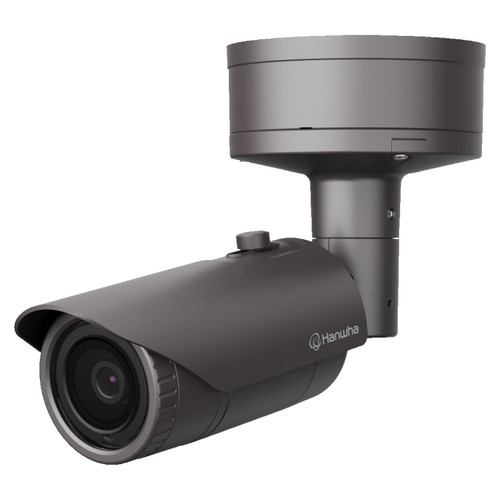
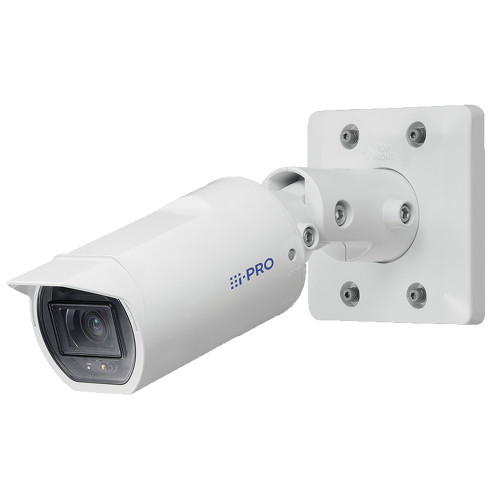
Both the Hanwha XNO-6020R and the i-PRO WV-U1532LA are 2MP outdoor bullet IP cameras intended for perimeter and general surveillance deployments. They share the same resolution class, bullet form factor, PoE power, H.265/H.264/MJPEG compression, ONVIF compatibility, 30m IR range, and IK10 impact resistance. The comparison is meaningful for installers choosing between a fixed wide-angle bullet with deep WDR and rich onboard analytics versus a motorized-varifocal bullet with remote lens adjustment and a longer manufacturer warranty.
In This Guide
How do the imaging specs compare?
The XNO-6020R uses a 1/2.8-inch 2MP CMOS sensor with a fixed 4mm lens at F1.4, delivering an 88.6° horizontal field of view. Its minimum illumination is 0.015 lux in color and 0 lux in IR mode, and it achieves 150dB Wide Dynamic Range. Maximum frame rate reaches 60fps. The WV-U1532LA uses an approximately 1/3-inch 2MP CMOS sensor with a 2.9–7.3mm motorized varifocal lens (F2.0 wide, F3.0 tele), giving a horizontal field of view of 43°–100° depending on zoom position. Its minimum illumination is 0.1 lux color and 0.04 lux B/W, and its Super Dynamic WDR tops out at 120dB at maximum level. Maximum frame rate is 30fps.
On low-light sensitivity the XNO-6020R holds a clear advantage: 0.015 lux color versus 0.1 lux color, and 0 lux IR versus 0.04 lux B/W for the i-PRO. The Hanwha's 150dB WDR also exceeds the i-PRO's 120dB by 30dB, which matters in scenes with simultaneous deep shadow and bright sky or headlights. The i-PRO's motorized varifocal lens is the key counterpoint: a 2.5× optical zoom ratio allows the focal length to be adjusted remotely without a ladder visit, whereas the XNO-6020R's fixed 4mm lens locks the field of view at installation. IR distance is rated at 30m for both cameras.
What about installation and environment?
Both cameras carry IK10 impact resistance and are rated for outdoor use. The XNO-6020R is certified IP67 and IP66 plus NEMA 4X; the WV-U1532LA is certified IP66 and NEMA 4X (Type 4X per UL50E) but does not carry an IP67 rating per the provided specs. Operating temperature for the XNO-6020R spans -30°C to +55°C; the WV-U1532LA spans -30°C to +50°C — a 5°C difference at the upper end that may be relevant in rooftop or southern-exposure installations. The i-PRO unit also specifies a Temish anti-condensation element and a wind resistance rating of up to 40 m/s (~89 mph), neither of which appears in the Hanwha spec sheet.
Power draw differs substantially: the XNO-6020R draws up to 9.7W over PoE (IEEE 802.3af, Class 3), while the WV-U1532LA draws only 6.7W (802.3af, Class 0). Lower wattage on the i-PRO means less burden on switch port budgets in multi-camera runs. The XNO-6020R also accepts 12VDC as an alternative power input; no alternative power source is listed for the WV-U1532LA. The Hanwha unit carries dual-slot microSD up to 512GB total edge storage; the i-PRO offers a single microSD slot up to 512GB. Physical size and weight differ: the XNO-6020R measures Ø70×296mm and weighs 1,220g (2.69 lb), while the WV-U1532LA measures 112.5×112.5×262mm and weighs approximately 860g (1.90 lb).
Which fits your VMS and analytics better?
Both cameras support ONVIF Profile S, G, and T, providing broad VMS compatibility. The XNO-6020R exposes Hanwha's SUNAPI (HTTP API) and Wisenet Open Platform in addition to ONVIF, which is relevant for Wisenet Wave/WAVE VMS integrations. The WV-U1532LA adds MQTT to its protocol list, which may benefit IoT-integrated or cloud-relay architectures. Simultaneous streams differ: the Hanwha supports up to 20 unicast users across up to 10 configurable streaming profiles; the i-PRO supports up to 14 simultaneous users. The XNO-6020R includes WiseStream II smart codec for bandwidth reduction; the i-PRO offers GOP control and AUTO VIQS as its smart-coding tools.
Onboard analytics depth is a significant differentiator. The XNO-6020R lists directional detection, appear/disappear, enter/exit, loitering, tampering, virtual line, face detection, digital auto tracking, defocus and fog detection, and audio-based sound classification, plus business-intelligence functions including people counting, queue management, and heatmap. The WV-U1532LA lists VMD (4 areas) and scene change detection (1 area); no additional AI analytics or business-intelligence functions are listed in the provided specs. Audio is present on the XNO-6020R (mic/line selectable input, line output, G.711/G.726 compression); no audio input, audio output, or audio compression is listed for the WV-U1532LA. The i-PRO spec sheet also lists no external I/O terminals, while the XNO-6020R provides one alarm input and one alarm output. Warranty is 3 years for the Hanwha and 5 years for the i-PRO.
Which should you choose: the XNO-6020R or the U1532LA?
Our take: The XNO-6020R is the stronger choice when maximum low-light performance, onboard analytics depth, and audio capture are the primary requirements; the WV-U1532LA is the stronger choice when remote lens adjustment and a longer warranty outweigh those factors. On imaging, the Hanwha's 150dB WDR is 30dB above the i-PRO's 120dB, and its 0.015 lux color sensitivity is roughly 7× more sensitive than the i-PRO's 0.1 lux. On analytics, the Hanwha provides people counting, loitering, and enter/exit rules while the i-PRO lists only 4-area VMD. On installation, the i-PRO's motorized varifocal (2.9–7.3mm, 2.5× optical zoom) eliminates focal-length revisits, its 6.7W draw is 3W lower than the Hanwha's 9.7W, and its 5-year warranty is two years longer. Choose the XNO-6020R for analytics-heavy or low-light-critical fixed-angle deployments on Wisenet infrastructure; choose the WV-U1532LA where lens flexibility, low PoE draw, or the extended warranty is the deciding factor.
Side-by-Side Comparison
Spec-for-spec, from manufacturer data.
| Specification | Hanwha XNO-6020R | i-PRO U1532LA |
|---|---|---|
| Resolution | 2MP | 2MP |
| Image Sensor | 1/2.8" 2MP CMOS | Approx. 1/3" type CMOS |
| Lens / Focal Length | 4mm fixed, F1.4 | 2.9–7.3mm motorized varifocal, F2.0–F3.0 |
| Optical Zoom | — | 2.5× |
| Horizontal Field of View | 88.6° | 43°–100° |
| Min. Illumination (Color / B&W) | 0.015 lux color / 0 lux IR | 0.1 lux color / 0.04 lux B/W |
| Wide Dynamic Range | 150dB | Max. 120dB |
| IR Range | 30m (98.4ft) | 30m |
| Max. Frame Rate | 60fps | 30fps |
| Video Compression | H.265 / H.264 / MJPEG | H.265 / H.264 / MJPEG |
| IP Rating | IP67 / IP66 / NEMA 4X | IP66 / NEMA 4X |
| Impact Rating | IK10 | IK10 |
| Operating Temperature | -30°C to +55°C | -30°C to +50°C |
| Power Input / PoE Class | PoE 802.3af Class 3 / 12VDC; max 9.7W | PoE 802.3af Class 0; 6.7W |
| Edge Storage | Dual microSD/SDHC/SDXC up to 512GB | Single microSD up to 512GB |
| Audio | Mic/line in; line out; G.711/G.726 | — |
| Alarm I/O | 1 input / 1 output | — |
| ONVIF Profiles | S / G / T | G / S / T |
| Simultaneous Users | Up to 20 (unicast) | Up to 14 |
| Dimensions | Ø70 × 296mm (Ø2.76" × 11.65") | 112.5 × 112.5 × 262mm (4-7/16" × 4-7/16" × 10-5/16") |
| Weight | 1,220g (2.69 lb) | Approx. 860g (1.90 lb) |
| Warranty | 3 years | 5 years |
Frequently Asked Questions
Which should you choose: the XNO-6020R or the U1532LA?
The XNO-6020R is the stronger choice when maximum low-light performance, onboard analytics depth, and audio capture are the primary requirements; the WV-U1532LA is the stronger choice when remote lens adjustment and a longer warranty outweigh those factors. On imaging, the Hanwha's 150dB WDR is 30dB above the i-PRO's 120dB, and its 0.015 lux color sensitivity is roughly 7× more sensitive than the i-PRO's 0.1 lux. On analytics, the Hanwha provides people counting, loitering, and enter/exit rules while the i-PRO lists only 4-area VMD. On installation, the i-PRO's motorized varifocal (2.9–7.3mm, 2.5× optical zoom) eliminates focal-length revisits, its 6.7W draw is 3W lower than the Hanwha's 9.7W, and its 5-year warranty is two years longer. Choose the XNO-6020R for analytics-heavy or low-light-critical fixed-angle deployments on Wisenet infrastructure; choose the WV-U1532LA where lens flexibility, low PoE draw, or the extended warranty is the deciding factor.
Is the XNO-6020R or WV-U1532LA better for low-light and IR performance?
The XNO-6020R has a measurable low-light advantage. Its minimum illumination is 0.015 lux in color and 0 lux in IR mode, versus 0.1 lux color and 0.04 lux B/W for the WV-U1532LA. Both cameras provide 30m IR range. The Hanwha's larger 1/2.8-inch sensor and F1.4 aperture contribute to that sensitivity edge over the i-PRO's approximately 1/3-inch sensor at F2.0 wide.
Can I adjust the field of view after installation without revisiting the camera?
Only the WV-U1532LA supports remote lens adjustment. Its 2.9–7.3mm motorized varifocal lens provides 2.5× optical zoom and can be repositioned via the camera's web interface or VMS, shifting horizontal FoV between approximately 43° and 100°. The XNO-6020R has a fixed 4mm lens with a set 88.6° horizontal FoV that cannot be changed without physically swapping the lens module.
Which camera is better for a Wisenet VMS deployment with built-in analytics?
The XNO-6020R integrates more deeply with Wisenet infrastructure via SUNAPI and Wisenet Open Platform, and it carries a significantly broader onboard analytics set — including loitering, enter/exit, people counting, queue management, heatmap, and audio sound classification — compared to the WV-U1532LA's VMD and scene change detection. It also provides an alarm input/output terminal and audio I/O that the WV-U1532LA does not list, making it the more capable edge-processing node in a Wisenet ecosystem.
Get a Second Opinion on Your Camera Choice
Share your site layout, coverage goals, and budget. Our team will validate the camera selection, flag anything we would change, and recommend products that match the use case.