
Hanwha XNO-6020R vs i-PRO S1536LA-B: Specification Comparison
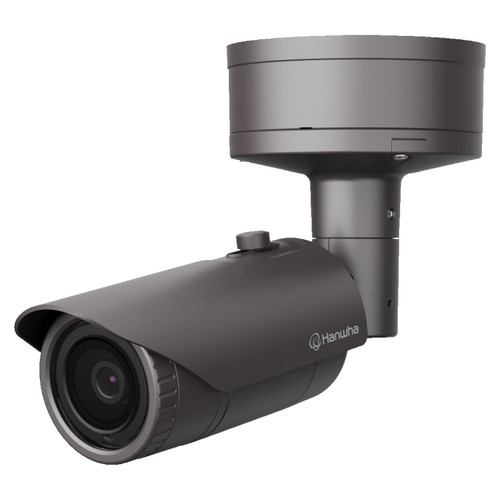
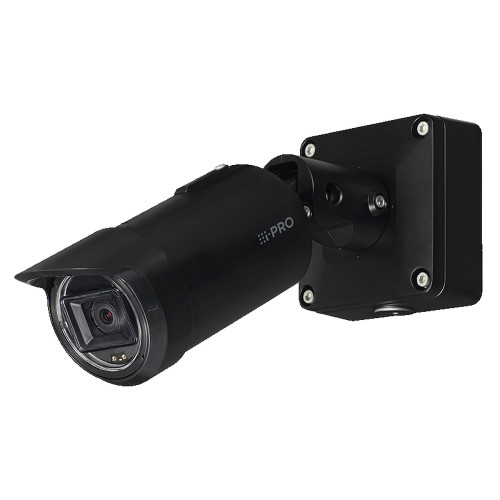
Both the Hanwha XNO-6020R and the i-PRO WV-S1536LA-B are 2MP outdoor bullet IP cameras targeting commercial and industrial perimeter surveillance. The XNO-6020R is a fixed-lens camera with a 4mm optic, while the S1536LA-B offers a motorized varifocal 2.9–9mm lens with 3.1x optical zoom. This comparison covers imaging performance, installation and environmental suitability, and VMS/analytics integration to help integrators and IT buyers select the right unit for their specific deployment conditions.
In This Guide
How do the imaging specs compare?
Both cameras use an approximate 1/2.8" 2MP CMOS sensor and deliver 1920×1080 resolution. The XNO-6020R specifies a maximum frame rate of 60fps and a fixed 4mm F1.4 lens yielding an 88.6° horizontal field of view, with a minimum color illumination of 0.015 lux and 0 lux in IR mode; IR range is 30m. The S1536LA-B also reaches 60fps and pairs a motorized 2.9–9mm varifocal lens (3.1x optical zoom, F1.3 wide to F2.5 tele) with a horizontal FoV of 37–117° depending on zoom position; minimum illumination is 0.007 lux color and 0.005 lux B&W, with 0 lux in IR mode; IR range is specified at 70m (30IRE) or 50m (50IRE). The S1536LA-B's IR reach more than doubles the XNO-6020R's 30m, and its lower lux floor gives a measurable low-light advantage.
On dynamic range, the XNO-6020R claims 150dB WDR, while the S1536LA-B specifies a maximum of 144dB in Super Dynamic mode (level 31). The XNO-6020R also includes lens distortion correction (LDC) and digital image stabilization, neither of which is listed in the S1536LA-B's published specifications. The S1536LA-B provides DORI distance figures (Detect 114.8m tele, Identify 11.5m tele) that facilitate IEC 62676-4 site planning; equivalent DORI data is not present in the XNO-6020R specification sheet.
What about installation and environment?
The XNO-6020R is rated IP67, IP66, and NEMA 4X with IK10 impact resistance. It operates from −30°C to +55°C (power-on) and stores from −50°C to +60°C. Power options are PoE IEEE 802.3af Class 3 (max 9.7W) or 12VDC (max 8.8W). The camera body is aluminum, dark grey, measuring Ø70×296mm and weighing 1,220g (2.69 lb). A USB Micro-B port and CVBS output are included for installation alignment without a network connection.
The S1536LA-B is rated IP66 and NEMA 4X with IK10 impact resistance; it does not carry an IP67 rating per its published spec. Operating temperature is −40°C to +60°C (power-on from −30°C), and operating humidity spans 10–100% RH. The unit includes a Temish element, heater, and moisture absorption gel as an anti-condensation system. Power is DC 12V or PoE 802.3af (8.5–9.1W); PoE class is listed as Class 0 in the provided data. Physical dimensions are Ø133×383mm and weight is approximately 2.4kg (5.3 lb), making it notably larger and heavier. Wind resistance is specified at up to 40m/s (~89mph). The S1536LA-B's lower cold-start temperature floor (−40°C vs −30°C) and active anti-condensation system give it an edge in extreme-climate deployments.
Which fits your VMS and analytics better?
The XNO-6020R supports ONVIF Profile S, G, and T, Wisenet SUNAPI (HTTP API), and the Wisenet open platform. Edge analytics include defocus detection, directional detection, fog detection, face detection, motion detection (8-zone polygonal), digital auto tracking, appear/disappear, enter/exit, loitering, tampering, virtual line, audio detection, and sound classification. Business intelligence functions—people counting, queue management, and heatmap—are also listed. Audio features include a selectable mic/line input (2.5VDC supply, 2kΩ impedance) and a line output (max 1Vrms). On-board storage is dual microSD/SDHC/SDXC slots supporting up to 512GB total. Alarm I/O is 1 input / 1 output.
The S1536LA-B supports ONVIF Profile G, M, S, and T—adding Profile M (metadata) that the XNO-6020R does not list. It carries AI Video Analytics covering 8 types (including face, people, and vehicle detection per card bullets), AI sound classification (gunshot, yell, vehicle horn, glass break), scene change detection (1 zone), and VMD (4 zones). Protocol support adds SFTP and MQTT (not listed for the XNO-6020R). The S1536LA-B provides 3 alarm inputs and 1 alarm output plus 1 AUX output, versus the XNO-6020R's 1 alarm input / 1 alarm output. Audio connectors are 3.5mm stereo mini jacks (input and output). On-board storage is a single microSD/SDHC/SDXC slot up to 512GB. Security certifications include FIPS 140-2 Level 3 and signed firmware, neither of which is listed for the XNO-6020R. The S1536LA-B supports up to 14 simultaneous users; the XNO-6020R supports up to 20 unicast users across up to 10 streaming profiles.
Which should you choose: the XNO-6020R or the S1536LA-B?
Our take: The XNO-6020R is the stronger choice when a fixed wide-angle field of view, higher WDR headroom, dual microSD edge storage, more simultaneous stream profiles, and a lower unit cost are the primary decision drivers. Its 150dB WDR exceeds the S1536LA-B's 144dB Super Dynamic spec, its dual-slot storage doubles the on-board redundancy, and it supports up to 20 unicast users versus 14. Conversely, the S1536LA-B is the better fit when IR range, cold-climate operation, or cybersecurity certification are priorities: its 70m IR reach is 2.3× the XNO-6020R's 30m, it operates at power-on temperatures down to −30°C (with a −40°C storage/off floor versus −30°C for the Hanwha), and its FIPS 140-2 Level 3 certification and signed firmware meet federal and high-security site requirements. The motorized varifocal lens also provides installation flexibility the fixed 4mm XNO-6020R cannot offer. Platform integrators already on Wisenet will favor the XNO-6020R; those on i-PRO or FIPS-mandated networks should select the S1536LA-B.
Side-by-Side Comparison
Spec-for-spec, from manufacturer data.
| Specification | Hanwha XNO-6020R | i-PRO S1536LA-B |
|---|---|---|
| Resolution | 2MP (1920×1080) | 2MP (1920×1080) |
| Image Sensor | 1/2.8" 2MP CMOS | Approx. 1/2.8" type CMOS |
| Lens / Focal Length | 4mm fixed, F1.4 | 2.9–9mm motorized varifocal (3.1x), F1.3–F2.5 |
| Horizontal Field of View | 88.6° | 37–117° (16:9) |
| Min. Illumination (Color) | 0.015 lux | 0.007 lux @ 30IRE |
| Min. Illumination (B&W / IR) | 0 lux (IR) | 0.005 lux B&W / 0 lux (IR) |
| IR Range | 30m (98ft) | 70m (30IRE) / 50m (50IRE) |
| Wide Dynamic Range | 150dB | Max. 144dB (Super Dynamic On, Level 31) |
| Max Frame Rate | 60fps | 60fps |
| Video Compression | H.265, H.264, MJPEG | H.265, H.264, MJPEG |
| IP Rating | IP67, IP66, NEMA 4X | IP66, NEMA 4X (no IP67 listed) |
| Impact Rating | IK10 | IK10 |
| Operating Temperature | -30°C to +55°C | -30°C to +60°C (power-on); -40°C storage |
| Power Input / PoE Class | PoE 802.3af Class 3 (9.7W max) or 12VDC | PoE 802.3af Class 0 (8.5–9.1W) or DC 12V |
| Edge Storage | Dual microSD/SDHC/SDXC, up to 512GB total | Single microSD/SDHC/SDXC, up to 512GB |
| Alarm I/O | 1 input / 1 output | 3 inputs / 1 output / 1 AUX output |
| ONVIF Profiles | S, G, T | G, M, S, T |
| FIPS / Signed Firmware | — | FIPS 140-2 Level 3 / Yes |
| Weight | 1,220g (2.69 lb) | Approx. 2,400g (5.3 lb) |
| Warranty | 3-year | 5-year |
Frequently Asked Questions
Which should you choose: the XNO-6020R or the S1536LA-B?
The XNO-6020R is the stronger choice when a fixed wide-angle field of view, higher WDR headroom, dual microSD edge storage, more simultaneous stream profiles, and a lower unit cost are the primary decision drivers. Its 150dB WDR exceeds the S1536LA-B's 144dB Super Dynamic spec, its dual-slot storage doubles the on-board redundancy, and it supports up to 20 unicast users versus 14. Conversely, the S1536LA-B is the better fit when IR range, cold-climate operation, or cybersecurity certification are priorities: its 70m IR reach is 2.3× the XNO-6020R's 30m, it operates at power-on temperatures down to −30°C (with a −40°C storage/off floor versus −30°C for the Hanwha), and its FIPS 140-2 Level 3 certification and signed firmware meet federal and high-security site requirements. The motorized varifocal lens also provides installation flexibility the fixed 4mm XNO-6020R cannot offer. Platform integrators already on Wisenet will favor the XNO-6020R; those on i-PRO or FIPS-mandated networks should select the S1536LA-B.
Is the XNO-6020R or S1536LA-B better for low-light performance?
The S1536LA-B has a lower minimum color illumination (0.007 lux vs 0.015 lux on the XNO-6020R) and a lower B&W floor (0.005 lux vs not separately specified for the Hanwha). Both reach 0 lux in IR mode, but the S1536LA-B's IR range is 70m (30IRE) compared to the XNO-6020R's 30m, making the i-PRO unit the stronger performer in low-light and long-range scenarios based on published specifications.
Which camera is better suited for government or high-security deployments?
The S1536LA-B lists FIPS 140-2 Level 3 certification, signed firmware, brute-force protection, and a device certificate among its security features. None of these certifications appear in the XNO-6020R's published specifications. For deployments with federal cybersecurity mandates or zero-trust network requirements, the S1536LA-B addresses those requirements as documented; the XNO-6020R does not.
Can I adjust the field of view on-site without changing the lens?
Only the S1536LA-B supports on-site field-of-view adjustment; its motorized varifocal 2.9–9mm lens provides 3.1x optical zoom and a horizontal FoV range of 37–117° (16:9), with motorized zoom and auto-focus controlled remotely. The XNO-6020R uses a fixed 4mm lens with a fixed 88.6° horizontal FoV and fixed focus; field-of-view changes require a physical lens swap, which is not supported on this model.
Get a Second Opinion on Your Camera Choice
Share your site layout, coverage goals, and budget. Our team will validate the camera selection, flag anything we would change, and recommend products that match the use case.